Radiology AI: How AI is Transforming Diagnostic Imaging
Artificial intelligence in radiology is revolutionizing how we detect disease, reduce diagnostic errors, and deliver faster patient care. Learn how radiology AI works, why it matters, and how 5C Network's radiology AI platform is leading this transformation across 2,000+ hospitals.
Go live in 72 hours. No upfront costs.
Quick Answer
- What is radiology AI?
- Artificial intelligence systems that analyze medical images (X-ray, CT, MRI, mammography) to detect abnormalities and assist radiologists with structured reporting, triage, and quality control.
- How accurate?
- It depends on the modality and on which pathologies were evaluated, so one number for the field is not meaningful. On chest X-rays, 5C Network reports 98% precision and 95% recall across the 76 pathologies evaluated in a 17-site study, mean AUC 0.97 — see the clinical evidence and the study preprint.
- Who uses it?
- 2,000+ hospitals and diagnostic centers across India use 5C Network's radiology AI to report 15,000+ scans daily, with an average turnaround time of 30 minutes.
- Does AI replace radiologists?
- No. AI augments radiologists. Every report is reviewed and signed off by a board-certified radiologist before release — the AI handles detection, measurement, and quality validation; the radiologist owns the diagnosis.
Turnaround and volume: 5C Network platform data, February 2026. Chest X-ray figures: multi-site study across 17 healthcare systems, full methodology and per-pathology results; preprint at arXiv:2504.00022. Figures describe chest X-ray, not every modality.
What is Radiology AI?
Radiology AI refers to artificial intelligence systems specifically designed to analyze medical images—X-rays, CT scans, MRIs, and other diagnostic imaging—to detect abnormalities, assist radiologists in making diagnoses, and improve the efficiency of radiology workflows. The application of artificial intelligence in radiology has moved from research labs to daily clinical practice, fundamentally changing how diagnostic imaging is delivered.
Unlike general-purpose AI, AI radiology software is trained on large volumes of medical images annotated by expert radiologists. This specialized training allows AI to recognize patterns associated with diseases, fractures, tumors, infections, and hundreds of other pathological findings. The best radiology AI platforms integrate detection, reporting, and quality assurance into a single workflow.
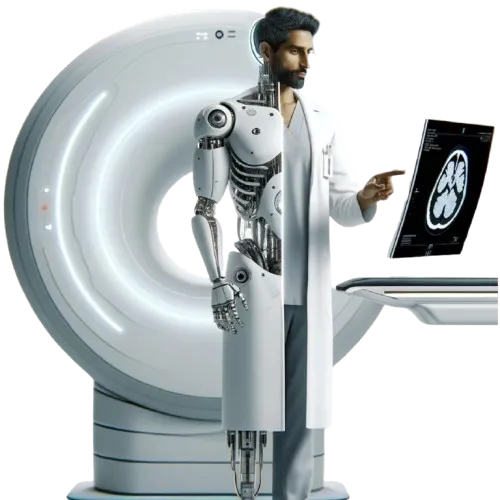
Modern radiology AI doesn't just detect problems—it can prioritize urgent cases, generate preliminary reports, suggest relevant prior studies, and even predict disease progression. When combined with human expertise, AI creates a powerful diagnostic partnership that improves accuracy, speed, and patient outcomes. At 5C Network, this full-workflow approach is what we call Generalised Medical AI (GM AI) — built on a Hybrid Intelligence framework where human radiologists and AI systems work together at every step. This is what an AI-native radiology practice looks like in production.
How Does AI in Radiology Work?
AI in radiology combines three powerful technologies to transform diagnostic imaging
Computer Vision
Deep learning models analyze pixel patterns in medical images to identify anatomical structures and detect abnormalities. These models are trained on large annotated image datasets.
- 76 chest X-ray pathologies evaluated
- 98% precision, 95% recall on those 76
- Works across all modalities
Speech Recognition & NLP
AI converts radiologist dictation into structured reports, understanding medical terminology, anatomical references, and clinical context to produce accurate documentation. Compare the leading options in our guide to the best radiology AI dictation tools.
- Medical-grade speech recognition
- Structured report generation
- 10x faster documentation
Large Language Models
LLMs perform quality assurance, checking reports for consistency, completeness, and clinical accuracy. They can also explain findings in patient-friendly language.
- 8 specialized QA agents
- Report quality validation
- Patient-friendly explanations
Why Does Radiology AI Matter?
The healthcare industry faces critical challenges that radiology AI companies are uniquely positioned to solve
Radiologist Shortage
Global demand for imaging is growing 15% annually while radiologist supply grows only 3% (Source: RSNA/WHO Global Health Observatory). In India, there's 1 radiologist per 100,000 people versus 1 per 10,000 in developed nations, according to the WHO Global Health Observatory and National Medical Commission data. AI helps bridge this gap.
Diagnostic Delays
Traditional radiology workflows average 24-48 hours for routine reports. For critical findings, every hour matters. AI enables 30-minute turnaround with automatic prioritization of urgent cases.
Human Error
Studies show radiologists miss 3-5% of significant findings due to fatigue, interruptions, or volume pressure (Source: Radiology, 2020). AI never gets tired and provides consistent second-read quality on every scan.
Scaling Access
Rural hospitals and tier-2/3 cities struggle to attract specialist radiologists. AI-powered teleradiology makes subspecialty expertise available anywhere with an internet connection.
How Accurate is Radiology AI?
Accuracy in radiology AI is reported with metrics like precision (how often a flagged finding is real), recall (how much of what is there gets caught) and AUC (how well the model separates positive from negative cases across thresholds). The number that matters is always attached to a modality, a cohort and a named list of pathologies — a figure quoted without those is not comparable to anything.
5C Network's chest X-ray model was trained on 5M+ chest X-rays and evaluated across 17 healthcare systems — government hospitals, private facilities and diagnostic centres. Across the 76 pathologies evaluated it reached 98% precision and 95% recall, mean AUC 0.97, with no evaluated pathology below 0.95. This means:
- High Sensitivity: Catches 95%+ of true findings—critical for screening programs
- High Specificity: Minimizes false positives that cause patient anxiety and unnecessary follow-ups
- Consistent Performance: Unlike humans, AI doesn't degrade with fatigue or time pressure
Chest X-ray: the published result
Across the 76 pathologies evaluated, 17 healthcare systems
Every 5C Network report is reviewed and signed by a radiologist. The AI assists; it does not report.
Chest X-ray only, on the evaluated set. Per-pathology results, subgroup analysis and limitations: clinical evidence. Preprint: arXiv:2504.00022.
Applications of AI in Radiology
From detection to reporting, AI radiology software is transforming every aspect of diagnostic imaging
Chest X-ray Analysis
Detects pneumonia, tuberculosis, lung nodules, cardiomegaly, and 50+ chest pathologies
Brain CT/MRI
Identifies strokes, hemorrhages, tumors, and neurodegenerative changes with critical finding alerts
Mammography Screening
Improves breast cancer detection rates while reducing false positives and unnecessary biopsies
Musculoskeletal Imaging
Detects fractures, arthritis, bone tumors, and degenerative changes across X-ray, CT, and MRI
Abdominal Imaging
Identifies liver lesions, kidney stones, appendicitis, and bowel abnormalities
Workflow Optimization
Prioritizes worklists, routes cases to specialists, and predicts reporting times
See these capabilities on your own studies
The fastest way to evaluate radiology AI is to run it on your own cases. Leave your details and we'll set up a pilot on your modality mix — AI pre-reads, radiologist-signed reports, no integration project.
Run 5C's radiology AI on your cases
Tell us where to reach you — a 5C radiology consultant responds within one business day.
5C Network: India's Largest Radiology AI Platform
Among radiology AI companies, 5C Network stands apart in scale and integration. We don't just build AI tools — we operate India's largest radiology AI platform, processing 15,000+ scans daily across 2,000+ hospitals with a network of 400+ radiologists. Every scan flows through our Bionic AI suite — from AI-assisted detection and structured reporting to LLM-powered quality assurance — delivering 30-minute turnaround, 24/7.
Our Hybrid Intelligence approach means AI and human radiologists work together at every step. Hospitals get the consistency of AI with the clinical judgment of experienced specialists — accessible via teleradiology from any location in India.
How 5C compares to other radiology AI companies
Global AI radiology vendors like Aidoc (Israel/US, focused on critical-finding triage), Paige (US, digital pathology) and Lunit (South Korea, chest and mammography detection) build excellent detection software. In India, Qure.ai is the most prominent home-grown AI vendor, with strong work in chest X-ray, head CT and TB screening.
5C Network's positioning is different. We don't sell standalone AI detection software — we operate an integrated AI + radiologist + India-first reporting service. Every Bionic AI output is reviewed and signed by an NMC-registered radiologist before release, which makes the workflow medico-legally compliant under the Telemedicine Practice Guidelines 2020. Hospitals get AI assistance and a signed diagnostic report as one bundled teleradiology services in India deliverable, not separate purchases.
The choice between vendors depends on the use case: if a hospital wants AI overlays inside its own radiologists' workflow, standalone detection products fit. If a hospital wants reports done — fast, accurate, signed, India-compliant — the bundled AI + radiologist model fits. For details on the underlying workflow, see our radiology reporting software page.
Radiology AI across Indian hospitals
5C Network's radiology AI is in production use at 2,000+ hospitals and diagnostic centres across 20+ Indian states — from tier-1 metros to tier-2 and tier-3 towns.
Indian hospital chains, government hospitals and standalone diagnostic centres connect via DICOM in 72 hours, no on-premise GPU required. The same AI pipeline — detection, structured reporting, 8-agent QC — runs whether the scan originates in a Bangalore quaternary-care centre, an AIIMS state branch, or a rural diagnostic centre.
India-first deployment. Pricing, SLAs and compliance (NMC, CDSCO, NABH) are designed around Indian hospitals and diagnostic centres.
Frequently Asked Questions About Radiology AI
What is radiology AI?
How accurate is AI in radiology?
Does AI replace radiologists?
What imaging modalities can AI analyze?
How does radiology AI improve patient outcomes?
Is radiology AI safe and validated?
What is the future of AI in radiology?
Which is the best radiology AI company in India?
Is radiology AI software approved by CDSCO in India?
How much does radiology AI software cost in India?
What Indian hospitals use radiology AI?
Does Indian medical regulation allow AI in radiology reporting? (NMC, CDSCO)
What's the difference between AI-assisted and AI-only radiology in India?
AI by Imaging Modality
Deep dive into how AI works for specific imaging types. Each page includes peer-reviewed research from our arXiv publications.
Chest X-Ray AI
Multi-pathology detection for pneumonia, TB and cardiac conditions. 76 pathologies evaluated at 98% precision and 95% recall.
MRI AI
Brain, spine & MSK analysis. Automated segmentation, pathology detection, quantitative measurements.
CT Scan AI
3D CNNs for emergency detection. Intracranial bleeding, PE, organ segmentation. Under 15 min critical TAT.
Explore Our Radiology AI Platform
Bionic AI Suite
Our full-stack AI radiology software for detection, reporting, and QA
Hybrid Intelligence
How human radiologists and AI work together for better outcomes
Teleradiology Services
AI-powered remote reporting for hospitals across India
For Hospitals
Complete radiology solutions for healthcare facilities
AI-Native Radiology Practice
What radiology looks like when AI runs the workflow by default
Ready to Transform Your Radiology Workflow?
Join 2,000+ healthcare facilities using AI-powered radiology. Get started in 72 hours with no upfront costs.