Generalised Medical AI
(GM AI)
Beyond narrow detection. A single AI system that sees, speaks, and thinks across the entire radiology workflow.
TL;DR: GM AI is a paradigm shift from single-task detection models to unified AI systems that handle the complete radiology workflow — image analysis, report generation, and quality assurance — in one integrated platform.
The Problem with Narrow Medical AI
When most people hear "AI in radiology," they picture a detection algorithm — a model trained to spot a single pathology on a single imaging modality. Detect a lung nodule on a chest X-ray. Flag a brain hemorrhage on a CT scan. Alert for a pneumothorax. These are examples of narrow medical AI: single-task models designed to solve one specific problem.
Narrow AI has proven its value in research settings and controlled deployments. But in the daily reality of a busy radiology department, single-task detection models create more problems than they solve. Radiologists don't just detect — they interpret, contextualize, report, and quality-check. A detection alert is only one small step in a workflow that involves opening the study, correlating with clinical history, dictating findings into a structured report, cross-referencing with prior imaging, and ensuring the final report meets institutional quality standards.
The result is a growing set of pain points that narrow AI cannot address:
- Alert fatigue: Multiple narrow AI tools each generating their own notifications, competing for the radiologist's attention rather than fitting into a unified workflow.
- Fragmented tools: A patchwork of point solutions — one vendor for chest X-ray AI, another for CT, a third for quality control — none of which communicate with each other.
- No report generation: Detection is only step one. Narrow AI does not draft clinical reports, leaving the highest-effort task entirely to the radiologist.
- No quality control: Once the radiologist signs off, there is no systematic AI layer verifying completeness, consistency, or clinical accuracy of the report.
Radiologists read 50-100+ studies daily
Detection alerts alone don't solve the workload crisis.
Source: 5C Network platform data, February 2026. Validated in peer-reviewed research.
The scale of the challenge compounds the problem. India has approximately 30,000 radiologists serving a population of 1.4 billion people (Source: National Medical Commission). The World Health Organization recommends at least one radiologist per 100,000 population — India would need roughly 14,000 radiologists at that baseline, and current demand far exceeds even that benchmark. Medical imaging volumes are growing at 10-15% annually (Source: Indian Radiological & Imaging Association), driven by expanded insurance coverage, new screening programs, and increased access to diagnostic equipment in tier-2 and tier-3 cities.
Narrow AI was built for the research lab. The clinical workflow needs something fundamentally different — an AI system that handles the full scope of what radiologists actually do, every day, at scale.
What is Generalised Medical AI?
Generalised Medical AI (GM AI) is an AI system that operates across the full medical imaging workflow — not just detecting pathologies, but generating structured reports, applying quality checks, and adapting to multiple modalities and clinical contexts. Unlike narrow AI tools that address single tasks, GM AI functions as an integrated operating system for radiology.
First defined by 5C Network, 2026
The word "generalised" is deliberate. It does not mean "general purpose" in the way that large language models like GPT-4 or Gemini are general purpose. GM AI is domain-specific — it is built for medical imaging. "Generalised" refers to the breadth of tasks within that domain: detection, measurement, comparison with prior studies, report generation, quality verification, and clinical decision support. A GM AI system handles all of these in a single, integrated architecture rather than requiring separate models for each task.
This distinction matters because radiology is not a series of independent tasks. Detection informs the report. The report must be quality-checked against the images. Quality control must understand the clinical context. When these capabilities are separated into different tools from different vendors, information is lost at every handoff. GM AI eliminates those handoffs by building the entire workflow into one system.
Think of it as the difference between a collection of standalone apps and an operating system. Narrow AI gives you apps. GM AI gives you the operating system that ties everything together — with shared context, shared intelligence, and a single unified workflow.
How Does GM AI Compare to Narrow Medical AI?
| Dimension | Narrow AI | GM AI (5C Network) |
|---|---|---|
| Scope | Single pathology or modality | Full workflow across all modalities |
| Output | Detection alert | Structured clinical report |
| Quality control | None built-in | 8 specialized QC agents, 96.7% accuracy |
| Integration | Separate vendor per tool | Single platform, shared context |
| Learning | Static after deployment | Continuous learning from radiologist feedback |
| Radiologist workflow | Interrupts with alerts | Embedded in reporting workflow |
Source: 5C Network internal framework, March 2026
The Three Pillars of GM AI
See. Speak. Think. Three capabilities that together form a complete AI operating system for radiology.
See
Bionic Vision
Computer vision across hundreds of pathologies and multiple imaging modalities. Detection, measurement, and comparison with prior studies — all in a single pass. Bionic Vision does not just find abnormalities; it quantifies them, tracks changes over time, and provides structured annotations that feed directly into the reporting engine.
0.93 F1 score across hundreds of pathologies. Validated in peer-reviewed research.
Speak
Bionic Voice
Voice-to-structured report generation. Not transcription — AI-generated clinical reports from natural dictation. Radiologists speak freely in "Brain Dump" mode, and Bionic Voice uses clinical natural language understanding to organize findings into properly formatted, template-compliant structured reports.
Think
Bionic LM
Eight specialized QC agents that verify, cross-reference, and ensure report accuracy before sign-off. The cognitive layer that catches what humans miss — from contradictions between findings and impressions to missed critical incidental findings. The thinking layer that turns AI output into clinical-grade intelligence.
Validated in peer-reviewed research (arXiv:2504.00022).
Inside Bionic Vision
5CNet
The "See" pillar runs on 5CNet, 5C Network's neural architecture for sparse anomaly detection in medical imaging. The finding that decides a diagnosis usually fills a tiny part of an otherwise normal study, so 5CNet repeats one five-step block at every scale, from the whole study down to a single patch.
- 01 Context Understand the whole study
- 02 Compare Measure deviation from expected normal anatomy
- 03 Concentrate Spend extra compute only where it is unexpected
- 04 Confirm Seek support in adjacent slices, other views, priors
- 05 Characterize A structured finding, with its uncertainty
How GM AI Differs from Narrow AI
Understanding the architectural differences between single-task detection models and full-workflow AI systems.
| Capability | Narrow Medical AI | GM AI |
|---|---|---|
| Detection | -- Single pathology/modality | Hundreds of pathologies, multiple modalities |
| Reporting | -- None | Full structured report generation |
| Quality Control | -- None | 8 AI agents, 96.7% accuracy |
| Workflow | -- Alert/notification only | End-to-end integration |
| Adaptability | -- Fixed model | Multi-modal, context-aware |
| Human Role | -- Interpret AI flag | Supervise AI output → Hybrid Intelligence |
Why Full-Workflow AI Matters
Four structural forces making the case for generalised approaches over narrow tools.
Radiologist Shortage
India has approximately 30,000 radiologists for 1.4 billion people. The WHO recommends at least 1 radiologist per 100,000 population. The gap is structural and growing. Full-workflow AI systems can extend the reach of existing radiologists — handling routine detection and report drafting so clinicians focus their expertise where it matters most.
Source: National Medical Commission, WHO Global Health Observatory
Volume Growth
Medical imaging volumes are growing 10-15% annually across India, driven by expanded insurance coverage (Ayushman Bharat), new screening programs, and increased access to CT and MRI equipment in tier-2 and tier-3 cities. Human radiologist capacity is not keeping pace. This volume-capacity mismatch is the core structural driver behind full-workflow AI.
Quality at Scale
A radiologist reading their 80th study of the day brings the same clinical knowledge but inevitably less attention than on their 10th. Full-workflow AI maintains consistent thoroughness across every scan — the same detection accuracy, report structure, and quality verification whether it is the first case of the day or the thousandth.
Economics
Full-workflow AI makes variable-cost radiology models possible. When AI handles detection, reporting, and QC, the economics shift from fixed overhead (full-time radiologists) to per-scan pricing. This has significant implications for access — smaller facilities that cannot recruit or afford on-site radiologists gain access to the same quality of analysis.
The Road to GM AI: Starting with Radiology
Building GM AI doesn't start with a grand unifying model. It starts with deeply understanding one domain — and radiology is the right place to begin.
Radiology is the only medical specialty that produces a complete, machine-readable visual record of human anatomy. Every CT scan, MRI, and X-ray captures the body's internal structure in standardized DICOM format. An AI system that truly understands radiology — not just detecting individual pathologies, but interpreting anatomy across modalities, generating clinical reports, and verifying diagnostic quality — has effectively learned to see and understand the human body. That capability is the foundation for generalised medical intelligence.
This is 5C Network's thesis: radiology is the gateway to GM AI. The company has spent since 2017 building toward this vision — processing over 20 million scans across 2,000+ facilities, training on 4 billion+ clinical images, and developing the See-Speak-Think framework (Bionic Vision, Voice, and LM) that covers detection, reporting, and quality control in a single integrated system. These capabilities have been validated in peer-reviewed research (arXiv:2504.00022).
The approach is incremental and evidence-based. Each capability — multi-pathology detection, voice-to-structured reporting, multi-agent quality control — was built, deployed, and validated in real clinical workflows before the next was added. The result is not a research prototype but an operational system serving hundreds of facilities daily. The scale matters not as a marketing metric but as validation that full-workflow AI is technically achievable and clinically useful.
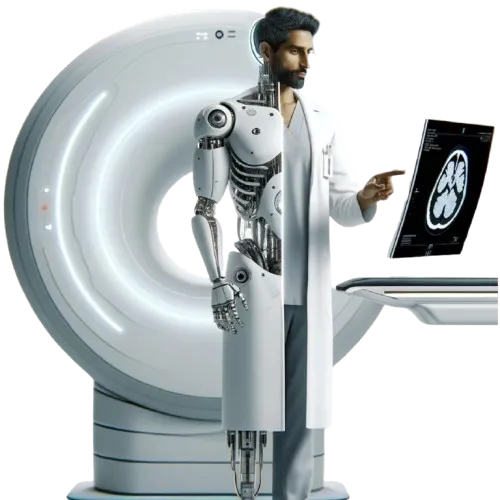
This operational model — where AI and expert radiologists work together — is what we call Hybrid Intelligence. The AI handles pattern recognition, report drafting, and quality verification at machine speed. The radiologist provides clinical judgment, contextual reasoning, and final accountability. Neither works alone. The combination produces outcomes that exceed what either achieves independently.
The Broader Landscape
The medical imaging AI market has grown rapidly over the past decade, with hundreds of companies developing AI algorithms for radiology. However, the vast majority of these solutions remain in the narrow AI category: a single algorithm detecting a single condition on a single modality. This fragmented approach mirrors the early days of enterprise software, when businesses ran dozens of disconnected point solutions before integrated platforms (ERP, CRM) emerged to unify workflows.
The industry is beginning to recognize the limitations of this approach. Healthcare systems that deployed narrow AI detection tools report mixed results — the technology works in isolation, but integration into clinical workflows remains challenging. Radiologists describe "AI fatigue" from managing multiple notification systems, each with its own interface, sensitivity settings, and false positive patterns.
WHO workforce projections show that the gap between global imaging volume growth and radiologist availability will continue to widen through at least 2035. In low- and middle-income countries, this gap is already critical. The solution cannot be more narrow AI tools added to an already fragmented workflow. It requires a fundamentally different architecture — AI systems that handle the complete workflow, not just one step within it.
GM AI represents this next evolution: from point solutions to integrated operating systems for radiology. Just as general-purpose computing moved from single-function calculators to multi-application operating systems, medical AI is moving from single-task detection to full-workflow intelligence. The question is no longer whether this shift will happen, but how quickly — and whether the transition will be driven by integrated architectures or by stitching together narrow tools after the fact.
"The industry has been stuck at Level 1 AI for a decade: detect one thing, send an alert, hope someone acts on it. GM AI is a fundamentally different architecture. It is not about better detection; it is about owning the full workflow. When AI generates the report, checks the report, and learns from the corrections, you get a system that compounds in accuracy over time. That is what separates an operating system from a feature."
Frequently Asked Questions
GM AI is only half the picture. The other half is how AI and radiologists work together — what we call Hybrid Intelligence. Understanding both frameworks together explains why full-workflow AI requires human expertise, not replaces it.
For the research underpinning this framework, read "From Slices to Reports" — our survey of 20+ AI models, three critical gaps, and the hybrid architecture for clinically viable AI radiology.
GM AI is Being Built Now
The shift from narrow detection tools to full-workflow medical AI is underway. If you're a healthcare leader, radiologist, or researcher interested in this space, we'd welcome the conversation. Try 10 cases free. No commitment.