Hybrid Intelligence
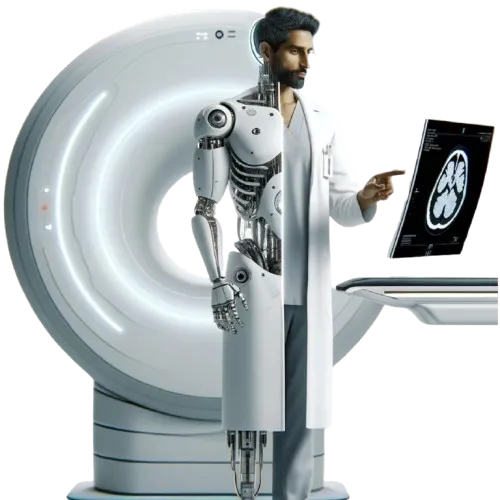
Not AI replacing doctors. Not doctors ignoring AI. The model where both work as one — and patients get better outcomes.
Hybrid Intelligence is the operational model where AI handles pattern recognition, report drafting, and quality checks at machine speed, while expert radiologists provide clinical judgment, complex reasoning, and final sign-off. Neither alone is sufficient. Together, they deliver speed, accuracy, and scale.
The False Dichotomy: AI vs. Doctors
Every AI headline asks the same question: "Will AI replace doctors?" The question itself is wrong. It creates a false binary that obscures the real opportunity in front of us. The real question is far more useful and far more urgent: How do AI and doctors work together to deliver better patient outcomes?
This is not a new pattern. History gives us plenty of precedent. Calculators did not replace mathematicians — they freed mathematicians to work on harder problems. Spell-check did not replace writers — it let writers focus on structure and meaning instead of typos. Autopilot did not replace pilots — it handles the routine so pilots can focus on the moments that require human judgment. The pattern is clear and consistent: technology augments expertise, it does not eliminate it.
In radiology, the divide is even clearer, as demonstrated in landmark studies published in Radiology and validated in 5C Network's own multi-site research. AI excels at perception tasks — pattern recognition across thousands of images at machine speed. It can scan a chest X-ray and flag hundreds of possible pathologies in ten seconds. It does not get tired after the 80th scan of the day. It does not miss a subtle nodule because it was distracted. For sheer volume and speed of visual analysis, AI is unmatched.
But humans excel at reasoning — clinical context, patient history, complex differential diagnosis, empathy, and the kind of intuitive judgment that comes from years of training and thousands of patient interactions. A radiologist knows that a shadow on a lung scan means something different for a 25-year-old marathon runner than for a 60-year-old smoker. AI sees pixels. Radiologists see patients.
Neither alone is enough. AI alone is fast but fragile — it processes at inhuman speed but can miss context, produce false positives, and lacks the clinical reasoning to navigate ambiguous findings. Humans alone are accurate but bottlenecked — limited by the number of hours in a day, susceptible to fatigue after long shifts, and constrained by the growing volume of imaging studies worldwide.
The answer is not either/or. It is both. And the operational model that brings them together has a name: Hybrid Intelligence.
What is Hybrid Intelligence?
Hybrid Intelligence is an operational model in healthcare where AI systems and human clinicians function as an integrated unit. The AI performs high-speed pattern recognition, generates structured reports, and applies systematic quality checks. The human provides clinical reasoning, contextual judgment, and final accountability. This collaboration produces outcomes that neither AI alone nor humans alone can achieve.
First defined by 5C Network, 2026
How Does Hybrid Intelligence Compare?
| Dimension | AI Alone | Human Alone | Hybrid Intelligence |
|---|---|---|---|
| Speed | Seconds per scan | 15-30 min per scan | AI draft in seconds, human review in minutes |
| Clinical context | Limited to image data | Full patient history | AI flags + human interprets in context |
| Fatigue | Never tires | Declines after 50+ scans | AI handles volume, human focuses on judgment |
| Quality control | Automated but brittle | Manual sampling | 8 AI agents + radiologist sign-off on 100% of reports |
| Accountability | No clinical liability | Full liability | Radiologist retains final authority |
| Accuracy (QC) | Variable | High but inconsistent | 96.7% across 20M+ scans |
Source: 5C Network platform data, March 2026
The Hybrid Intelligence Model
How AI and radiologists work as one integrated system at 5C Network
AI Layer
Bionic — the AI co-radiologist
Integration Zone
Radiologist
Expert Review
Final Report: AI Speed + Human Accuracy
Why Neither AI Nor Humans Work Alone
Each has strengths the other lacks. The magic happens when they combine.
AI Alone: Fast but Fragile
- High speed: 10-second analysis across hundreds of pathologies
- Can miss clinical context, rare findings, patient history nuance
- Risk: false positives overwhelm workflow without human filter
Human Alone: Accurate but Limited
- Deep clinical reasoning and contextual understanding
- Bottlenecked by volume, susceptible to fatigue, limited availability
- Challenge: maintaining quality across 50-100 studies/day consistently
Hybrid: Best of Both
- AI handles the 80% routine — humans focus on the 20% that matters most
- Speed of AI + judgment of humans = best patient outcomes
- Two pairs of eyes on every scan — one digital, one human
The Math
A radiologist reviewing 80 studies/day + AI pre-reads = subspecialist-level accuracy at 3x throughput.
30 min
Avg TAT
Sub-spec
Quality
24/7
Available
Source: 5C Network platform data, February 2026. Validated in peer-reviewed research.
Hybrid Intelligence in Practice
Every scan that enters the 5C platform goes through this integrated workflow.
Study Arrives at 5C Platform
T+0sDICOM images transmitted from the hospital's modality via secure connection. The study enters the intelligent routing queue.
Bionic Vision Analyzes
10 secondsComputer vision engine scans the images, detecting hundreds of pathologies with 0.93 F1 accuracy. Findings are flagged with confidence scores and annotated on the images.
Validated in peer-reviewed research (arXiv:2504.00022).
Bionic Voice Drafts Structured Report
15 secondsAI generates a structured radiology report based on the detected findings, organized into proper template sections with measurements, impressions, and recommendations.
Bionic LM Runs 8 QC Checks
8 agentsEight specialized AI agents validate the draft: checking for contradictions, template compliance, clinical question coverage, differential diagnoses, measurement consistency, laterality errors, incidental finding documentation, and impression-findings alignment.
Radiologist Reviews + Adds Clinical Context
Expert ReviewA board-certified radiologist reviews the AI-assisted draft, examines the original images, incorporates clinical context and patient history, modifies or adds findings as needed, and applies their clinical judgment before signing off.
Final Report Delivered to Hospital
30 min avgThe finalized, radiologist-signed report is transmitted back to the hospital's PACS/HIS. Critical findings trigger immediate alerts. The report combines AI speed with human accuracy — Hybrid Intelligence in action.
Powered by Generalised Medical AI (GM AI) — the AI operating system behind Hybrid Intelligence. 400+ radiologists + the GM AI platform operating at scale since 2017.
Results That Speak
These are not AI-only results or human-only results. They are Hybrid Intelligence results.
0
Scans Processed
0
Facilities Served
0
Average TAT
0
QC Accuracy
Source: 5C Network platform data, February 2026. Validated in peer-reviewed research.
What Radiologists Say
"AI doesn't replace the radiologist — it removes the grunt work so they can do what they were trained to do: think, reason, and care for patients."
Senior Radiologist, 5C Network
Reduced Cognitive Fatigue
AI handles repetitive pattern matching — the kind of work that leads to burnout after 60+ scans a day. Radiologists stay sharp for the cases that need their full attention.
More Time for Complex Cases
When AI handles routine pattern detection, radiologists can spend more time on subspecialty focus — the complex, ambiguous cases where clinical expertise makes the biggest difference in patient outcomes.
Better Patient Outcomes
Two pairs of eyes on every scan — one digital, one human. The AI catches what fatigue might miss. The human catches what context requires. Patients get the benefit of both.
Career Enhancement
Radiologists become AI supervisors, not obsolete. They learn to work with cutting-edge technology, expand their subspecialty exposure, and take on a role that is more intellectually engaging — and more valuable to the healthcare system.
24/7 Coverage Without Burnout
AI never sleeps, so critical findings are flagged instantly even at 3 AM. Radiologists work sustainable shifts — not 18-hour marathons — because the AI layer provides continuous coverage between human review cycles.
"Every AI headline asks whether machines will replace doctors. That is the wrong question. The right question is: how do you build a system where both operate at their best? Hybrid Intelligence is 5C Network's answer. The AI handles the parts of radiology that benefit from machine speed and consistency. The radiologist handles the parts that require human judgment and clinical context. Neither is optional."
Frequently Asked Questions
Hybrid Intelligence is powered by Generalised Medical AI (GM AI) — learn about the AI system that makes this collaboration possible. You can also explore Bionic, the AI co-radiologist that powers the AI layer, or learn about our compliance and regulatory framework.
For the full technical analysis, read "From Slices to Reports" — a survey of 20+ AI models identifying why this hybrid approach is the only viable path to clinically deployable AI radiology.
Experience Hybrid Intelligence for Your Hospital
Join 2,000+ facilities where AI and radiologists work as one. Try 10 cases free. No commitment.
Request a Demo