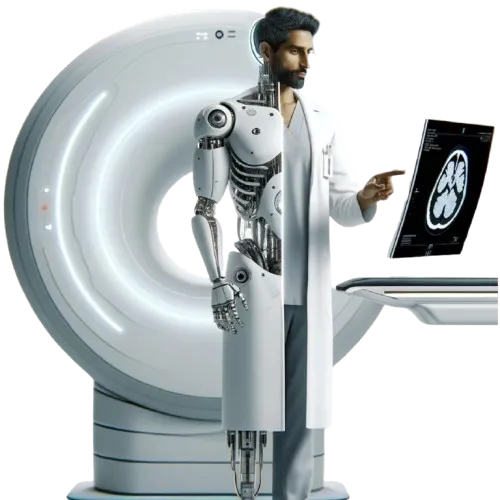
Agentic Software and the Power of Outcomes as a Service

The next evolution of healthcare AI isn't about better tools—it's about autonomous systems that deliver outcomes directly. Welcome to the era of agentic software.
For decades, healthcare technology has followed a predictable pattern: identify a problem, build a tool to solve it, sell the tool to practitioners. Electronic health records, imaging systems, diagnostic algorithms—all tools designed to help humans do their jobs better. But this model is reaching its limits.
From Tools to Agents
Traditional software is passive. It waits for input, processes according to fixed rules, and produces output. A radiologist must initiate every action, interpret every result, and make every decision. The software assists, but the human carries the cognitive burden.
Agentic software is different. These are AI systems that can perceive their environment, make decisions, and take actions autonomously to achieve specific goals. They don't just assist—they act. They don't wait for instructions—they pursue outcomes.
Consider the difference. A traditional AI tool flags a lung nodule on a chest X-ray. An agentic system identifies the nodule, cross-references with prior imaging, assesses growth rate, checks the patient's risk factors, determines the appropriate follow-up protocol, schedules the CT scan, and alerts the referring physician—all without human intervention at each step.
Outcomes as a Service
This shift enables a new business model: Outcomes as a Service. Instead of selling software licenses or per-study fees, healthcare organizations can contract for specific outcomes delivered.
Imagine paying not for an AI tool that detects fractures, but for the outcome of "zero missed fractures." Not for a reporting platform, but for "diagnostic reports completed within 30 minutes, 24/7." Not for a quality assurance system, but for "100% report accuracy guaranteed."
The vendor becomes accountable for results, not just features. This alignment transforms the relationship between technology providers and healthcare organizations. Both parties are now focused on the same goal: better patient outcomes, not better tool adoption.
What Makes Software Agentic
Not every autonomous system qualifies as truly agentic. The key characteristics include goal-directed behavior—the system pursues explicit objectives rather than executing fixed commands. It has perception and awareness of its environment, understanding context and changes over time. It can reason and plan, breaking complex goals into steps and adjusting when circumstances change. It takes action in the real world, not just producing reports but triggering workflows. And crucially, it learns and adapts, improving performance through experience.
These capabilities require more than traditional machine learning. They demand systems that can maintain state over time, reason across multiple modalities, integrate with diverse data sources, and interact with complex workflows—all while remaining accountable and interpretable.
The Radiology Use Case
Radiology is particularly well-suited for agentic transformation. The workflow is complex, multi-step, and time-sensitive. It involves coordination between technologists, radiologists, referring physicians, and patients. Quality and speed directly impact patient outcomes. And the volume of data—images, reports, histories, lab results—exceeds what humans can optimally process.
An agentic radiology system might work like this: A patient arrives for a CT scan. The agent pulls the relevant clinical history, checks for prior imaging, verifies the protocol with the ordering physician, and ensures the technologist has all necessary information. It monitors scan quality in real-time, flagging issues before the patient leaves. It routes the study to the appropriate radiologist based on subspecialty, workload, and urgency.
During interpretation, it surfaces relevant priors, suggests differential diagnoses, checks for contradictions, and ensures complete anatomical coverage. It drafts a preliminary report, which the radiologist reviews and finalizes. It then routes results to the referring physician, schedules follow-up imaging if needed, adds the case to appropriate quality registries, and updates the patient's longitudinal record—all while maintaining complete audit trails.
The radiologist is not replaced. They are elevated. Freed from routine coordination and checking, they can focus on complex interpretation, clinical consultation, and patient-centered decision-making. The agent handles the orchestration; the human provides the expertise.
The Business Model Shift
Outcomes as a Service changes how healthcare technology is bought and sold. Instead of capital expenditure on software licenses, organizations pay for operational outcomes. Instead of implementation projects measured in months, deployment is measured in days because the agent handles integration. Instead of training users on new tools, the system learns the existing workflow and adapts.
Risk shifts from the customer to the vendor. If the promised outcomes aren't delivered, the vendor doesn't get paid. This creates powerful incentives for continuous improvement, reliable performance, and genuine partnership.
For healthcare organizations, this means converting fixed costs to variable costs, reducing implementation risk, ensuring technology actually delivers value, and aligning vendor incentives with patient outcomes. For vendors, it means deeper customer relationships, recurring revenue streams, and the ability to capture value proportional to impact.
Challenges and Considerations
Agentic systems are not without challenges. Accountability becomes complex when AI makes decisions—who is responsible when something goes wrong? Transparency is essential—clinicians must understand why an agent took a particular action. Integration with legacy systems requires careful architecture. And trust must be earned through consistent, reliable performance over time.
Regulatory frameworks are still evolving. Current medical device regulations were designed for tools, not agents. New standards will be needed for autonomous systems that make clinical decisions. But the direction is clear: regulators, clinicians, and patients are increasingly comfortable with AI that demonstrates consistent, explainable, beneficial behavior.
The 5C Vision
At 5C Network, we are building towards this agentic future. Our platform is evolving from a collection of AI tools to an integrated system that can perceive, reason, act, and learn across the entire diagnostic workflow. We are moving from selling per-study services to guaranteeing outcomes—diagnostic accuracy, turnaround time, continuous availability.
Our agents don't just detect findings. They understand patient journeys, coordinate care teams, ensure quality, and continuously improve. They work alongside radiologists as partners, handling the complexity so humans can focus on what they do best.
This is not science fiction. The technology exists today. The question is who will deploy it responsibly, at scale, with the trust of clinicians and patients. That is the opportunity—and the responsibility—we embrace.
The Future is Agentic
The transition from tools to agents, from features to outcomes, represents the most significant shift in healthcare technology since the introduction of electronic records. It promises not just incremental improvement but fundamental transformation of how care is delivered.
Organizations that embrace agentic software and outcomes-based models will gain competitive advantage through superior efficiency, quality, and scale. Those that cling to traditional tool-based approaches will find themselves managing complexity rather than delivering value.
The future belongs to those who can deliver outcomes, not just tools. In radiology and beyond, agentic software is the path to that future. At 5C Network, we are committed to walking that path—and inviting our partners to join us.
Kalyan Sivasailam is CEO of 5C Network, where he leads the development of next-generation AI-powered diagnostic platforms.