The Clinical
Flywheel
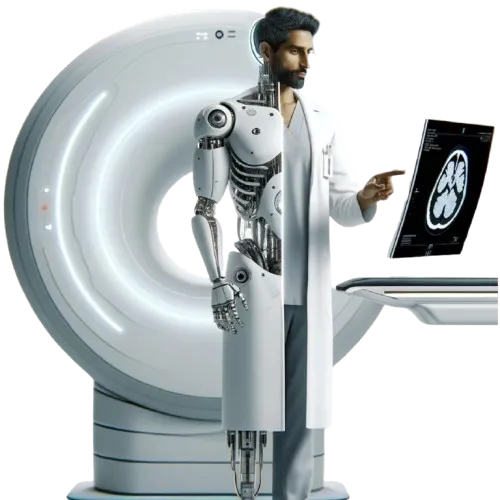
AI reads. Radiologists correct. The AI improves. Every scan makes the next scan better.
TL;DR: Most medical AI is frozen at the point of deployment. 5C Network's Clinical Flywheel is different. Every scan generates expert corrections that flow back into the model. 20,000+ corrections per day, compounding since 2016. The AI that reads your scan tomorrow is measurably better than the one that reads it today.
The Loop
Three steps. Repeated 20,000+ times per day. Each cycle makes the AI more accurate than the last.
AI reads the scan
The AI analyzes the medical image in 10 to 20 seconds. It detects pathologies, segments anatomy, generates measurements, and drafts a structured report. Trained on 4 billion+ clinical images across X-ray, CT, MRI, and mammography.
Radiologist validates
A board-certified radiologist reviews the AI output. They accept correct findings, correct errors, and add clinical context. 400+ subspecialist radiologists perform this step across the network every day.
AI learns
Every correction flows back into the training pipeline. The model updates. Accuracy improves. The AI that reads the next scan is better than the AI that read the last one. 20,000+ corrections per day, compounding.
20,000+ expert corrections per day. That is the raw material of a compounding advantage.
Why This Compounds
The flywheel works like compound interest. Small daily improvements accumulate into an insurmountable lead over time.
The foundation. One of the largest annotated medical imaging repositories in the world.
Real patient scans, not curated research datasets. Clinical edge cases included.
Validated against radiologist consensus. Subspecialist-level performance at scale.
Subspecialists across neuro, MSK, chest, abdomen, cardiac, mammo, and pediatric radiology.
The compound interest of clinical data
Consider a 0.1% improvement in accuracy per week. Negligible in isolation. But compounded over 52 weeks, the model is measurably different from where it started. Compounded over five years (since 5C Network began processing at scale), the gap between this model and a static one becomes a chasm.
Most medical AI products ship a frozen model. It was trained once, validated once, and deployed. It does not learn from the scans it reads in production. The Clinical Flywheel is the opposite. Every day, 20,000+ scans generate 20,000+ expert-labeled corrections. The model evolves continuously.
The flywheel is the reason our accuracy today is not the same as it was six months ago. Every radiologist who corrects an AI finding is training the next version of the model. That feedback loop does not exist in any static AI product.
The Data Moat
Three ingredients, required simultaneously. That is why the flywheel is hard to replicate.
Proprietary training data at scale
4 billion+ clinical images. Not scraped from the internet. Not licensed from a public dataset. Collected through clinical operations over years. Annotated by domain experts. This corpus cannot be assembled by writing a check. It is the product of years of clinical relationships and operational volume.
A live clinical network generating continuous corrections
400+ radiologists across 7 subspecialties review and correct AI output on every scan. These are not crowd-sourced labels from medical students. They are expert corrections from board-certified subspecialists working in real clinical workflows, on real patient scans, under real time pressure. 20,000+ of these corrections happen every single day.
Workflow integration across 2,000+ facilities
The flywheel only works if scans flow through the system at scale. 5C Network is integrated into the PACS and RIS systems of 2,000+ healthcare facilities. This distribution layer ensures a steady, high-volume stream of clinical scans that feed the cycle. A research lab with a good model but no distribution has no flywheel.
Why a new entrant cannot shortcut this
Data alone is not enough without live corrections. Corrections alone are not enough without scale. Scale alone is not enough without proprietary data. A new entrant would need all three simultaneously. Building any one of them takes years. Building all three at once is the barrier.
What This Means for Hospitals
You are not buying a static product. You are connecting to a living system.
Continuous improvement
The model reading your scans today is better than the one that read them last month. No upgrade cycles. No new purchases. Improvements flow automatically through the network.
Network-level accuracy
Your hospital benefits from corrections made across the entire 5C network. A rare finding caught at a facility in Chennai improves the model for a facility in Delhi. Scale creates accuracy.
No frozen models
Traditional AI vendors ship a model and walk away. It degrades over time as clinical patterns shift. The flywheel ensures the model adapts to real-world distribution changes continuously.
Human + AI, compounding
Every radiologist who validates a report contributes to the next generation of the model. The human-AI relationship is not static. It is a partnership that deepens with every scan.
Connect to the flywheel
2,000+ facilities already connected. Go live in 72 hours. The AI improves while you sleep.
Frequently Asked Questions
What is the Clinical Flywheel in medical AI?
The Clinical Flywheel is a self-reinforcing cycle where AI reads medical scans, radiologists validate and correct the results, and the AI learns from those corrections. Each cycle makes the AI more accurate, which attracts more scans, which generates more corrections. 5C Network processes 20,000+ scans daily, producing 20,000+ expert corrections that feed back into the model.
Why is the Clinical Flywheel hard to replicate?
The flywheel requires three simultaneous ingredients: proprietary training data (4 billion+ clinical images), a live clinical network generating continuous expert corrections (400+ radiologists correcting 20,000+ scans daily), and workflow integration across 2,000+ facilities. A new entrant would need all three at once. Data alone is not enough without live corrections. Corrections alone are not enough without scale.
How does the Clinical Flywheel benefit hospitals?
Hospitals connected to the flywheel get an AI that improves continuously. The model reading a scan today is measurably better than the one that read a scan six months ago. Hospitals do not need to buy new software versions or run upgrade cycles. Improvements flow automatically through the network.
What data fuels the Clinical Flywheel?
5C Network's AI models are trained on 4 billion+ clinical images and have processed 20 million+ clinical scans. The models cover hundreds of pathologies across X-ray, CT, MRI, and mammography, achieving 0.93 F1 accuracy. Every day, 400+ radiologists provide expert corrections that continuously refine the models.