AI in Medical Imaging: Building the Calculator for Radiologists
What Fundamental Problem is AI Solving in Radiology?
The core challenge in radiology isn't a lack of talent, but an overwhelming volume of routine work leading to systemic overload. Specialists, particularly in high-demand regions like India, where the radiologist-to-population ratio is extremely low, are struggling to manage an unsustainable caseload. This massive volume of routine cases, such as general health check-ups and standard chest X-rays, causes the most significant delays, misdiagnoses, and professional burnout.
Why is the Radiologist's Role Compared to That of a Mathematician?
Radiologists can be likened to mathematicians who have advanced from basic arithmetic to solving complex equations. They are highly trained experts capable of diagnosing complex cancers and rare conditions. However, when these specialists are forced to spend the majority of their time on the "basic arithmetic" of medicine—the high-volume, repetitive, and routine scans—their skills are underutilized, leading to fatigue and an increased risk of error in both simple and complex cases. The burnout crisis stems from this mismatch between high-level expertise and high-volume basic tasks.
How is Superior AI Technology Built in Medical Imaging?
Developing effective medical imaging AI goes far beyond creating a simple algorithm—it requires a strategic, data-centric approach. While many companies remain at the "base camp" of basic models, those achieving true impact must reach the "summit." The key distinction is the quality and scale of the data and the integrated workflow.
A successful platform doesn't start as purely an AI company; it must first establish itself as an essential online radiology platform. This allows the collection of millions of perfectly annotated, real-world cases and establishes a vital built-in feedback loop. In this loop, human radiologists continuously validate and refine the AI's predictions, ensuring the algorithm's robustness and clinical accuracy. This approach allows algorithms, like one for chest X-rays, to be trained on millions of data points, vastly outperforming models trained on limited samples.
Can AI Achieve Real Accuracy in Reading Medical Scans?
Yes, AI can achieve remarkable accuracy, especially in recognizing established patterns.Highly advanced algorithms, like those used to analyze chest X-rays, benefit from an enormous dataset that covers the full spectrum of radiology pathology. This scale is crucial for accuracy, allowing the AI to perform tasks such as:
- Precision Measurement: Automatically measuring organs, such as the liver, with sub-millimeter precision.
- Flagging Subtle Pathology: Identifying conditions like fatty liver disease that might be easily missed in a high-volume reading environment.
- Integrating Clinical Context: Providing differential diagnoses (e.g., distinguishing between pneumonia and cancer for a consolidation on an X-ray) by integrating available patient history from hospital systems.
Will Artificial Intelligence Replace Human Radiologists?
Absolutely not. AI is a tool, not a replacement.4 Since AI fundamentally excels at pattern recognition, its utility is limited in complex cases where a diagnosis involves subtle anatomical knowledge, non-pattern-forming cancers, and deep clinical reasoning.
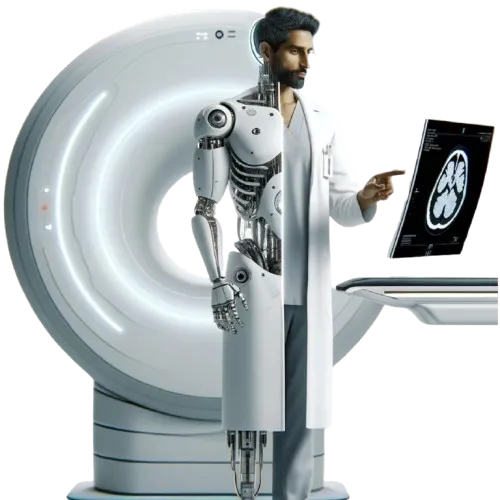
The goal of AI is not to substitute human experts but to serve as a "calculator for radiologists." By automating the high-volume, routine, and time-consuming tasks, AI frees up specialists to focus on:
- Complex Diagnosis: The difficult cases that require human expertise.
- Collaboration: Spending time consulting with surgeons and other physicians on optimal treatment approaches.
- Patient Communication: Engaging in the critical human-centric aspects of medicine.
What Defines a Successful Strategy in the Medical Imaging AI Market?
Success in the medical imaging AI market, particularly in unique environments like India, requires more than just a powerful API. It demands deep customer understanding and custom orchestration. Successful models focus on selling directly to hospitals and health systems, which are motivated by concrete operational benefits:
- Faster Turnaround Times (TAT).
- Fewer Diagnostic Errors.
- Improved Departmental Efficiency.
Effective implementation involves customizing the AI workflow to the hospital's specific needs, such as triaging scans into normal/abnormal categories, and then further classifying them (e.g., into emergency or surgical urgency) using language models. This shift requires vendors to act more like strategic partners focused on solving workflow problems rather than just selling a generic software solution.
Ready to Transform Radiology?
The shift from a manual, overwhelmed system to an AI-augmented future is already underway, changing the roles of radiologists and vastly improving patient care.
To get the full depth of these insights, including how innovative companies are navigating regulations, competing with tech giants, and planning global expansion, make sure to watch the complete conversation.