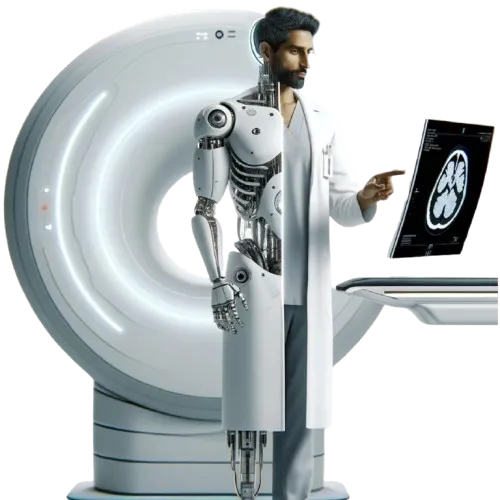
Why AI Makes Great Radiologists More Valuable, Not Less
There is a neat story people like to tell about AI in medicine.
It says AI will commoditize expertise, flatten talent, and make specialists increasingly interchangeable. In that version of the future, the machine does the hard work and the clinician becomes a thin layer of supervision.
We think that story is wrong.
In radiology, AI is more likely to increase the value of the very best specialists while putting real pressure on the middle of the market. The gap between exceptional radiologists and average radiologists will widen. The people with the deepest judgment, highest standards, and strongest work ethic will become more important, not less.
And they will be in extraordinary demand.
AI does not erase expertise. It makes it more visible.
Every major technology wave changes how value is distributed.
The spreadsheet did not eliminate great analysts. It increased their leverage. Software did not eliminate elite operators. It made them more powerful. The internet did not make great teachers irrelevant. It extended their reach.
AI will do the same in radiology.
When AI takes over repetitive detection, formatting, prioritization, measurement, and drafting, the radiologist is pushed upward into the highest-value layer of the workflow. That is where judgment, synthesis, ambiguity resolution, accountability, and trust matter most.
These are not secondary skills. They are the profession.
A weaker specialist may become faster with AI. They may even look more productive. But speed without judgment is not excellence. Throughput without rigor is not quality. In a specialty where every report can alter a clinical decision, the ability to think clearly under complexity remains rare and immensely valuable.
That is why AI will not flatten radiology. It will make the difference between average and exceptional impossible to ignore.
The middle gets compressed
This is the uncomfortable part, but it matters.
When AI makes standard output easier to produce, specialists whose value comes mainly from handling routine volume at acceptable quality become more replaceable. That does not mean they disappear. It means the market begins to price them differently.
If a radiologist adds only marginal value beyond what the workflow, platform, and AI system already provide, then their economic value will come under pressure.
That is what technology does. It raises the floor, and when the floor rises, the middle compresses.
The people most at risk are not necessarily untrained or unintelligent. They are the ones who stop at competence, do not deepen their judgment, do not sharpen their standards, and do not take ownership of hard cases, hard shifts, or hard decisions.
AI will make average work easier. It will not make average work more valuable.
Great radiologists become force multipliers
Now look at the other side.
What happens when you give a truly excellent radiologist better tools?
You do not get a marginal improvement. You get a step change.
A great radiologist with AI can read faster without compromising standards, maintain consistency over longer stretches, handle greater complexity, and influence quality across larger systems.
Their work no longer scales only through individual effort. It begins to scale through systems, workflows, and networks.
This is where the economics of radiology shift.
In the past, even elite specialists were constrained by time, fatigue, and workflow friction. AI does not remove those constraints entirely, but it reduces them enough that exceptional radiologists can operate with far more leverage.
That means the best specialists will not merely remain valuable. They will shape the performance of entire organizations.
When talent starts influencing systems instead of just individual reports, its value rises sharply.
Excellence matters even more in the AI era
Some people assume the winners in an AI-first world will simply be the most technically fluent or the fastest to adopt new tools.
That is not enough.
The specialists who will thrive are the ones who already have the habits that excellence demands: seriousness, rigor, intellectual honesty, discipline, curiosity, consistency, and pride in difficult work.
AI rewards these traits disproportionately.
AI systems are powerful, but they still require oversight, calibration, correction, and judgment. A casual operator will use AI to become faster. A great specialist will use AI to become better.
That difference is everything.
The future will not belong to people who merely sit beside AI. It will belong to people who can direct it, challenge it, improve it, and use it in service of better patient care.
This matters especially in radiology
Radiology is one of the first specialties where AI can meaningfully alter the economics of expert work.
Three pressures are rising at once: imaging demand, case complexity, and expectations around speed and quality.
But the supply of truly exceptional radiologists is not keeping pace.
That creates a simple reality. As AI adoption rises, the people who can consistently deliver high-quality judgment will become even more valuable.
Not less valuable.
One of the most important effects of AI in radiology may be that it makes talent more legible. When routine work becomes easier, the real differentiator is no longer baseline competence. It is depth of judgment.
That is why we believe the best radiologists will become more central to healthcare delivery in the AI era, not less.
What we believe at 5C
At 5C, we do not see AI as a substitute for great radiologists.
We see it as the infrastructure that allows great radiologists to operate at their full potential.
Our goal is simple: increase the leverage of the best specialists, remove wasted effort, improve quality, and create systems where exceptional clinical talent can do more of what matters with better tools and stronger support.
That future will not be built by average commitment.
It will be built by people who care deeply about the craft, hold themselves to a high standard, and want to help define what radiology looks like in the AI era.
Those people will always be in demand.
We are always looking for them.
If you are one of them, we should talk
If you are the kind of radiologist who wants to be held to a high standard, work at the frontier of AI-powered radiology, and build a career where excellence matters more, not less, we would love to hear from you.
Because the age of AI will not diminish the best specialists.
It will make them indispensable.