How 5C Uses AI to Personalize Onboarding and Reporting for Every Client
Radiology clients do not fail because they lack software. They struggle when software does not understand how their clinical and operational workflows actually run.
Every hospital, diagnostic center, and healthcare network has its own reality. Emergency cases move differently from routine studies. A multi-location diagnostic chain needs consistency across sites. A hospital may need tighter escalation for critical findings. A specialty-heavy center may care deeply about routing, templates, and turnaround time by modality.
At 5C Network, we believe radiology technology should adapt to those realities, not flatten every client into the same workflow.
The future of radiology operations is not generic automation. It is personalization at scale, with clinical accountability built in.
Onboarding should start with how the client actually works
A good onboarding is not just account creation, integration, and training. In radiology, onboarding succeeds when the operating model is understood early.
What studies does the client send most often? Which modalities need the fastest turnaround? What does an emergency workflow look like? Are there preferred report formats? How should critical findings be escalated? Which subspecialties require dedicated routing? Who needs visibility when volumes spike?
Traditionally, these answers are collected through manual discovery, scattered notes, repeated calls, and post-go-live corrections. That approach works, but it is slow and easy to miss nuance.
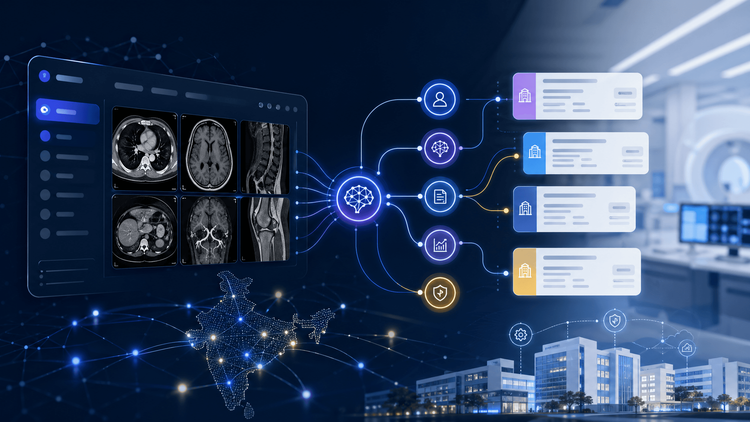
AI helps 5C make this process more structured. It can organize onboarding inputs, identify workflow patterns, surface configuration needs, and help teams build a more accurate operating picture before reporting begins.
That means fewer avoidable surprises after go-live, and a client experience that feels configured around real clinical priorities from day one.
The reporting experience is more than the final report
Radiology reporting depends on clinical accuracy. But the client experience depends on the entire system around that report.
Clients notice whether urgent studies are prioritized correctly. They notice whether reports follow the expected structure. They notice whether critical findings are escalated reliably. They notice whether turnaround time is predictable. They notice whether different locations receive the same level of consistency.
AI helps personalize these operational layers without asking radiologists or client teams to carry more coordination burden.
Case prioritization. AI can help identify urgency signals and support faster movement of time-sensitive studies through the workflow.
Specialty-aware routing. The system can help match cases to the right radiologist based on modality, subspecialty, availability, and client expectations.
Client-specific report preferences. Report structure, template behavior, comparison style, and terminology expectations can be captured and reinforced over time.
Escalation discipline. Critical findings and operational exceptions can be surfaced faster, reducing the risk that important cases sit unnoticed.
Turnaround visibility. AI-supported monitoring can help identify bottlenecks before they become client-facing problems.
This is where personalization becomes practical. It is not about creating a completely different product for every client. It is about making the operating system intelligent enough to adjust around the client’s needs.
The system should learn after go-live
The most important client preferences often become visible only after work begins.
A client may repeatedly ask for a particular structure in certain reports. A site may generate predictable emergency volume at specific times. A modality may need different routing during night hours. Feedback may reveal that one department cares more about comparison detail, while another cares more about speed and escalation.
These signals are too important to leave buried in emails, chats, and ad hoc feedback.
AI can help convert daily operational signals into continuous improvement. It can highlight repeated preferences, identify workflow friction, support quality review, and help teams tune the reporting experience as the relationship matures.
The best onboarding does not end at go-live. It becomes a learning loop that keeps improving the reporting experience.
Personalization has to scale, or it becomes manual work
The hard part is not personalizing one client. The hard part is doing it across many clients, modalities, radiologists, locations, and operating patterns without creating chaos.
Manual customization alone does not scale. It depends too much on individual memory, repeated coordination, and after-the-fact corrections. At network scale, that creates variation where there should be consistency, and rigidity where there should be adaptation.
AI gives 5C a better balance.
It helps standardize what should be standardized: quality controls, escalation discipline, workflow visibility, reporting reliability, and operational accountability. At the same time, it allows the client experience to reflect local preferences, modality mix, clinical priorities, and service expectations.
That balance matters. Clients should get the reliability of a large radiology network without feeling like their workflow has been forced into a generic template.
AI should support radiologists, not replace clinical judgment
5C’s approach to AI is practical and human-centered.
AI is not the radiologist. It is not the care team. It is not a substitute for clinical expertise, governance, or accountability.
Its role is to reduce operational friction around clinical work. It helps route studies more intelligently, surface relevant context, reduce repetitive coordination, improve consistency, and ensure the right people see the right cases at the right time.
When used well, AI gives radiologists more room to focus on interpretation. It gives operations teams better visibility. It gives clients more confidence that their reporting workflow is understood and improving.
The client experience will become a competitive advantage
The next generation of radiology services will not be defined only by who can report faster. Speed matters, but speed without adaptability is fragile.
Healthcare providers need partners who understand their workflows, respond to their priorities, and improve with them over time. That requires a platform that can combine clinical expertise, operational discipline, and AI-enabled learning.
For 5C, this is the direction of travel: onboarding that captures nuance early, reporting workflows that adapt to real operational needs, and a client experience that becomes sharper with every interaction.
Every client is different. The radiology reporting experience should be built to understand that difference and keep getting better because of it.