How AI-Powered Speech Recognition Transforms Radiology Reporting
How AI Is Revolutionizing Modern Healthcare
Artificial intelligence is transforming industries worldwide. From Microsoft's ChatGPT to Google's Alpha Code, numerous generative AI platforms offer vast arrays of use cases. The near future will see increasing leverage of these technologies to build automated, autonomous, and robust workflows—particularly in overworked yet critical sectors like healthcare.
The global artificial intelligence in healthcare market is projected to grow from $13.82 billion in 2022 to $164.10 billion by 2029 at a CAGR of 42.4%. AI-powered teleradiology platforms have become increasingly popular methods for radiologists to provide remote consultations and interpret imaging studies from anywhere while healthcare providers receive timely, accurate diagnoses.
With advanced healthcare delivery systems comes the need for efficient communication tools. Speech recognition has emerged as one of the most transformative features in modern radiology practice.
What Is AI-Powered Speech Recognition in Radiology
AI-powered speech recognition technology allows radiologists to dictate their findings while software automatically converts speech to text in real-time. Unlike older voice recognition systems requiring extensive training and producing error-prone results, modern AI speech recognition achieves accuracy levels making it practical for clinical documentation.
This technology builds on consumer applications like Siri and Alexa but is specifically trained on medical terminology, radiological language patterns, and clinical documentation requirements. The result is a tool that understands complex anatomical terms, pathology descriptions, and radiological conventions without requiring radiologist adaptation.
Why Does Radiology Need Speech Recognition
The medical profession is increasingly dependent on clinical documentation. Radiologists spend nearly four times as much time on documentation as they do on actual scan interpretation. This documentation burden creates bottlenecks, contributes to burnout, and reduces the number of patients radiologists can serve.
Traditional typing-based reporting is slow, ergonomically problematic, and takes radiologists' attention away from images. Speech is the most natural form of communication—humans speak 3-4 times faster than they type. AI-powered speech recognition harnesses this natural efficiency to transform radiology workflow.
How Does Speech Recognition Improve Radiology Workflow
Reduced Documentation Time
With AI-powered speech recognition, radiologists dictate findings while software automatically converts speech to text in real-time with high accuracy. By documenting this way, radiologists operate at nearly 4X the speed of traditional typing methods, saving over 3 hours daily.
This time recovery is substantial. For a radiologist interpreting 50 studies daily, reducing documentation time from 5 minutes per case to 1-2 minutes creates capacity for 20-30 additional cases or allows earlier workday completion. The efficiency gains directly impact both productivity and work-life balance.
Seamless System Integration
AI-based voice recognition software is highly intuitive, requiring minimal training or familiarization processes. The technology integrates fully with existing PACS and reporting systems without necessarily requiring hardware or infrastructure upgrades.
Radiologists can begin using speech recognition immediately without workflow disruption. The software adapts to individual speaking patterns, medical terminology preferences, and reporting styles, becoming more accurate with use while maintaining compatibility with institutional reporting standards.
Multi-Platform Accessibility
Speech recognition increases efficiency, productivity, and speed across all work environments. The tool enables clinical reporting on the go via mobile, web, and desktop applications, allowing radiologists flexibility in where and how they work.
This accessibility is particularly valuable for teleradiology services where radiologists may work from home offices, while traveling, or across multiple facility locations. The consistent speech recognition capability follows radiologists across all platforms, maintaining productivity regardless of device or location.
Enhanced Report Quality
Speech recognition reduces duplication errors common with copy-paste workflows and promotes digital note-taking that's more effective than manual typing. Radiologists maintain focus on images rather than keyboards, improving observation quality and diagnostic accuracy.
The natural flow of dictation often produces more comprehensive, clearly expressed reports than typed documentation. Radiologists can describe findings fluidly while viewing images rather than breaking concentration to type, look up, review images, and resume typing.
What Are the Clinical Benefits
Radiologists empowered by speech recognition software provide more attentive and effective consultations. The time saved from efficient documentation can be redirected to better quality interpretation, reviewing more cases to reduce backlogs, or improving work-life balance to prevent burnout.
For healthcare facilities, speech recognition enables higher radiologist productivity without additional hiring costs. The same radiologist workforce can handle increased imaging volumes that would otherwise require expensive recruitment in a tight labor market.
Patients benefit from faster report turnaround times, enabling quicker clinical decision-making and treatment initiation. The improved report quality from focused interpretation also enhances diagnostic accuracy, directly impacting patient outcomes.
How Does AI Improve Speech Recognition Accuracy
Modern AI-powered speech recognition uses deep learning models trained on millions of medical dictations to understand radiological language patterns, pronunciation variations, and clinical context. The technology recognizes medical terminology that general speech recognition systems misinterpret.
For example, the AI distinguishes between "ileum" and "ilium," "hyper" and "hypo," or "millimeter" and "centimeter"—critical distinctions that older systems frequently confuse. Context awareness allows the system to predict likely terms based on body region, imaging modality, and report section.
The AI continuously learns from corrections, improving accuracy for individual radiologists over time. This adaptive learning means the system becomes more personalized and accurate the more a radiologist uses it.
What About Integration Challenges
Unlike legacy speech recognition requiring extensive vocabulary training and system configuration, modern AI-powered solutions integrate seamlessly with existing radiology infrastructure. The cloud-based architecture connects to PACS and RIS systems via standard APIs without requiring server installations or network modifications.
Radiologists access speech recognition through web browsers or mobile apps that connect securely to reporting platforms. IT departments appreciate the minimal support burden—there's no hardware to maintain, no software to update on individual workstations, and no compatibility issues with operating system updates.
Security and compliance requirements are built into cloud platforms with HIPAA-compliant architecture, encrypted data transmission, and audit trails documenting all dictation and report activities.
Real-World Impact Metrics
Radiology departments implementing AI-powered speech recognition typically observe measurable improvements within the first month:
- Documentation speed: 3-4X faster than typing
- Time savings: 3+ hours per radiologist daily
- Productivity increase: 20-30% more cases per radiologist
- Error reduction: Fewer transcription and copy-paste errors
- Adoption rate: 90%+ radiologist satisfaction and continued use
- ROI timeline: Cost recovery within 3-6 months through increased throughput
These metrics demonstrate speech recognition isn't just a convenience feature—it's an essential infrastructure for modern radiology operations facing increasing imaging volumes and persistent radiologist shortages.
Why Invest in Speech Recognition Now
The combination of AI accuracy improvements, seamless integration capabilities, and proven ROI makes this the optimal time for radiology practices to adopt speech recognition technology. The tools have matured beyond early adoption challenges to become reliable, user-friendly solutions delivering immediate value.
Radiologists expect modern workflow tools comparable to consumer technology experiences. Practices offering efficient, technology-enabled workflows have competitive advantages in recruiting and retaining radiologist talent in tight labor markets.
For healthcare facilities, speech recognition enables handling imaging volume growth without proportional increases in radiologist headcount—a critical capability given nationwide radiologist shortages and lengthy recruitment timelines.
The Future of Voice-Enabled Radiology
Speech recognition represents the beginning of broader voice-enabled radiology workflows. Future developments will include voice-commanded image manipulation, spoken queries to AI diagnostic assistants, and conversational interfaces for accessing patient history or prior studies.
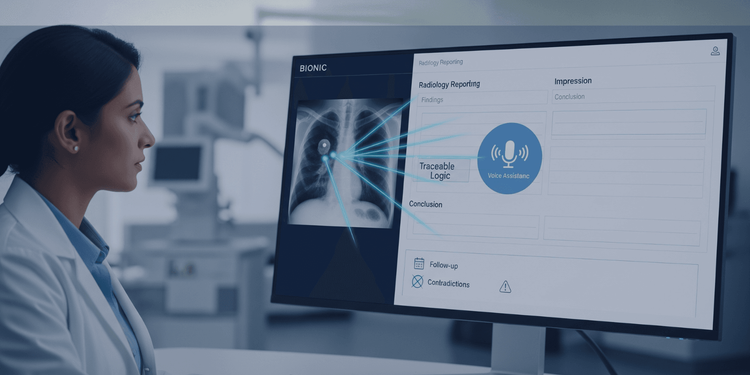
Integration with large language models will enable radiologists to dictate preliminary findings and have AI generate structured reports with appropriate impressions, follow-up recommendations, and clinical correlations. The radiologist reviews and approves rather than drafting from scratch.
Voice biometrics will provide secure authentication, eliminating password typing while ensuring only authorized users can dictate reports. This seamless security balances convenience with compliance requirements.
Implementation Considerations
Successful speech recognition implementation requires selecting platforms with proven radiology-specific accuracy, seamless PACS/RIS integration, multi-platform support, and responsive technical support. Radiologists should evaluate systems through hands-on trials ensuring the technology meets individual workflow needs.
Training requirements should be minimal—if significant training is necessary, the system isn't sufficiently intuitive for clinical use. The best solutions work immediately with accuracy improving through use rather than requiring upfront configuration effort.
Pricing models vary from per-radiologist subscriptions to usage-based pricing. Practices should calculate ROI based on time savings and productivity increases rather than viewing speech recognition as pure expense.
SEE ABOUT How Key Images in Radiology Reports Increase Revenue
Testimonials
I'd say my reporting time has dropped by at least 40%. It's not just faster, it's a huge shift in workflow. I actually feel like I have more control over my day now"
— Senior Radiologist with 12+ years of experience, Bengaluru
"It's super reliable. It catches all those stupid little consistency errors I'd miss when I'm tired or rushing. It's a huge stress reliever, seriously. I just hit sign now and don't worry about it."
— Early-Career Radiologist with 2–3 years of experience, Mumbai
"I'm reading 80+ cases a day and I'm less exhausted than when I did 50. The AI handles the boring stuff—I get to do actual radiology instead of being a typist."
— Senior Radiologist with 10 years of experience, Kolkata
"I used to spend 3-4 hours just on documentation. Now with speech recognition, I'm done in half the time. The AI handles all the template filling—I just focus on the actual diagnosis."
— Consultant Radiologist with 8 years of experience, Hyderabad
RECOMMENDED READINGS
Deep Learning Models for Early Disease Detection in Medical Imaging