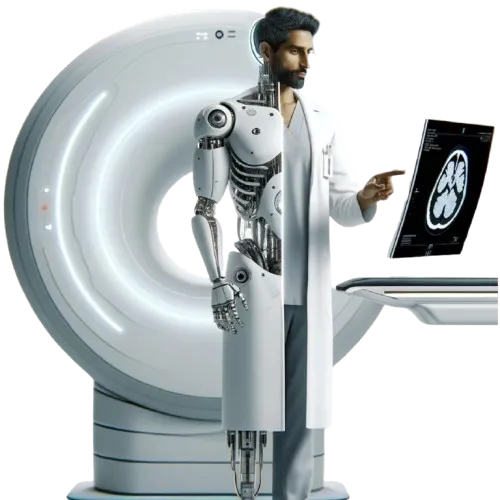
The Paradox of AI Productivity: Why Faster Radiologists Need More Protection, Not Less

When we make radiologists 5x more productive, we also concentrate 5x the cognitive weight into the same number of hours. This is not a problem to solve later. It is the problem.
The Productivity Trap
There is a seductive logic to AI in radiology: automate the routine, surface the critical, let radiologists focus on what matters. On paper, everyone wins. Turnaround times drop. Throughput increases. Hospitals get more value from the same headcount.
But something else happens too.
When AI handles triage and pre-reads, the cases that reach the radiologist are no longer a mix of routine and complex. They are all complex. Every case demands attention. Every read requires judgment. The cognitive buffer that came from easy cases—the ones you could clear quickly—disappears.
A radiologist who used to read 50 mixed cases now reads 50 hard ones. Same hours. Five times the mental load.
What the Research Shows
The Economic Times recently published a piece on what is now being called "The AI Burnout"—a pattern where professionals using AI tools report higher productivity alongside higher exhaustion.
This is not intuitive. If AI is doing more work, shouldn't people be doing less?
The answer is no. AI does not reduce human effort in knowledge work. It concentrates it. The tool handles volume; the human handles judgment. And judgment is expensive. It depletes working memory, requires sustained attention, and accumulates fatigue in ways that routine tasks do not.
In radiology, this effect is amplified. The consequences of a missed finding are severe. The pressure is constant. And unlike other fields, there is no "good enough"—every read is a decision that could change a life.
The 5C Approach
We think about this constantly at 5C. Not because we are against productivity—we are not. We have built systems that genuinely make radiologists faster and more accurate. But we have also learned that speed without protection is not sustainable.
Here is what that means in practice:
Cognitive load management. Our AI does not just triage cases. It presents information in ways that reduce mental overhead—surfacing relevant priors, highlighting key measurements, organizing findings by clinical significance. The goal is not just "faster reads" but "easier reads."
Workflow pacing. We design systems that allow natural breaks. Not every efficiency gain needs to be captured as throughput. Some of it should go toward sustainability.
Human-in-the-loop, not human-as-bottleneck. When AI handles pre-reads, we are careful about what gets escalated and how. The radiologist should feel supported, not ambushed by a queue of edge cases.
The Uncomfortable Question
Every radiology leader deploying AI needs to ask: What happens to my radiologists when they become 5x more productive?
If the answer is "they read 5x more cases," you have not solved anything. You have created a burnout pipeline with better throughput metrics.
The better answer is: they read more cases and they go home less exhausted. They have time to think. They catch things they would have missed under pressure. They stay in the field longer.
That is the version of AI productivity worth building toward.
The Bottom Line
AI will transform radiology. That much is certain. The question is whether that transformation serves radiologists or just extracts more from them.
At 5C, we are betting on protection. Not because it is easier—it is not. But because the alternative is a field full of burned-out experts who leave medicine wondering why the tools that were supposed to help made everything harder.
That is not the future we want to build.