How 5C Network has Built the Future of Radiology Reporting
What Is the Current State of Radiology in India
India's healthcare industry is experiencing significant expansion, particularly in diagnostic imaging. The Indian Diagnostic Imaging Services market was valued at $9.54 billion in 2022 and is projected to reach $17.54 billion by 2030, growing at 7.9% annually.
However, this growth reveals a critical challenge. Despite conducting approximately 1 million radiological scans daily, India has only 14,000 registered radiologists available to interpret these studies. The PCPNDT Act further restricts this limited workforce by requiring that only registered radiologists can perform ultrasonography, consuming nearly half of these professionals' time with ultrasound-specific work rather than comprehensive diagnostic reporting.
This severe shortage creates diagnostic bottlenecks across the country. Patients face extended wait times for scan interpretation, treatment decisions get delayed, and radiologists experience unsustainable workloads leading to burnout and quality concerns. LEARN MORE ABOUT 10 Real-World Examples from 5C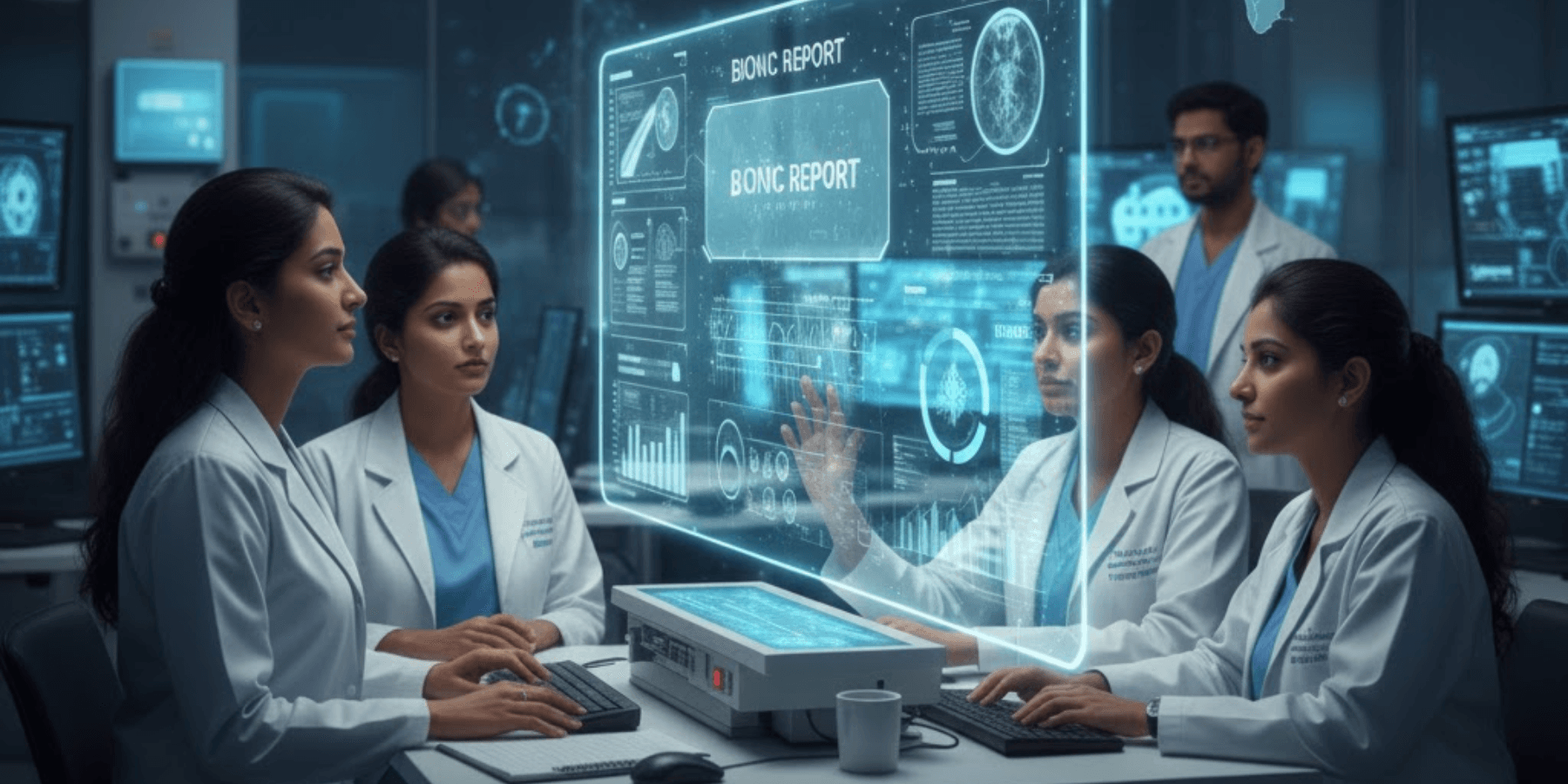
Why Are Traditional Solutions Failing to Address the Crisis
The Hospital Challenge
A tier 1 city hospital exemplifies this national crisis. The facility experienced a surge in diagnostic scans as more patients sought healthcare services. With only one radiologist available, the hospital could not maintain acceptable turnaround times for scan interpretation.
Report backlogs grew unmanageable, treatment decisions faced dangerous delays, and specialized cases requiring expert interpretation languished in queues. The hospital needed a solution to manage high scan volumes and clear pending reports within a 12-hour timeframe—an impossible task for a single radiologist using conventional methods.
Hiring additional radiologists proved impractical due to the nationwide shortage and prohibitive costs. The hospital required an innovative approach that could scale diagnostic capacity without proportionally increasing radiologist headcount.
How Does Bionic Report Combine AI with Radiologist Expertise
Recent years have shifted radiologist perspectives on artificial intelligence from viewing it as a threat to recognizing its potential as a complementary tool that enhances rather than replaces human expertise.
Bionic Report by 5C Network represents a significant advancement in AI-assisted radiology reporting. The system harnesses a state-of-the-art fine-tuned language model embedded within a Retrieval-Augmented Generation framework to produce detailed, clinically precise reports.
SEE HOW BIONIC AI HELPS THE RADIOLOGIST
Training on Real-World Data
The AI model was trained using 8.5 million actual radiology reports interpreted by 5C Network's radiologist network. This massive real-world dataset ensures the system understands authentic clinical language, reporting patterns, and diagnostic reasoning used by practicing radiologists across diverse pathologies and imaging modalities.
Unlike generic AI models, Bionic Report learned from reports that underwent radiologist review and validation, ensuring its output reflects clinical standards rather than theoretical medical knowledge.
What Makes Bionic Report Different from Other AI Tools
Automated Content Generation
The system streamlines report drafting through intelligent content generation that understands clinical context. Radiologists provide findings, and Bionic Report structures these into comprehensive, clinically coherent reports following institutional standards and best practices.
This automation handles the tedious documentation work that consumes radiologist time without adding diagnostic value, allowing professionals to focus cognitive energy on image interpretation rather than report composition.
Built-In Error Detection
A sophisticated error-checking algorithm functions as a vigilant quality control officer working in real-time. The system cross-references findings against known error patterns, identifying contradictions, missing anatomical references, and logical inconsistencies before report finalization.
This significantly reduces mistake risk and ensures high-quality outcomes by catching errors that slip through during high-volume reporting when radiologist fatigue naturally increases error rates.
Disease-Specific Reporting
Bionic Report's capabilities extend beyond general diagnostics to specialized disease-specific analysis. For conditions like pneumonia and tuberculosis, the AI system meticulously analyzes and reports on disease extent, specific patterns, distribution, and severity characteristics.
This detailed analysis provides referring physicians with actionable information for patient management decisions, moving beyond simple presence/absence reporting to comprehensive disease characterization that guides treatment planning.
How Does the AI Model Actually Work
The advent of large language models like ChatGPT and GPT-4 has transformed natural language processing with direct applications to radiology. These models handle sophisticated understanding and interpretation of extensive textual data including radiology reports and clinical notes.
Why Open-Source Models Matter
The open-source movement has contributed significantly to advanced LLM development, producing models like Llama2, Mixtral, and Yi. Among these, Mixtral 8x7B stands out for exceptional architecture and benchmark performance, making it particularly suited for radiology reporting applications.
Open-source models offer advantages over proprietary systems for healthcare applications. They allow customization for medical terminology, enable on-premise deployment addressing privacy concerns, and provide transparency into model decision-making critical for clinical validation.
The Training Process
Bionic Report's development utilized the extensive 8.5 million report dataset to encompass a comprehensive range of pathologies across all imaging modalities and body systems. The training process employed systematic keyword searches to extract relevant pathologies from each report.
This created structured input-output relationships where identified pathologies serve as inputs and corresponding detailed reports act as outputs. The model learned to accurately associate each pathology with specific descriptors, patterns, and clinical significance, enabling generation of comprehensive and precise reports.
This meticulous methodology enhanced the model's understanding of medical terminology while ensuring it learned radiology report writing nuances. The system absorbed clinical reasoning patterns, appropriate uncertainty expression, and follow-up recommendation protocols from millions of real-world examples.
What Results Has Bionic Report Achieved
The system aims to alleviate radiologist caseload by 65%, effectively tripling productivity without compromising quality. This dramatic efficiency gain addresses India's radiologist shortage by enabling each professional to handle significantly higher case volumes sustainably.
For the tier 1 hospital facing overwhelming scan volumes with limited radiologist capacity, Bionic Report provided immediate relief. The single radiologist could manage the increased workload by leveraging AI for routine report generation while focusing expertise on complex cases requiring specialized interpretation.
Report turnaround times decreased from dangerous delays to clinically acceptable timeframes. The 12-hour backlog clearance target became achievable as AI handled preliminary report generation for straightforward cases while flagging complex studies requiring detailed radiologist attention.
How Does This Benefit Patients and Healthcare Systems
For Patients
Faster report turnaround means quicker treatment decisions and reduced anxiety during diagnostic workups. Patients in tier 2 and tier 3 cities gain access to expert-level reporting quality previously available only in major urban centers with adequate radiologist coverage.
The system's disease-specific analysis capabilities ensure consistent, comprehensive reporting regardless of which radiologist reviews the case or when it's interpreted. This consistency improves diagnostic accuracy and treatment planning across the healthcare system.
For Healthcare Providers
Hospitals and imaging centers can scale diagnostic capacity without proportional increases in radiologist hiring costs. This economic efficiency makes advanced diagnostic services financially viable in underserved markets.
Radiologists experience reduced burnout through workload redistribution. AI handles routine documentation and quality checking, preserving radiologist cognitive resources for complex diagnostic challenges that genuinely require human expertise and clinical judgment.
For the Healthcare System
Addressing the radiologist shortage through AI augmentation helps India's healthcare infrastructure keep pace with growing diagnostic demand. The technology enables efficient utilization of the limited radiologist workforce by removing bottlenecks caused by documentation and routine case burdens.
What Does the Future Hold for AI in Indian Radiology
As AI technology continues advancing, its role in radiology will become increasingly integral to sustainable practice. Bionic Report represents not just a helpful tool but an essential component of modern radiology infrastructure.
The vision is a healthcare system where radiologists leverage AI capabilities to enhance their diagnostic power rather than spending time on tasks that don't require their specialized training. This allows professionals to provide the highest standards of patient care in an increasingly demanding healthcare landscape.
Expanding Capabilities
Future enhancements will include expanded disease-specific modules covering more pathologies, integration with electronic health records for clinical context awareness, and predictive analytics identifying patients at risk for complications based on imaging trends.
The technology will continue learning from new cases, improving accuracy and expanding its understanding of rare conditions and unusual presentations that challenge even experienced radiologists.
Scaling Across India
Bionic Report's deployment across tier 2 and tier 3 cities will democratize access to quality radiology reporting. Smaller hospitals and rural healthcare centers can offer diagnostic services matching urban facility standards through AI-enhanced teleradiology networks.
This geographic scaling addresses healthcare inequality by ensuring patients receive consistent, high-quality diagnostic interpretation regardless of location or local radiologist availability.
How was Bionic Report trained
Bionic Report was trained on 8.5 million actual radiology reports from 5C Network's radiologist network. The AI learned from real-world clinical language, reporting patterns, and diagnostic reasoning across diverse pathologies and imaging modalities. This massive dataset ensures the system understands authentic radiologist workflows and produces reports that reflect clinical standards rather than theoretical medical knowledge.
How does Bionic Report address India's radiologist shortage
India has only 14,000 radiologists for 1 million daily scans. Bionic Report helps each radiologist handle significantly higher case volumes sustainably by automating routine report generation and error detection. This effectively triples productivity without compromising quality, enabling hospitals to manage increasing scan volumes without proportionally increasing radiologist headcount—making quality diagnostic services accessible even in tier 2 and tier 3 cities.
Why Is Now the Time for AI Adoption in Radiology
India's diagnostic imaging market growth at 7.9% annually while radiologist supply remains stagnant creates an unsustainable trajectory. Without technological intervention, the gap between diagnostic demand and radiologist capacity will widen, compromising patient care quality and access.
AI-assisted reporting isn't a future possibility—it's a present necessity for maintaining healthcare system functionality. Early adopters gain competitive advantages through improved turnaround times, higher throughput capacity, and better radiologist retention as professionals experience sustainable workloads.
The technology has matured beyond experimental stages. With 8.5 million reports informing its training and real-world validation across diverse clinical settings, Bionic Report represents proven infrastructure ready for widespread deployment.
Transform Your Radiology Practice with AI-Powered Reporting
Is your radiology department struggling with increasing scan volumes and limited radiologist capacity? Bionic Report by 5C Network offers a proven solution that addresses India's critical radiologist shortage while maintaining the highest standards of diagnostic quality.
With AI trained on 8.5 million real-world radiology reports, healthcare facilities across India are reducing radiologist workload and clearing report backlogs within hours instead of days. The future of radiology in India depends on smart technology adoption. Hospitals and imaging centers implementing AI-powered reporting systems today are gaining competitive advantages through faster turnaround times, improved diagnostic consistency, and better radiologist retention. Don't wait until the gap between diagnostic demand and radiologist capacity becomes unsustainable—explore how Bionic Report can transform your radiology workflow and patient care delivery.
Ready to scale your radiology department's capacity and reduce radiologist burnout? Discover how AI-assisted reporting can help your facility manage growing scan volumes while delivering expert-level diagnostic interpretation across all imaging modalities.