How Bionic AI Transforms Radiology Reporting Workflow
When Seconds Matter: A Radiologist vs. Time
It's 7:48 PM. Dr. Radhika Joshi has been reading scans since dawn. The next case is flagged urgent: 56-year-old male with sudden-onset aphasia, query infarct. She opens the CT Brain and sees subtle hypodensity in the left insular cortex, early loss of lentiform outline, no hemorrhage, a partial MCA territory infarct requiring immediate clarity.
Her fingers hover over the microphone as questions flood in: What terminology should she use? Should she mention ASPECTS score? Does the stroke team need a clock time? Should she describe what's not seen or only what matters? Time ticks while she mentally organizes the report structure.
Why Conventional Reporting Frustrates Radiologists
Radiology reporting is part science, part mental triage, part improvisation. Most radiologists learn through mentorship and repetition, not formal training in medical communication. The result is massive variability: one report reads like poetry, another like code. Some bury key findings in paragraphs of anatomical description; others list facts without clinical context.
The Contributing Factors
Dictation speeds up input but doesn't guide thinking or structure. Pre-made templates help standardize format but feel rigid and disconnected from real-world case complexity. Add fatigue, differing personal styles, clinical pressure, and clunky PACS interfaces, and reports often miss their target not from lack of skill but lack of structured support.
How Bionic Provides Structure Without Stiffness
Intelligent Template System
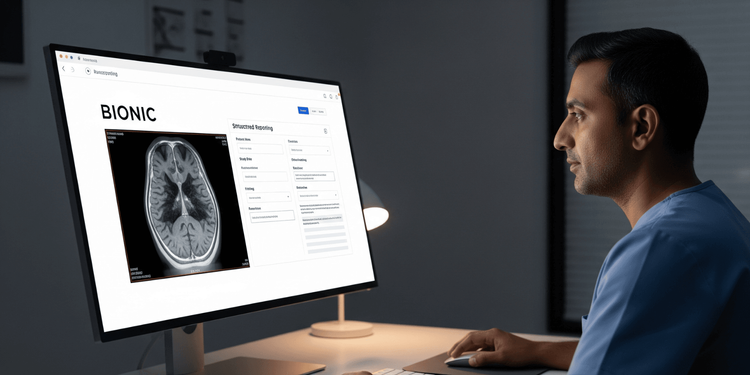
When Dr. Joshi opens the same stroke case in Bionic, the interface doesn't wait passively; it meets her halfway. A structured template appears automatically, shaped by the imaging modality, clinical question, and patient metadata. Sections highlight key areas: Hemorrhage? Early ischemia? Mass effect? Intracranial vessels? Each section acts as a cognitive cue not a rigid command but a gentle nudge guiding her thought process.
Cognitive Prompts and Flexible Input
As she dictates "Subtle hypodensity in the left insular cortex," the system prompts: "Would you like to include ASPECTS?" A dropdown appears with pre-filled zones based on her marked regions. She can type freely, speak into the microphone, or use shorthand that Bionic expands intelligently. The system adapts to her workflow rather than forcing workflow adaptation.
Auto-Generated Impression
The impression compiles automatically: "Findings consistent with early left MCA territory infarct. ASPECTS score: 8/10. No hemorrhage or mass effect. CTA shows tapering of left M2 branch. Suggest urgent neurology consult." Crisp, coherent, clinically useful—no cognitive ping-pong between dictation and memory.
The Language of Precision and Clarity
Traditional reports swing between extremes: overly dry ("No acute pathology seen") or cluttered with hedges ("Possibly representing early ischemic change?"). Bionic treats language as a tool for clarity rather than formality. It doesn't strip away uncertainty but teaches meaningful expression. "Likely" gets anchored in a clinical context. "Cannot exclude" is reserved for situations where it truly matters clinically.
Adaptive Learning
If Dr. Joshi describes vascular changes with specific terminology, Bionic absorbs and adapts. If she prefers bullet points in trauma cases and prose in stroke cases, the system learns her style. Over time, it becomes less a tool and more a partner, an editor with infinite patience that maintains her voice while ensuring structural clarity.
Reader-Focused Reports
Reports become technically sound, readable, scannable, and immediately useful for emergency physicians, neurologists, or junior residents needing to act fast. Bionic prioritizes the report reader, ensuring clinical utility alongside technical accuracy.
Does AI Help Radiologists Maintain Mental Clarity
Bionic's true gift isn't speed, though that improves. It's not even consistent, though that's transformative. It's mental clarity during the reporting process. Instead of starting from a blank page or generic template, radiologists begin with a scaffold built from clinical intention. The system holds space for nuance while gently preventing omissions.
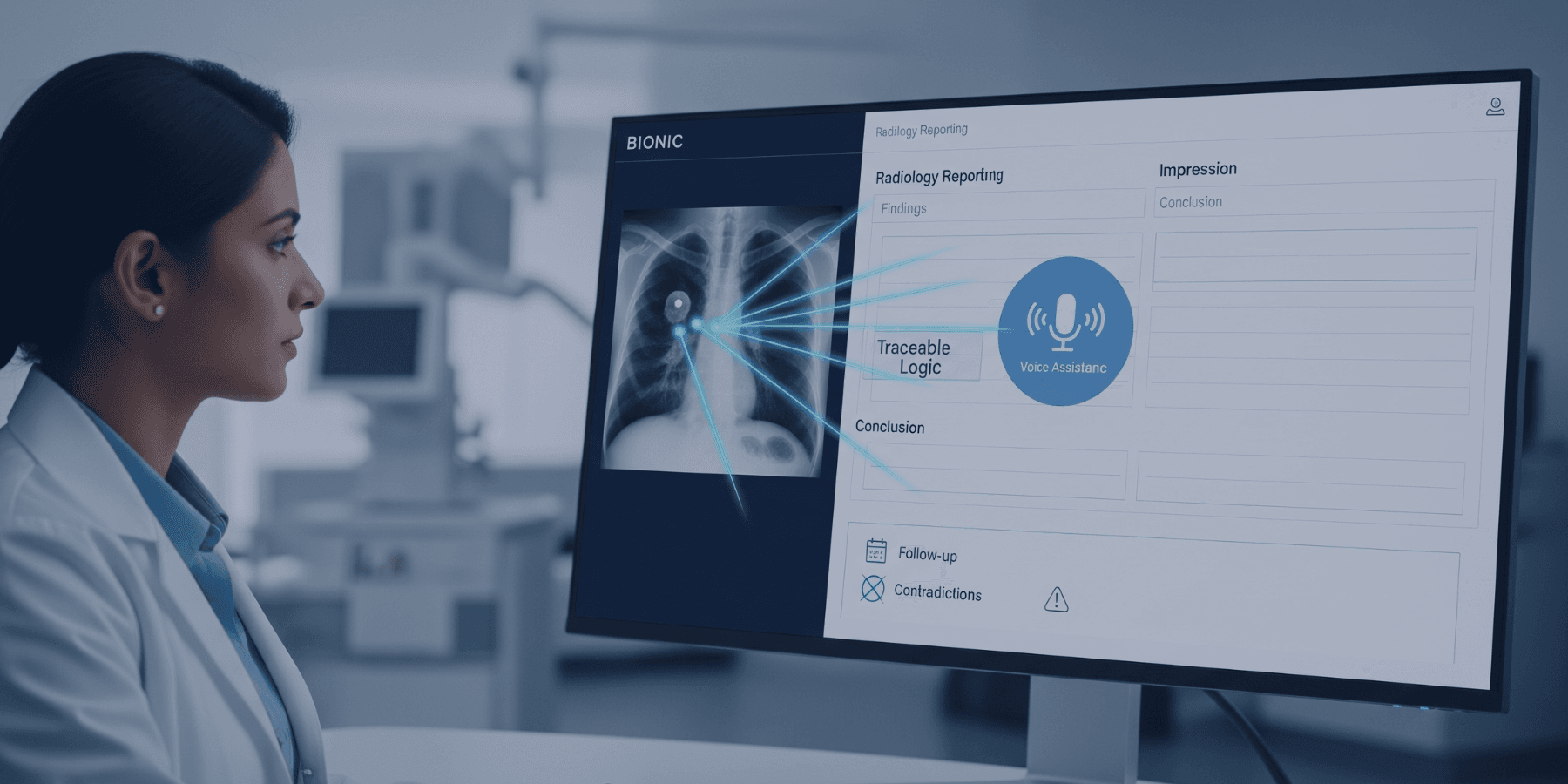
Bionic remembers follow-up recommendations, flags internal contradictions, and links impressions to findings with traceable logic. It removes the burden of remembering reporting rules so radiologists can focus on clinical judgment. This re-centers reporting as a craft—a thoughtful synthesis of what is seen, what is suspected, and what must be done clinically.
What is the Clinical Impact
Dr. Joshi finishes the stroke case in under four minutes. The neurologist calls back impressed by the clarity. The resident reads it and knows exactly what to do next. One report generates dozens of better clinical decisions downstream.
Radiology reports aren't just records, they're acts of patient care. They guide treatment decisions, shape therapies, and in acute conditions like stroke, can determine the difference between disability and recovery. A Bionic report isn't just faster or prettier, it's designed for meaning. For tired radiologists, overburdened clinicians, and patients whose outcomes depend on reporting clarity even though they never see these hidden medical documents.
What is Bionic AI in radiology
Bionic AI is an intelligent radiology reporting system that provides structured templates, cognitive prompts, and adaptive language tools to help radiologists create clearer, faster reports. It automatically generates organized sections based on the imaging modality and clinical question, guiding radiologists through the reporting process while learning their personal style. The system auto-compiles impressions, suggests relevant clinical scores (like ASPECTS for stroke), and ensures key findings aren't missed—all while maintaining the radiologist's voice.
How does Bionic AI improve radiology report quality
Bionic AI improves report quality by providing cognitive scaffolding that prevents omissions and inconsistencies. It prompts radiologists to include relevant clinical information (like ASPECTS scores in stroke cases), flags internal contradictions, and automatically links impressions to findings with clear logic. The system ensures reports are reader-focused—technically accurate yet scannable and immediately useful for emergency physicians, neurologists, and other clinicians who need to make quick treatment decisions. This structured approach reduces variability between radiologists while maintaining clinical nuance.
Read more about AI-Driven MRI Spine Pathology Detection