How to Set Up a Diagnostic Center or Hospital Radiology Department
Setting up a diagnostic center used to look like a real estate and equipment project. Find the location. Buy the machines. Hire the technicians. Arrange a radiologist. Start scanning.
That playbook is no longer enough.
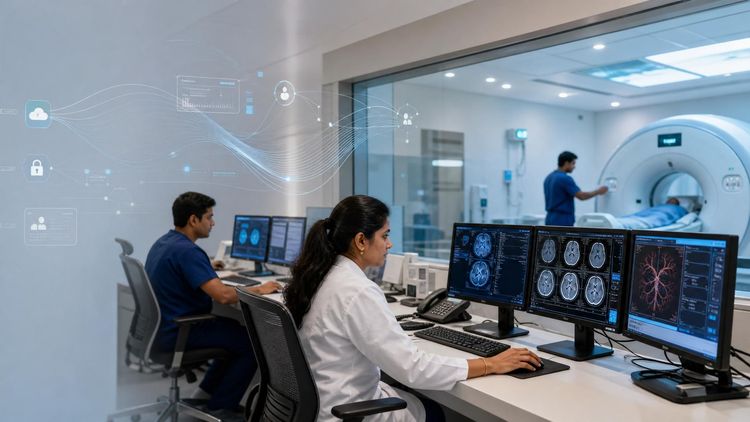
A modern diagnostic center, or a radiology department inside a hospital, is an operating system for clinical decisions. The machine is only one part of it. The real product is an accurate report, delivered fast enough to change care, with the right escalation when something is urgent.
That means the founder, hospital CEO, or department head has to think about reporting capacity, AI support, clinical governance, compliance, patient experience, and turnaround time from day one.
If you are planning a diagnostic center today and thinking about radiology reporting only after the scanner arrives, you are already late.
Start with the clinical promise, not the equipment list
Most new diagnostic projects begin with the wrong question: which CT, MRI, ultrasound, or X-ray machine should we buy?
That question matters. But it should come after a more important one: what kind of diagnostic promise are we making to patients and referring doctors?
Are you building a high-volume neighborhood diagnostic center that depends on fast reporting and predictable pricing? Are you building a hospital radiology department that must support emergency, inpatient, ICU, oncology, neurology, and surgical workflows? Are you building a premium imaging center where subspecialty interpretation is part of the brand? Are you trying to serve rural or semi-urban demand where local radiologist availability is limited?
Each model needs a different operating design.
The equipment plan, staffing plan, room design, IT stack, reporting support, and AI layer should all follow the clinical promise. A 24/7 emergency hospital cannot run radiology like a daytime outpatient center. A center doing advanced MRI cannot depend only on generalist reads. A chain planning to scale beyond one location cannot build workflows around WhatsApp, manual uploads, and ad hoc phone calls.
The first strategic decision is not which machine to buy. It is what level of speed, accuracy, availability, and specialist depth the center will be known for.
Build the physical foundation correctly
Once the clinical model is clear, the physical setup becomes easier to design.
A diagnostic center needs the obvious pieces: reception, billing, patient waiting, changing areas, modality rooms, reporting space, UPS and power backup, network connectivity, equipment access routes, storage, fire safety, biomedical waste processes, and patient movement that protects privacy and dignity.
But radiology has modality-specific requirements that cannot be treated casually.
For X-ray, CT, fluoroscopy, and mammography, radiation shielding, room layout, equipment commissioning, quality assurance, and statutory licensing are central to the project. In India, diagnostic X-ray facilities and institutions are required to obtain the necessary regulatory consents from AERB through e-LORA. AERB has also made it clear that unauthorized manufacture, supply, or use of medical diagnostic X-ray equipment can invite serious action, including sealing of facilities operating without statutory license.
For ultrasound, especially obstetric ultrasound, PC-PNDT compliance is not optional paperwork. Registration, record keeping, display requirements, doctor linkage, and renewal discipline have to be built into operations from the beginning. For MRI, the risks are different: magnetic safety, zoning, screening protocols, implant checks, emergency procedures, and staff training become critical.
This is where many projects lose time. They treat compliance as a final approval step. It is not. It is a design input.
Choose equipment for workflow, not prestige
Equipment decisions should be made with a hard operational lens.
A center does not need the most expensive machine in every category. It needs the right machine for its case mix, expected volumes, local referral base, staffing capability, maintenance environment, and reporting model.
For X-ray and ultrasound, throughput, reliability, image quality, service uptime, and technician familiarity often matter more than headline specifications. For CT, the choice depends heavily on emergency needs, cardiac ambitions, contrast workflows, dose optimization, and the expected mix of trauma, oncology, chest, abdomen, and neuro cases. For MRI, the decision between 1.5T and 3T is not only a marketing decision. It affects cost, siting, protocols, scan time, patient comfort, specialist reading requirements, and referral positioning.
The mistake is buying for brochure value and then discovering that the center cannot run the machine efficiently.
Equipment should be evaluated together with service contracts, uptime guarantees, applications training, protocol support, spare part availability, power requirements, room readiness, and integration with PACS/RIS. A scanner that produces great images but creates operational bottlenecks is not a good business decision.
The better question is: what machine helps us deliver the reports our market needs, at the speed and quality we are promising, with economics that still work after maintenance, staffing, downtime, and financing are included?
Design the reporting model before the first scan
This is the part that separates good diagnostic centers from expensive rooms full of machines.
Radiology is not complete when the scan is acquired. It is complete when the right clinician receives the right report at the right time and knows what to do next.
That requires a reporting architecture.
You need to decide which studies will be read in-house, which will be routed to a teleradiology partner, which require subspecialty reads, how emergency cases will be prioritized, who handles night coverage, how critical findings are escalated, how discrepancies are reviewed, and how referring doctors can ask clinically meaningful questions.
For a standalone center, this often determines whether the business works. If reports are slow, referring doctors lose confidence. If complex cases are read by the wrong person, quality suffers. If the center depends on one local radiologist, growth becomes fragile. If there is no night or weekend coverage, hospital partnerships become difficult.
For a hospital department, the stakes are even higher. Emergency, ICU, stroke, trauma, oncology, and surgical decision-making all depend on radiology reliability. A report delayed by six hours is not just an operational inconvenience. It changes patient flow, bed utilization, physician trust, and sometimes outcomes.
This is why reading support should not be a backup plan. It should be part of the original design.
A modern diagnostic center should launch with reporting redundancy, subspecialty access, emergency escalation, and AI-assisted prioritization already in place.
Make AI part of the workflow, not a marketing sticker
Every new diagnostic center will be asked whether it uses AI.
That is the easy question. The harder question is where AI actually sits in the workflow.
AI can help prioritize urgent scans. It can flag suspected intracranial bleeds, strokes, pneumothorax, fractures, chest findings, and other time-sensitive abnormalities depending on the modality and model. It can support structured reporting. It can reduce misses by acting as a second layer of review. It can help route studies to the right radiologist. It can help operations teams monitor turnaround time, backlog, and quality.
But AI is useful only when it is connected to the real radiology workflow.
If AI is a separate dashboard that someone checks when they remember, it will not change much. If it produces alerts that are not tied to escalation protocols, it may create noise. If nobody owns quality governance, AI can give false confidence. If the PACS, RIS, reporting system, and radiologist workflow are not integrated, AI becomes another isolated tool.
AI should be treated like infrastructure. It should help the center answer urgent operational questions in real time.
Which studies need attention first? Which cases need subspecialty routing? Which reports are breaching TAT? Which findings require immediate communication? Which radiologists are best suited for this case type? Which errors or discrepancies need review?
That is the difference between AI as a feature and AI as an operating advantage.
Do not underestimate the IT layer
The IT stack of a diagnostic center is not back-office plumbing. It is the nervous system.
At minimum, a serious radiology setup needs PACS for image storage and viewing, RIS or workflow software for scheduling and reporting operations, DICOM connectivity from modalities, secure report distribution, patient and referring doctor access, backup and disaster recovery, role-based access control, audit trails, and strong cybersecurity discipline.
For hospitals, integration with HIS/EMR, billing, order entry, and clinical communication is critical. For diagnostic chains, multi-site worklists, centralized reporting, analytics, and standard operating protocols become important early. For centers using external reporting support, image transfer must be secure, fast, and reliable.
The worst version of this is a center that buys modern machines but runs operations on manual uploads, shared passwords, local hard drives, and scattered communication channels. That may work for a few weeks. It does not scale, and it is not safe.
Radiology IT should be selected for interoperability, uptime, security, and workflow depth. The center should know how images move, how reports move, how access is controlled, how failures are handled, and how data is backed up.
In a world where AI and remote reporting are becoming core to radiology, closed systems are a strategic liability.
Staff for reliability, not just presence
A diagnostic center needs radiologists, technicians, nurses, front desk teams, center managers, biomedical support, IT support, and compliance ownership. But the real question is not whether the roles exist on paper. It is whether the system is reliable when volume rises, someone is on leave, a machine goes down, or an emergency scan arrives at night.
Technicians need protocol discipline, patient handling skills, contrast safety training where relevant, image quality awareness, and escalation habits. Front desk teams need to manage appointment flow, report expectations, prior studies, patient anxiety, and referring doctor communication. Center managers need to watch utilization, TAT, cancellations, downtime, repeat scans, consumables, cash collection, and patient complaints.
Radiologists need the right work environment. That includes good image quality, complete clinical history, prior studies, structured workflows, critical alert pathways, and the ability to escalate complex cases.
Many centers think they have a staffing problem when they actually have a workflow design problem. Good people cannot compensate forever for broken routing, poor clinical information, weak systems, and no reporting redundancy.
Build the business model around trust
The economics of a diagnostic center are unforgiving.
Rent, equipment financing, maintenance contracts, staff salaries, electricity, consumables, marketing, compliance, software, and reporting costs all arrive before the center has built referral trust. The instinct is often to reduce cost wherever possible.
That is understandable. But cutting corners on reporting quality, turnaround time, compliance, or IT reliability damages the very thing the business depends on: trust.
Doctors refer to centers that make them look good in front of patients. Patients return to centers that feel organized, clean, respectful, and fast. Hospitals partner with centers that are dependable under pressure. Insurers and corporate accounts prefer centers that can document quality and consistency.
The business model should therefore be designed around trust metrics: report TAT, repeat scan rates, critical alert closure, discrepancy review, patient wait time, machine uptime, referring doctor satisfaction, and report clarity.
Price matters. Location matters. Branding matters. But in diagnostics, trust compounds.
Where 5C fits into the setup decision
If you are setting up a diagnostic center or hospital radiology department today, 5C should be part of the conversation before launch.
Not because every center needs to outsource everything.
Because every center needs a serious answer to reporting capacity, AI support, subspecialty access, turnaround time, emergency coverage, and quality governance.
5C Network is built for exactly that operating problem. We help diagnostic centers and hospitals connect their imaging workflows to a large radiologist network, AI-supported prioritization, faster turnaround, subspecialty depth, and scalable reporting operations. For a new center, that can mean launching with credibility from day one instead of waiting months to build local reporting capacity. For a hospital, it can mean strengthening radiology coverage without carrying the full burden of 24/7 specialist availability internally.
The strategic point is simple: do not build the center first and solve reporting later. Build reporting, AI support, and quality assurance into the original architecture.
The setup checklist that actually matters
Here is the practical way to think about the project.
Clinical model. Define the patient segments, referral sources, modalities, emergency expectations, specialist requirements, and turnaround promise before finalizing equipment.
Compliance and safety. Plan AERB, PC-PNDT, local clinical establishment requirements, radiation safety, MRI safety, biomedical waste, fire safety, documentation, and staff training as design requirements, not last-mile approvals.
Equipment and facility design. Choose machines, rooms, shielding, power, HVAC, network, access routes, patient flow, and service contracts around expected volume and uptime needs.
IT and interoperability. Put PACS, RIS/workflow, DICOM routing, secure report delivery, backup, cybersecurity, and hospital or partner integrations in place before launch.
Reporting architecture. Decide in-house coverage, teleradiology support, night coverage, emergency escalation, subspecialty routing, quality review, and referring doctor communication.
AI support. Use AI where it changes workflow: triage, prioritization, routing, quality review, reporting support, operational monitoring, and critical alerting.
Operating metrics. Track TAT, scan volume, utilization, downtime, report corrections, critical findings, patient wait time, referral conversion, and repeat visits from the first month.
Bottom line
A diagnostic center is not a machine business. It is a clinical reliability business.
The centers that win over the next decade will not be the ones that simply buy the newest scanner or advertise the lowest price. They will be the ones that combine good equipment, disciplined operations, strong compliance, modern IT, AI-enabled workflows, reliable radiology reporting, and measurable quality.
If you are setting up a diagnostic center or radiology department, make one decision early: do not treat reporting and AI as add-ons.
Make them part of the foundation.
That is how you build a diagnostic center that doctors trust, patients recommend, and hospitals can depend on.