Why Do Most Radiology AI Startups Fail After Deployment
What Is Happening in the Radiology AI Market
The radiology AI market reached $1.8 billion in 2023, with venture capital investing billions into companies promising to revolutionize medical imaging. Yet for every success story, dozens of well-funded startups with impressive FDA clearances quietly disappear from hospital systems, their algorithms unused in software suites.
The pattern repeats consistently: promising pilots, successful regulatory approval, initial customer excitement, then gradual abandonment. Understanding why requires looking beyond technology to the fundamental misalignment between what founders build and what healthcare systems actually need.
Why AI That Performs Well in Demos Often Falls Short in Real Clinical Practice
Companies emerge with compelling demonstrations showing AI outperforming radiologists on specific tasks—detecting lung nodules, identifying fractures, or flagging stroke indicators. These capabilities generate impressive academic papers and attract significant funding rounds.
The narrative is compelling: radiologists face overwhelming workloads, imaging volumes grow 4-6% annually, and burnout rates exceed 50%. AI promises to solve workforce shortages while improving diagnostic accuracy. Investors see a massive underserved market with clear technical solutions.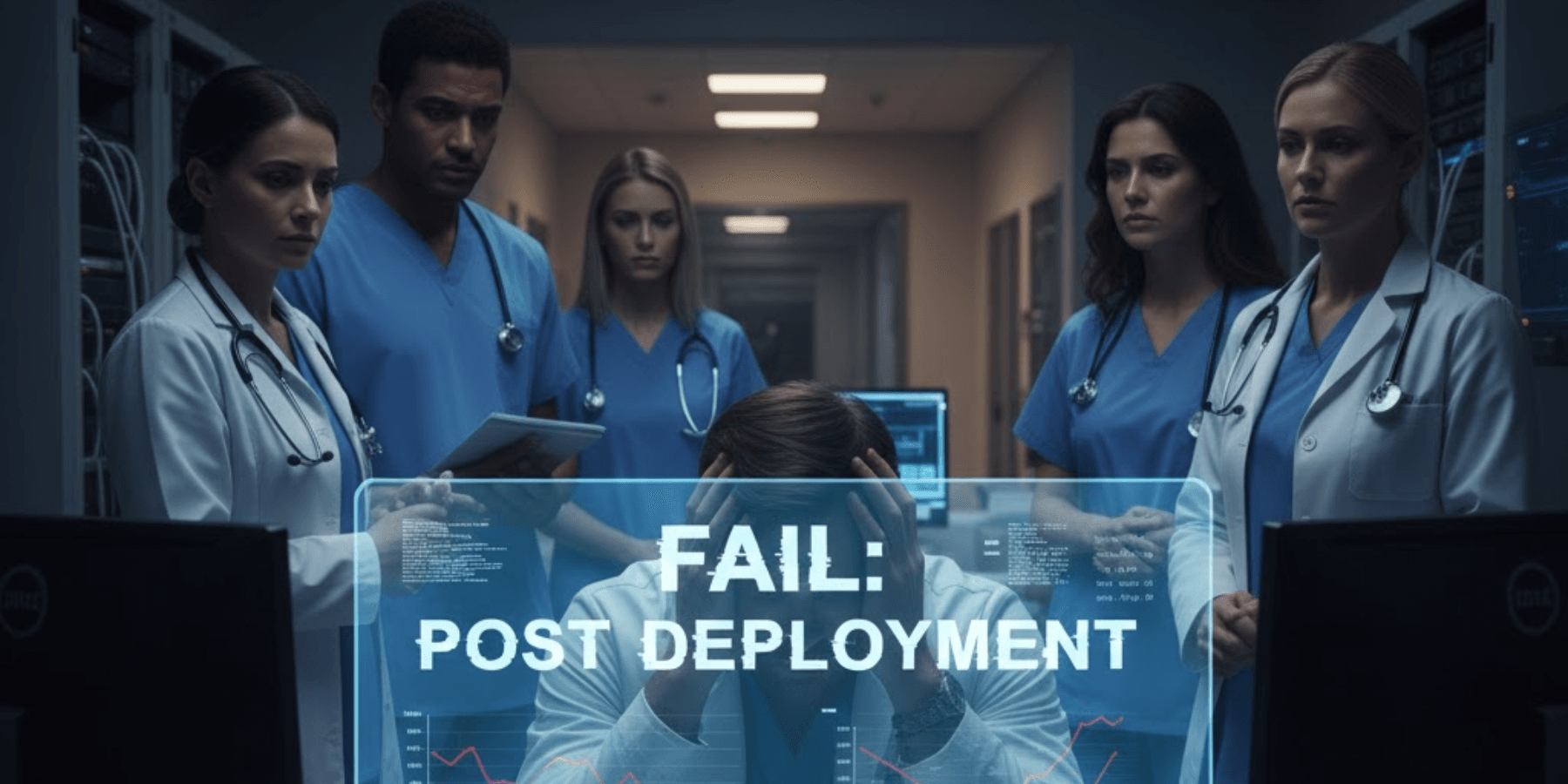
The Fundamental Misunderstanding
This framing fundamentally misunderstands the problem. Radiology isn't a collection of isolated detection tasks—it's an integrated workflow where diagnostic value emerges from synthesizing findings across multiple imaging modalities, clinical context, and patient history.
Most AI companies optimize for sensitivity and specificity metrics that sound impressive in pitch decks but create friction in real-world workflows. A 95% sensitivity rate means little if the algorithm generates alerts radiologists must constantly investigate and dismiss.
What Is the FDA-First Problem
The regulatory-first approach dominating radiology AI creates perverse incentive structures. Companies spend 18-24 months and millions of dollars optimizing algorithms for FDA submission, focusing on narrow use cases with clean datasets and clear endpoints.
This regulatory tunnel vision produces tools that work well in controlled environments but fail in clinical reality. A chest X-ray algorithm trained on perfect PA and lateral views struggles with portable ICU images. A mammography AI optimized for screening populations generates false positives when applied to diagnostic workups.
Does FDA Clearance Guarantee Clinical Success
FDA clearance validates safety and efficacy for specific indications, not whether tools integrate meaningfully into existing workflows or address genuine clinical pain points. Many companies discover post-deployment that their carefully validated algorithms solve problems radiologists didn't actually have.
A tool flagging incidental pulmonary nodules might be clinically accurate but operationally useless if it doesn't integrate with follow-up scheduling systems or provide actionable next steps.
What Prevents Radiology AI from Scaling
Workflow Fragmentation
Most AI tools operate as point solutions, requiring radiologists to context-switch between multiple interfaces. A typical reading session involves the PACS viewer, AI tool, dictation system, and EMR. Each transition breaks cognitive flow and adds friction to already time-pressured processes.
Radiologists don't want another application to open—they want intelligence embedded seamlessly into their existing workflow where they already spend their time.
False Positive Burden
Algorithms optimized for high sensitivity generate alerts radiologists must investigate and dismiss. When AI flags 15% of studies for findings proving clinically insignificant, it creates work rather than eliminating it.
The cognitive overhead of constantly evaluating AI suggestions often exceeds any time savings from automated detection. Radiologists become alert-fatigued, eventually ignoring or disabling systems that cry wolf too frequently.
Implementation Complexity
Healthcare IT environments are notoriously fragmented. Getting AI tools to work reliably across different PACS systems, hanging protocols, and display configurations requires extensive customization.
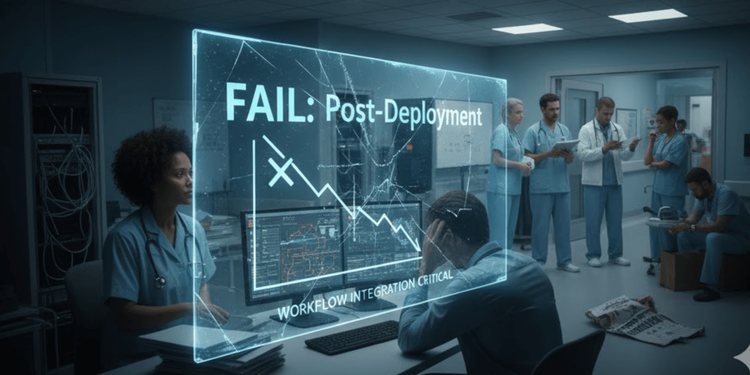
Many promising pilots fail during full deployment when edge cases and system incompatibilities emerge. What worked perfectly in the vendor demonstration room fails mysteriously in production environments with real patient data and legacy system constraints.
What Do Successful Radiology AI Companies Do Differently
Companies achieving sustained adoption take different approaches, building comprehensive workflow solutions rather than standalone detection tools.
Workflow Integration Over Point Solutions
Instead of requiring radiologists to use separate AI tools, successful technology becomes invisible infrastructure enhancing existing processes. AI-generated insights appear contextually within familiar interfaces, eliminating workflow disruption.
BionicLM exemplifies this approach by integrating AI capabilities directly into reporting workflows rather than creating additional applications radiologists must remember to check.
Multi-Modal Intelligence
Rather than optimizing for specific detection tasks, successful platforms synthesize information across imaging modalities, clinical data, and historical studies. This holistic approach mirrors how radiologists actually think about cases.
A brain MRI algorithm that considers only current imaging misses critical context. Systems that incorporate prior studies, clinical indication, and patient history provide more clinically useful insights.
Adaptive Learning Systems
The most effective systems continuously learn from user behavior and feedback, becoming more useful over time rather than remaining static post-deployment. This creates positive feedback loops increasing adoption rather than negative spirals common with rigid AI tools.
When radiologists dismiss false positives, adaptive systems learn from those corrections, reducing future alert fatigue and improving clinical utility.
What Should Founders Building Radiology AI Know
Start with workflow, not algorithms. Spend time in reading rooms understanding actual problems radiologists face before building solutions. Regulatory approval is necessary but not sufficient—focus on demonstrating clinical utility and workflow efficiency from day one.
Talk to radiologists during their shifts, not in conference rooms. Watch how they interact with systems, where they get frustrated, what slows them down. The insights from observational workflow studies are more valuable than feature requests collected in surveys.
Build minimum viable products that solve real workflow problems, even if the AI component is initially simple. A tool that saves radiologists 30 seconds per case through better workflow will get adopted faster than technically sophisticated algorithms requiring 2 minutes of additional interaction time.
What Should Clinicians Evaluating AI Tools Consider
Evaluate AI tools based on impact on daily work, not technical specifications. Ask pointed questions about workflow integration, false positive rates, and long-term support during vendor evaluations.
What Questions Should You Ask AI Radiology Vendors?
Workflow Integration: "How many additional clicks or screen switches does using this tool require compared to my current workflow?"
False Positive Rates:"What percentage of alerts will I investigate that turn out to be clinically insignificant? How does the system adapt when I dismiss alerts?"
Implementation Support: "What happens when the system doesn't work with our specific PACS configuration? Who troubleshoots integration issues?"
Long-Term Viability: "How many active users do you have? What's your customer retention rate? Can I speak with radiologists who've used this for over a year?"
What Should Product Leaders Focus On
Build for the system, not the individual user. Healthcare technology succeeds when it makes the entire care team more efficient, not just the primary user. Consider how tools affect technologists, referring physicians, and administrative staff.
An AI tool that saves radiologists time but creates more work for technologists positioning patients or more confusion for referring physicians interpreting reports will ultimately fail regardless of algorithmic performance.
Think Beyond the Radiologist
For Technologists: Does the AI provide feedback on image quality that helps technologists capture better studies the first time?
For Referring Physicians: Does the AI help radiologists communicate findings more clearly, reducing callback requests for clarification?
For Administrators: Does the AI provide operational insights about workflow bottlenecks and quality metrics that help optimize department performance?
What Is the Future of Radiology AI
The radiology AI market remains massive and underserved, but success requires moving beyond the detection-first mindset dominating first-generation companies. The future belongs to platforms making radiologists more effective, not tools trying to replace their judgment.
Companies surviving the current shakeout will solve real workflow problems rather than impressive technical challenges. This requires deep healthcare domain expertise, iterative product development, and fundamental understanding that healthcare technology adoption depends more on organizational change management than algorithmic performance.
The Shift from Detection to Integration
First-generation radiology AI focused on "Can we detect X?" Second-generation focuses on "How do we make detecting X part of a seamless workflow that improves overall radiologist efficiency?"
This shift represents maturation from research projects to clinical products—from proving technical feasibility to delivering sustained value in production environments.
About Workflow-Integrated AI by 5C Network
5C Network builds radiology AI that integrates directly into clinical workflows rather than operating as standalone point solutions. BionicLM provides AI capabilities within existing reporting processes, eliminating context-switching and workflow disruption that plague traditional AI tools.
The platform synthesizes multi-modal intelligence, adapts continuously from user feedback, and demonstrates measurable workflow efficiency improvements alongside diagnostic accuracy gains.
Read What Is Digital Diagnostics Delivery and How Does It Differ from Teleradiology