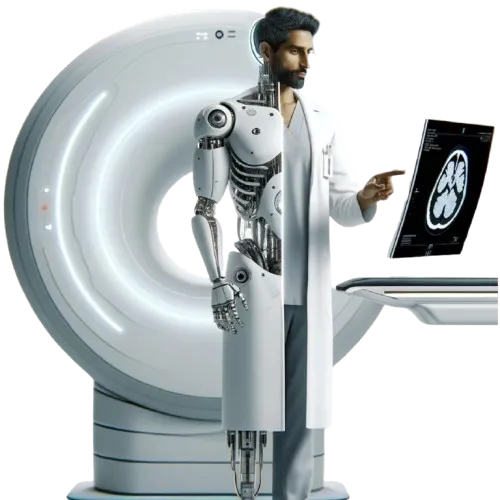
Hospitals Should Choose AI-First Vendors, Not Vendors AI Will Replace

Hospitals should stop asking only whether a vendor works today. They should ask whether that vendor becomes stronger as AI gets better, or whether AI removes the reason that vendor exists.
The market is about to split in two
Over the next 12 to 24 months, healthcare vendors will increasingly fall into two groups.
The first group is AI-first. These companies are built so that better models make their product better, faster, cheaper, and harder to displace. Their economics improve as automation improves. Their workflows get tighter. Their turnaround times come down. Their quality systems become stronger because more of the process is measured, audited, and improved inside software.
The second group looks stable today, but much of their value comes from work that better models will soon compress. They may still have revenue. They may still have customers. They may still deliver acceptable outcomes right now. But their margins, delivery model, and product story depend on bottlenecks that AI is likely to remove.
Hospitals should be very careful about building strategic workflows on top of vendors whose core value is being compressed by AI.
Buying for the next three years is not the same as buying for today
Healthcare procurement often treats technology as a snapshot. A hospital compares vendor A and vendor B based on current demos, current pricing, and current references. That approach made sense when software improved slowly.
It makes far less sense in an AI market where product capability can change materially in a few quarters.
If a hospital signs a two or three year agreement today, it is not just buying what the vendor can do this month. It is buying the vendor's future position in the market. It is buying whether that company will become more central to the workflow or more disposable as foundation models improve.
That is why this moment is different. The risk is not just choosing the wrong product. The risk is choosing a vendor whose category itself is weakening.
What an AI-first vendor looks like
An AI-first vendor is not simply a company with an AI feature on its homepage. It is a company whose operating model is built around the assumption that models will keep getting better.
It lives inside workflow. In healthcare, workflow matters more than demos. A vendor that lives inside the system of record, the diagnostic workflow, the reporting loop, or the quality process has a much better chance of surviving model shifts than a vendor that only adds surface-level analysis.
It gets better as automation gets better. Better models should lower delivery cost, shorten turnaround times, reduce repetitive manual work, and increase consistency. If model improvement creates disruption instead of leverage, that is a warning sign.
It has proprietary context. General models will become more capable, but domain-specific data, quality controls, integration depth, and deployment muscle will still matter. AI-first vendors build moats around those layers.
It uses people where judgment matters most. The best AI-first companies do not pretend humans disappear. They design systems where humans handle exceptions, governance, escalation, and quality review, while software absorbs routine work at scale.
What hospitals should avoid
Hospitals should be cautious with vendors whose value comes mostly from packaging work that AI is quickly learning to do.
That includes vendors whose workflow is still heavily manual behind the scenes, vendors whose product is mostly a thin interface on top of human operations, and vendors whose economics depend on tasks that are moving toward automation.
It also includes point solutions that are not deeply integrated into hospital workflow. A narrow tool may still look useful in isolation, but if it does not sit inside a larger system of action, it can become one more replaceable layer as broader platforms get stronger.
The danger here is not that these vendors are fraudulent. Many are good companies built for a previous market reality. The problem is that hospitals do not have the luxury of buying for a previous market reality.
The procurement question that matters most
When evaluating any AI-related vendor, hospitals should ask one simple question.
If AI capabilities improve dramatically over the next 12 months, does this vendor become more valuable to us, or less necessary?
That question is much more revealing than asking whether the vendor has AI on their roadmap.
A strong answer will explain why better models make the vendor's workflow tighter, their quality better, their cost structure stronger, and their integration more valuable.
A weak answer will rely on brand, services, headcount, or the claim that healthcare changes slowly. Healthcare does move carefully, but that does not protect vendors whose core value is being automated.
How hospitals should evaluate vendors now
Hospitals should begin treating AI readiness as a strategic procurement filter. A good evaluation process should ask:
What part of the workflow improves automatically as models improve? If the answer is vague, the vendor is probably adding AI at the surface, not at the core.
What part of the cost structure still depends on manual work? Hospitals should understand whether margins come from software leverage or from hidden human labor that may soon be compressed.
What data, feedback loops, and quality controls make the system better over time? A vendor with real deployment depth should be able to explain how its product learns from operations, not just from model releases.
How deeply is the product integrated into clinical operations? The more central the workflow position, the harder the vendor is to replace and the more value the hospital gets as the system improves.
What happens if commodity models get much stronger next year? This is the real stress test. The goal is not to predict the future perfectly. The goal is to avoid locking the institution into partnerships that become weaker as the technology curve accelerates.
The bottom line
Hospitals do not buy software for novelty. They buy reliability, accountability, workflow continuity, and measurable improvement in patient care.
That is exactly why AI-first vendors matter. If a vendor is aligned with the direction of the technology curve, the hospital gets a partner that should deliver better performance over time. If the vendor is misaligned with that curve, the hospital inherits future migration risk, operational churn, and strategic dead weight.
This is not only a technology decision. It is a capital allocation decision.
Hospitals should work with vendors that are building the future operating layer of healthcare, not vendors whose main function will be absorbed by that future.
The winners will not just be the vendors with AI features. They will be the vendors whose products, margins, and workflows become stronger as AI improves.