The category, defined
Bionic
Radiology
AI runs the workflow. Radiologists own the diagnosis. One system, priced per answer — not per hour, seat, or retainer.
What is Bionic Radiology?
Definition
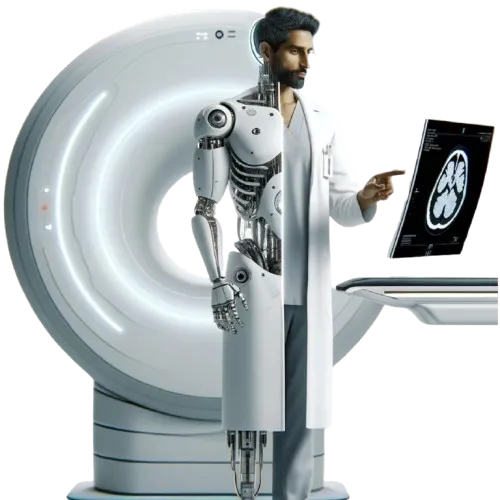
Bionic Radiology is a model of radiology practice in which AI systems run the diagnostic workflow end to end — triage, detection, drafting, and quality control — while board-certified radiologists supervise, correct, and sign every report. Neither the machine nor the human works alone: the AI makes the radiologist faster and more consistent, and the radiologist makes the AI safe and accountable. It is priced per signed report, not per seat, per hour, or per retainer.
"Bionic" means a human ability extended by technology — not replaced by it. A bionic limb doesn't make the athlete unnecessary; it makes the athlete faster. Bionic Radiology applies the same idea to diagnosis: the radiologist's judgment stays at the centre, and everything around that judgment — triage, detection, drafting, quality control — is run by machines that never tire and never skip a step.
The category exists because its two predecessors each solved half the problem. Teleradiology moved images to wherever radiologists were, but left the work itself unchanged — a human still did everything, just remotely. Radiology AI point tools automated fragments of the work, but shipped as software the hospital had to deploy, tune, and staff around, with no one accountable for the final read. Bionic Radiology fuses both halves into one accountable system that delivers a finished, signed answer.
5C Network coined the term and operates the model at national scale: 20,000+ studies a day for 2,000+ Indian healthcare facilities, each one AI-processed and radiologist-signed in about 30 minutes.
The full stack
Not a tool. Not a service. A stack.
Three layers, inseparable by design. Remove any one and it stops being Bionic Radiology — it becomes either unsupervised AI or unassisted humans.
The AI Engine
Bionic
- Vision reads the pixels — hundreds of pathologies flagged in 10–20 seconds
- Voice turns dictation into structured, ready-to-sign reports
- Trained on 4B+ clinical images — the world’s largest annotated repository
Runs the workflow. →
The Radiologist Network
400+ specialists
- Board-certified, NMC-registered radiologists across sub-specialties
- Every report reviewed, corrected where needed, and signed by a named specialist
- Diagnostic responsibility always sits with a human
Owns the diagnosis. →
Supervisory Intelligence
Bionic LM
- A second AI validates every report before it ships — 96.7% QC accuracy
- Fewer than 2% of studies need escalation
- Every correction feeds back into the models — the system compounds
Keeps both honest. →
The three layers run as one loop on the 5C platform — every corrected report makes the next read better.
The economics
You pay for answers. Nothing else.
Outcome pricing isn't a billing detail — it's the honest consequence of the model. When AI does the mechanical work, selling hours would mean selling something the machine already removed.
The old model
- Monthly retainers whether scans happen or not
- Per-seat software licences for AI tools someone still has to operate
- Hourly reading fees that reward slowness
- 24–48 hour turnarounds as the accepted standard
Bionic Radiology
- Pay per signed report — no retainers, no minimums
- The AI, the radiologists, and the QA layer arrive as one system
- Signed reports in ~30 minutes, 24/7, weekends included
- The provider earns only when a diagnosis is delivered
The journey
A decade of building the category
-
2016
The 48-hour wait
A family member of co-founder Syed S Ahmed waits two days for an MRI diagnosis — not because the scan was complex, but because no radiologist was available. The gap between imaging capacity and radiology expertise becomes impossible to ignore.
-
2017
5C Network founded
Kalyan Sivasailam and Syed S Ahmed found 5C in Bangalore to close that gap — the beginning of what would become Bionic Radiology.
-
2018
Seed funding
Unitus Ventures backs the thesis: radiology needs infrastructure, not another point tool.
-
2021
Pre-Series A
$5.4M from Celesta Capital, Capria Ventures and SNS Redwood to scale the network and the data engine.
-
2022
Bionic launches
The AI engine ships: Vision that sees, Voice that writes, a language model that validates. The stack that defines the category is complete.
-
2023
Series A — Tata 1mg
Series A led by Tata 1mg with Celesta Capital brings total funding to $12.1M. India’s largest digital-health platform bets on the model.
-
2024
The category at scale
2,000+ healthcare facilities. 20,000+ scans a day. 20M+ studies reported. Bionic Radiology stops being a thesis and becomes how a meaningful share of India gets diagnosed.
-
2035
The mission
Diagnose 10% of the world's radiology scans by 2035. Every scan read. No patient left waiting.
The humans in the loop
Bionic Radiology only works because named specialists stand behind every report. Meet some of the 400+ NMC-registered radiologists on the 5C panel.

Dr. Satyanarayan
MBBS, DMRD

Dr. C.M.
MBBS, DNB, DMRD

Dr. Kiranmai
MBBS, DNB, EDIR
Part of the 400+ board-certified, NMC-registered radiologist panel reporting for 5C Network across X-ray, CT, MRI, and Mammography.
Go deeper into the category
Frequently asked questions
What is Bionic Radiology?
Bionic Radiology is a model of radiology practice where AI runs the diagnostic workflow — triage, pathology detection, report drafting, and quality control — and board-certified radiologists supervise and sign every report. The term combines "bionic" (human ability extended by technology) with radiology: not AI replacing radiologists, and not radiologists working unaided, but one system where both work as one. 5C Network coined and operates this model at scale in India.
How is Bionic Radiology different from teleradiology?
Teleradiology moves images to distant radiologists; the reading work itself is unchanged. Bionic Radiology changes the work: AI prioritizes the worklist, pre-reads the study, drafts the structured report, and quality-checks the output, so the radiologist applies judgment instead of doing mechanical work. That is why a Bionic Radiology report is signed in about 30 minutes, against an industry standard of 24–48 hours.
How is Bionic Radiology different from radiology AI software?
Radiology AI software is a tool a hospital must buy, deploy, and staff around — and a point-detection algorithm only flags findings. Bionic Radiology is a full-stack service: the AI engine, the radiologist network, and the supervisory quality layer arrive as one system, and the hospital receives a finished, signed diagnostic report. You buy the outcome, not the tooling.
Who signs the reports in Bionic Radiology?
A board-certified, NMC-registered radiologist signs every report — always. AI in the Bionic Radiology model drafts, flags, and quality-checks, but diagnostic responsibility sits with a named human specialist. 5C Network operates a panel of 400+ such radiologists across sub-specialties.
How is Bionic Radiology priced?
Per signed report. There are no retainers, no per-seat software licences, and no minimum volumes. This outcome-based pricing is core to the model: the provider is paid only when a diagnosis is delivered, which aligns the economics with the hospital and the patient rather than with billable time.
Is Bionic Radiology safe and clinically accountable?
Yes — accountability is the reason the model has a human layer. Every AI output passes a supervisory quality check (Bionic LM validates reports at 96.7% QC accuracy), fewer than 2% of studies need escalation, and a registered radiologist signs each report and carries diagnostic responsibility for it. The AI is audited continuously against 4B+ clinical images and real-world feedback from every corrected report.
See Bionic Radiology read your scans.
Signed reports in 30 minutes, priced per answer. Onboarding takes days, not months.
Book a demo