5C Is Building the Trust System for Radiology AI
Radiology AI will not become clinical infrastructure simply because models get better. It will become clinical infrastructure only when hospitals can trust it on their own patients, inside their own workflows, under the authority of radiologists who understand both the technology and the consequences of getting it wrong.
That is the real work ahead.
It is easy to say that 5C is using AI in radiology. That is true, but it is too small a description of what is happening. Every serious healthcare company will use AI. Every RIS, PACS, reporting platform, teleradiology network, diagnostic chain, and hospital software vendor will add AI features. There will be AI triage, AI measurements, AI draft reports, AI follow-up suggestions, AI worklists, AI protocoling, and AI quality checks.
Using AI will not be the differentiator.
The differentiator will be trust.
The central question for radiology is not, "Can an AI model identify an abnormality in a benchmark dataset?" The harder question is: "Can a hospital safely use AI on its own cases, with its own scanners, protocols, patient mix, reporting language, clinicians, medicolegal environment, and quality expectations?"
That question is not answered by a demo. It is answered by infrastructure.
The first mistake is treating AI as a feature
Most conversations about AI in radiology still begin with the model. What can it detect? What is its sensitivity? What is its specificity? How fast is it? How well does it perform on a leaderboard?
Those questions matter. But they are only the beginning.
In real radiology, a model is never used in isolation. It sits inside a clinical system. The images come from different machines. The quality of the study varies. Priors may or may not be available. The clinical history may be incomplete. The referring doctor may be asking the wrong question. The finding may be technically correct but clinically irrelevant. The report may be accurate but poorly communicated. The follow-up recommendation may be safe for one patient and excessive for another.
Radiology is not just image recognition. It is clinical interpretation under uncertainty.
That is why a model by itself cannot create trust. A model can produce an output. A trust system has to answer a larger set of questions.
Can this AI be validated on local data? Can its output be audited? Can a radiologist challenge it? Can the system learn from corrections? Can performance be monitored over time? Can results be integrated into the reporting workflow without adding friction? Can hospitals understand when the AI is useful, when it is weak, and when it should not be used?
If the answer to these questions is unclear, AI remains a tool. It does not become infrastructure.
The future of radiology AI will not be won by the company with the most impressive demo. It will be won by the system that hospitals can trust enough to put into clinical flow.
Trust is not a feeling. It is a workflow.
In healthcare, trust cannot be built by confidence alone. It has to be engineered.
A hospital cannot adopt AI simply because the model looked good in a sales presentation. A radiologist cannot sign off on a report simply because the AI sounded certain. A clinician cannot change management simply because a software layer highlighted a finding.
Trust in clinical AI has to be visible, repeatable, and accountable.
That means the system must support validation before deployment, monitoring after deployment, audit trails when something changes, radiologist oversight at the point of care, and feedback loops that make the system better over time.
This is especially important in radiology because imaging is deeply local. The same AI model may behave differently across scanner types, acquisition protocols, disease prevalence, patient demographics, study quality, reporting conventions, and referral patterns. A model trained or validated in one environment cannot automatically be assumed to be safe in another.
Hospitals need a way to test AI on their own data before trusting it. They need to know where it performs well, where it fails, and what guardrails are required. They need to see the AI inside the same workflow where radiologists actually read, report, correct, communicate, and take responsibility.
That is the missing layer.
The industry has produced many AI models. It has produced far fewer systems that help hospitals turn those models into dependable clinical operations.
What 5C is really building
5C is not just adding AI to radiology. 5C is building the trust system that lets radiology AI become real clinical infrastructure.
That system has four parts.
First, clinical workflow. AI has to live where radiology work actually happens. It cannot sit outside the reporting process as a separate dashboard that doctors are expected to check when they remember. It has to connect to study routing, prioritization, reporting, comparison, quality review, and communication.
Second, local validation. Hospitals should be able to evaluate AI on their own cases, not only rely on broad published performance numbers. The question is not just whether the model works somewhere. The question is whether it works here, on this patient population, with this workflow, under these clinical expectations.
Third, radiologist authority. AI should support radiologists, not bypass them. The final clinical interpretation still needs human judgment, responsibility, and context. In an AI-native system, the radiologist becomes the authority who supervises AI output, resolves uncertainty, and converts machine assistance into clinically meaningful reporting.
Fourth, continuous learning. Every report, correction, discrepancy, peer review, follow-up, and clinical outcome can become part of a quality loop. Radiology should not be a static service where mistakes disappear into archives. It should become a learning network where the system gets more consistent, more reliable, and more clinically useful over time.
This is a very different ambition from "we use AI."
It is the difference between buying a tool and building an operating system.
The radiologist becomes more important, not less
The wrong version of AI in radiology imagines a future where models replace radiologists one task at a time.
The more serious future is different. AI increases the value of radiologists who can operate at a higher level.
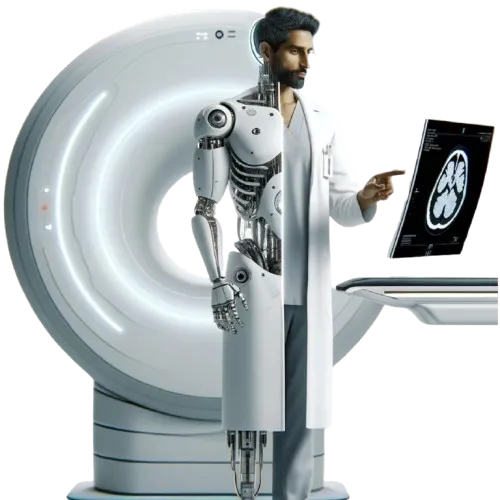
When AI can detect, draft, measure, compare, and triage, the radiologist's role moves from isolated pattern recognition to clinical command. The best radiologists will not merely check AI outputs. They will become the clinical operators at the frontier where AI meets real care.
This is the idea of the forward deployed radiologist.
The forward deployed radiologist is not just a report checker. They understand the clinical context, the limits of the AI, the quality of the study, the consequence of the impression, and the workflow around the patient. They know when AI is useful, when it is misleading, and when the report needs a level of judgment that no model can safely provide alone.
This matters because responsibility does not disappear when software improves.
If anything, responsibility becomes more complex. A radiologist in an AI-native system must understand image quality, clinical relevance, model behavior, report structure, downstream communication, and quality feedback. That is not a smaller role. It is a more powerful one.
The future is not AI replacing radiologists. The future is radiologists becoming the clinical authority inside AI-native radiology systems.
Why hospitals will care
Hospitals do not adopt infrastructure because it is exciting. They adopt it because it solves operational and clinical risk.
Radiology departments and diagnostic centers are under pressure from all sides: rising scan volumes, shortage of expert radiologists, turnaround expectations, quality variation, subspecialty gaps, emergency workflows, clinician dissatisfaction, and the need to serve patients faster without compromising accuracy.
AI can help with all of this. But only if it is trustworthy.
A hospital leader does not need another disconnected AI claim. They need a system that can answer practical questions.
Will this reduce time to diagnosis without increasing errors? Will it help prioritize urgent cases? Will it improve consistency across sites? Will it support general radiologists with subspecialty depth? Will it reduce missed findings? Will it make quality measurable? Will it produce an audit trail? Will it work with the existing reporting workflow? Will radiologists accept it? Will clinicians trust the output?
These are infrastructure questions.
They require more than a model. They require a platform that combines AI, radiologists, workflows, validation, monitoring, feedback, and accountability.
This is where 5C has a unique advantage. 5C already sits inside the operational reality of radiology at scale: hospitals, diagnostic centers, radiologists, scans, reports, turnaround expectations, quality processes, and clinical communication. That gives 5C a view of AI that is grounded in real work, not abstract possibility.
The question is not how to make AI impressive. The question is how to make AI usable, reliable, and clinically governed across thousands of real radiology decisions.
The uncomfortable truth about AI in medicine
Healthcare has seen many technologies that looked impressive in controlled settings but struggled in real deployment. AI will be no different unless the industry is honest about what clinical adoption requires.
The uncomfortable truth is that medicine does not only need better models. It needs better systems of evidence.
A field that produces disciplined, structured, reproducible knowledge will be able to use AI well. A field that depends on inconsistent practice, unstructured data, weak feedback, and invisible variation will struggle. AI exposes the quality of the system around it.
Radiology is one of the best places to build the right system because it already has digital images, structured workflows, measurable turnaround times, reporting standards, peer review practices, and a natural connection between data and diagnosis. But even in radiology, trust has to be built deliberately.
That means radiology AI must be validated, monitored, governed, and improved inside the clinical environment where it is used.
This is why open validation infrastructure matters. Hospitals should not have to treat AI as a black box that arrives from outside. They should be able to test it, understand it, monitor it, and decide how it fits into care.
Clinical AI should earn trust locally.
The bottom line
The next decade of radiology will not be defined by whether AI enters the field. It already has.
The real question is what kind of AI radiology system we build.
One path turns AI into another layer of software: a set of features, alerts, dashboards, and model outputs that may or may not fit the real work of care.
The better path turns AI into clinical infrastructure: validated on local data, embedded in workflow, supervised by radiologists, monitored over time, and connected to continuous quality improvement.
That is the path 5C is building.
5C is not just using AI in radiology. 5C is building the trust system that lets radiology AI become real clinical infrastructure.