How 5C Streamlines Night Reporting for Emergency Department
The 2 AM Emergency Dilemma
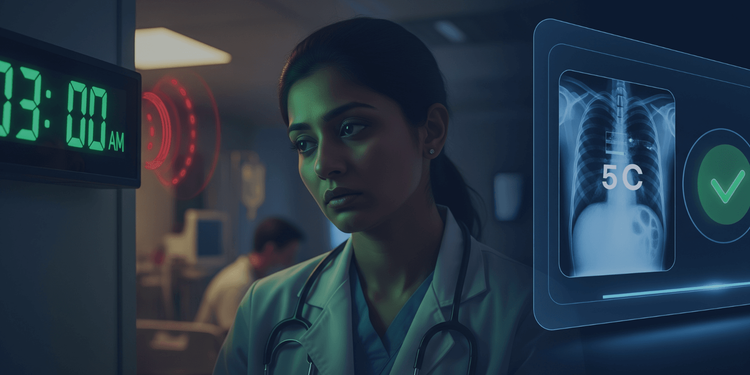
It's 2:47 AM. A 45-year-old construction worker arrives with chest pain and shortness of breath after a scaffolding fall. CT chest is ordered immediately every minute counts in trauma.
The scan completes fast, but the real problem hits: the on-call radiologist is managing a stroke at another campus, and the teleradiology service promises a two-hour turnaround. Meanwhile, the patient's oxygen drops.
The Core Problem
Emergency departments face high patient acuity 24/7, but imaging support shrinks dramatically after hours. This isn't just about having radiologists available, it's about getting the right expertise at the right time with quality assurance.
Why Night Coverage Fails
Patchwork Solutions
The Reality: Hospitals rely on overextended on-call radiologists or teleradiology with unpredictable turnaround times. Smaller hospitals lack night coverage entirely, forcing ED physicians to interpret images without radiology training.
The Cost: Unread studies clog workflows, extend ED stays, increase liability, and fuel burnout. Missed diagnoses like pulmonary embolism or intracranial hemorrhage can be fatal.
Time-Sensitive Risks
Conditions like bowel obstruction, stroke, or hemorrhage demand instant action. Traditional models fail overnight when queues grow and radiologists juggle multiple facilities.
How 5C Solves Night Coverage
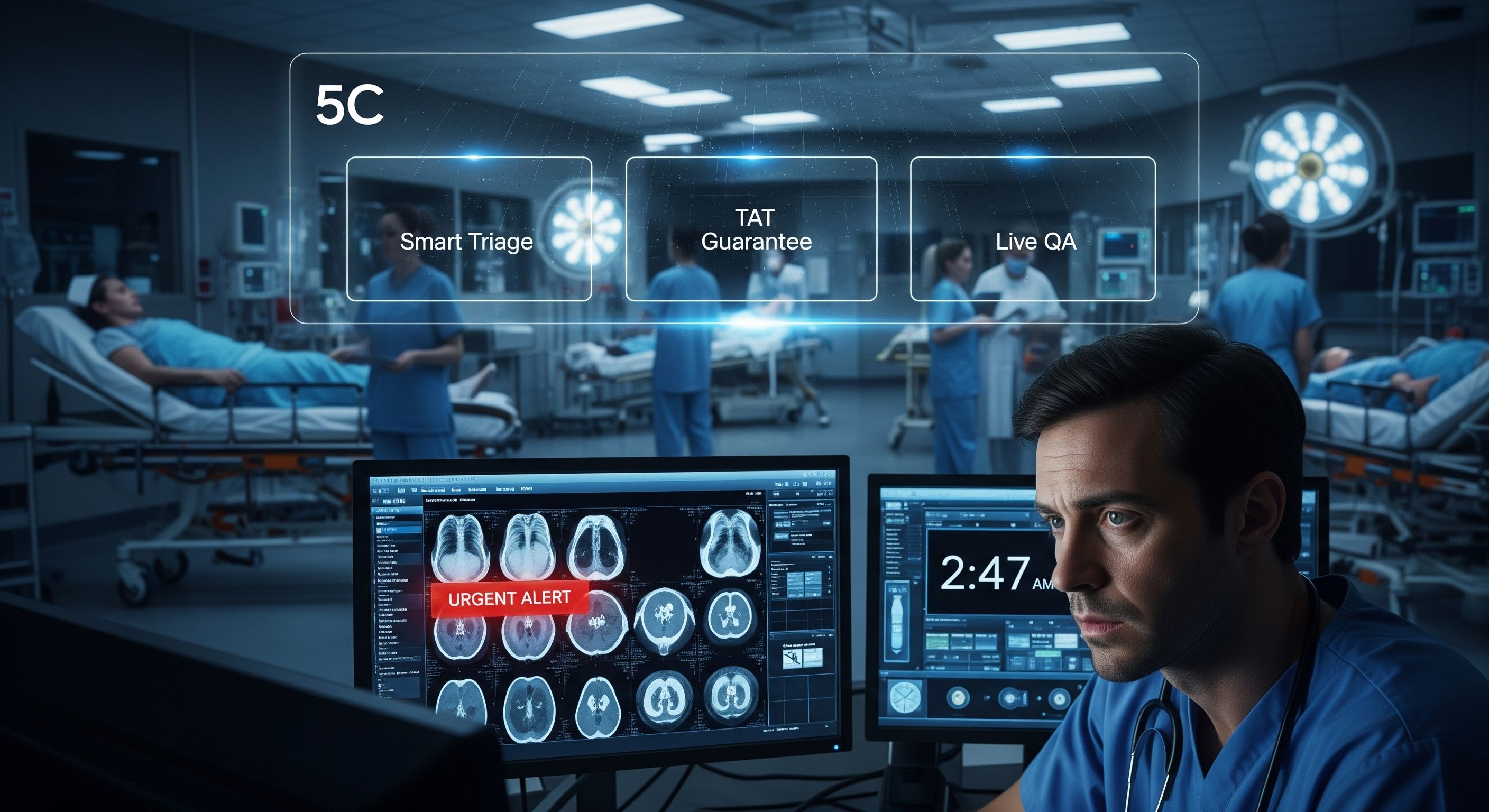
Smart AI Triage
AI trained on millions of emergency studies analyzes scans instantly, flags critical findings, and assesses complexity. It prioritizes cases without replacing radiologists—critical cases escalate to subspecialists immediately.
Flexible Reading Workflow
Routine scans get AI preliminary findings for quick decisions with human validation to follow. Critical cases connect to subspecialty radiologists fast with AI annotations highlighting concerns.
Guaranteed Turnaround Times
Critical Findings: Instant alerts for conditions like intracranial hemorrhage or aortic dissection.
Urgent Studies: Trauma and stroke protocols guaranteed within 30 minutes.
Routine Studies: Completed within defined windows with full transparency.
Built-In Quality Assurance
AI preliminaries receive human validation before final reporting. High-risk cases get double-reads with subspecialty backup. Real-time quality metrics track accuracy and turnaround compliance.
Real Case: Tension Pneumothorax
The Emergency
The 2 AM trauma patient's CT chest enters 5C's queue. AI analyzes the scan in 30 seconds and detects large pneumothorax with mediastinal shift life-threatening tension pneumothorax.
Instant Response
AI flags the case critical, sends instant alert to ED physician with annotated images, and escalates to emergency radiologist. Within 5 minutes total, physician has both AI findings and subspecialist confirmation.
The Outcome
Emergency chest tube placement happens immediately instead of hours later. The patient receives decompression before cardiovascular collapse—rapid AI-human collaboration saves the life.
What makes 5C different from standard teleradiology
Predictable Performance
Traditional teleradiology offers variable turnaround based on queue depth. 5C provides guaranteed turnaround commitments with real-time status visibility for predictable ED workflow.
Intelligent Prioritization
Standard services process studies first-in-first-out regardless of urgency. 5C's AI ensures critical cases get immediate attention while routing routine studies efficiently.
Quality Transparency
Many teleradiology companies provide minimal metrics. 5C offers comprehensive dashboards showing accuracy rates, turnaround compliance, and critical finding detection with continuous improvement.
Subspecialty Access
Generic teleradiology routes to general radiologists. 5C maintains subspecialty coverage for neuroradiology, trauma, cardiovascular imaging requiring specialized emergency expertise.
Does AI replace radiologists
No. AI handles initial screening and pattern recognition, flagging findings for radiologist validation. Subspecialists focus on complex interpretation rather than routine screening, allowing expert time to scale across multiple facilities without compromising quality.
AI maintains constant attention regardless of fatigue or case volume, catching findings that might be missed during high-volume overnight shifts.READ MORE ABOUT REDUCING BURNOUT
What operational improvements happen
Patient Flow
Predictable radiology turnaround eliminates imaging bottlenecks causing ED boarding. Physicians make faster disposition decisions, improving throughput and reducing length of stay.
Reduced Liability
Guaranteed critical finding detection with documented QA decreases missed diagnosis risk. Comprehensive audit trails provide legal protection demonstrating appropriate standard of care.
Physician Confidence
Reliable radiology backup reduces diagnostic uncertainty and defensive medicine practices like unnecessary admissions or repeat imaging.
Cost Efficiency
Improved throughput increases ED capacity without facility expansion. Reduced liability claims and shorter length of stay generate measurable ROI.
The Night Shift No Longer Needs to Be Your Weakest Link
Emergency departments operate 24/7, but radiology support shouldn't fade after hours. 5C bridges the gap between emergency medicine's constant demands and radiology's traditional limitations. Our AI-augmented platform ensures that critical findings get detected instantly, subspecialists engage immediately, and quality remains consistent around the clock.
Thousands of emergency patients across India already benefit from 5C's guaranteed turnaround times and intelligent prioritization. Isn't it time your ED joined them?
Take Action
Ditch the 2 AM dilemma. Connect with 5C to see how our AI + Telerad system builds night resilience for your ED. 👉 Contact Us