How Bionic AI Reduces Radiologist Burnout and Restores Job Satisfaction
The Radiologist Burnout Crisis
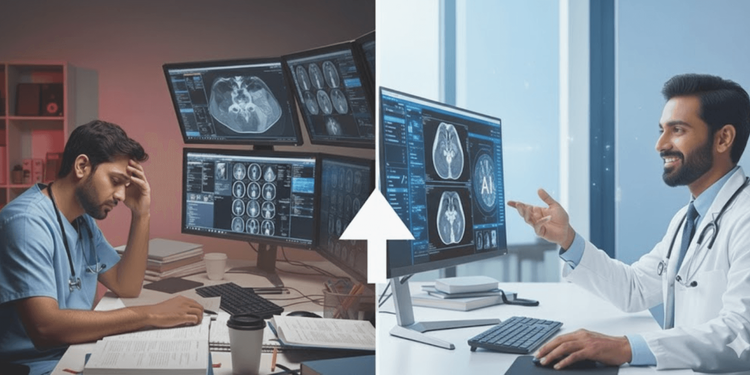
Radiologists decode medical mysteries hidden in every scan, but the job has become an exhausting grind. Long hours, endless reports, and constant pressure for perfection are pushing over 50% of radiologists into burnout. Fatigue, anxiety, and depersonalization are widespread, not because the work is inherently difficult, but because repetitive tasks drain even the most skilled professionals.
Imagine reading 100+ studies daily in high-pressure environments like teleradiology or large hospital systems. Each scan demands laser focus whether it's a critical case or routine "normal" study requiring thorough documentation. The mental gymnastics of switching between modalities, body parts, and clinical questions combined with tedious report proofreading and template assembly leaves radiologists drowning in clicks and checklists.
What Drives Burnout
Sheer Volume: Processing 100+ studies daily with minimal breaks creates unsustainable cognitive load and physical exhaustion.
Routine Cognitive Drain: Even normal or near-normal scans require meticulous attention and complete documentation, consuming mental energy without intellectual reward.
Mental Multitasking: Constantly toggling between clinical queries, patient histories, imaging modalities, and reporting systems fragments attention and increases fatigue.
Proofreading Burden: Catching contradictions like "no pleural effusion" followed by "bilateral effusions" requires additional review time and cognitive effort after initial interpretation.
Documentation Drag: Every case requires manually assembling templates and inserting patient-specific details, turning radiologists into data entry clerks rather than diagnosticians.
The complex cases aren't breaking radiologists—it's the repetitive, monotonous grind of routine documentation and quality checking.
How Bionic AI Addresses Burnout
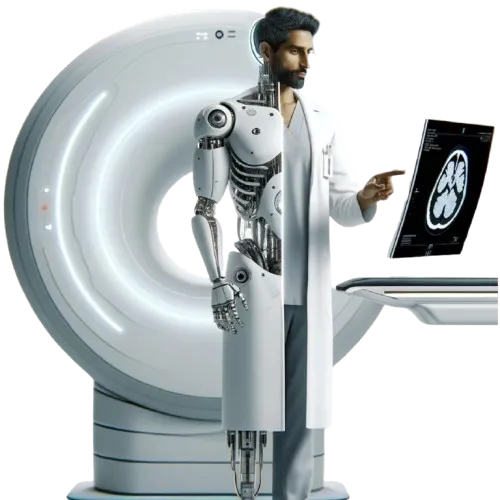
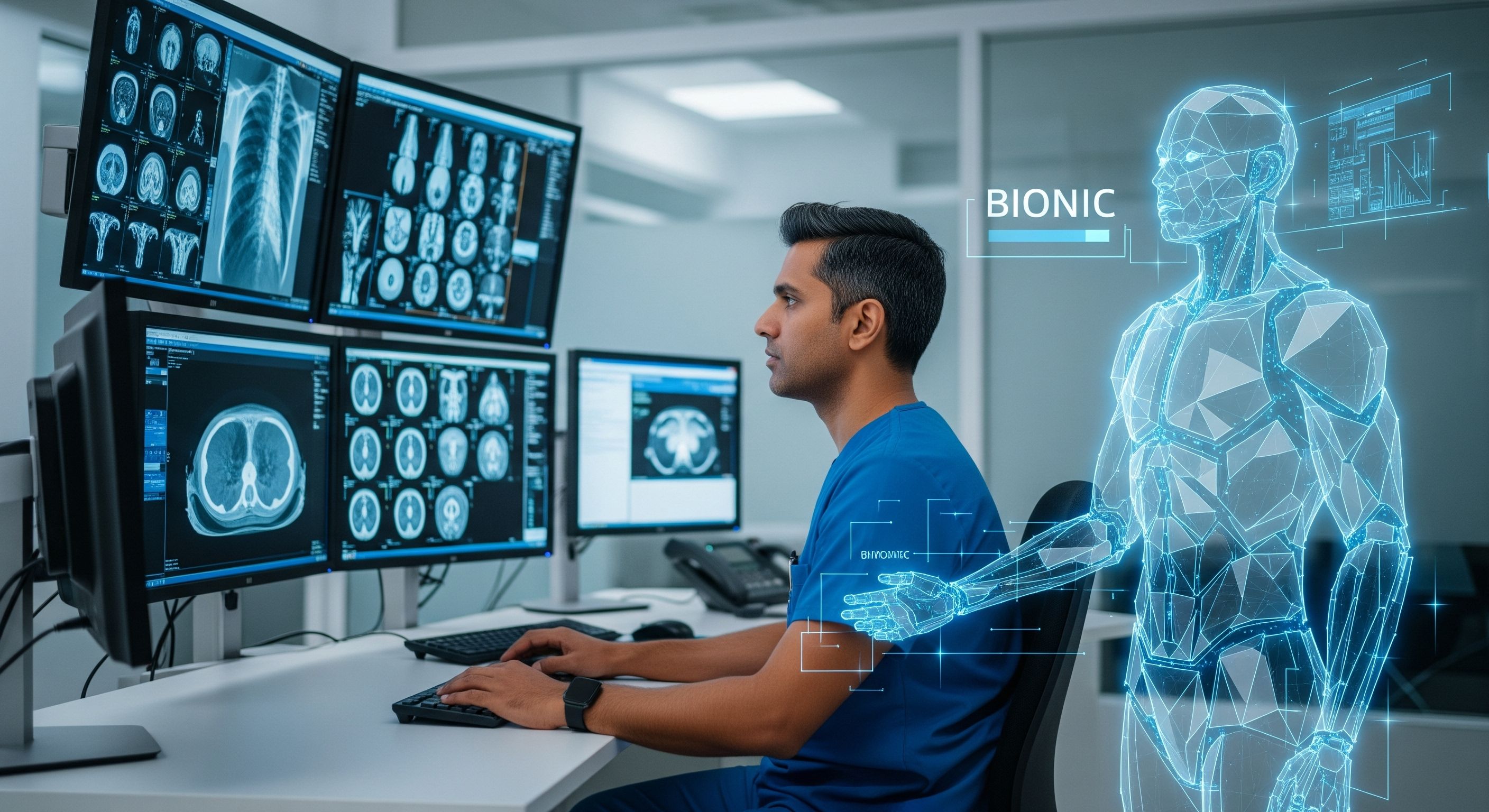
Bionic isn't designed to replace radiologists, it's an intelligent assistant that handles tedious tasks so radiologists can focus on what they do best: interpreting scans and making clinical decisions that improve patient outcomes.
Clinical Query Intelligence
Bionic's large language models understand the clinical question behind each scan requisition, ensuring reports answer what referring physicians actually need to know. No more guessing at vague requisitions or writing generic findings that miss the point.
The system cuts through documentation clutter to deliver concise, relevant impressions that directly address clinical concerns without unnecessary anatomical descriptions that don't contribute to decision-making.Learn more about how Does AI-Enabled Teleradiology Work
Dynamic Template Generation
Forget rigid, cookie-cutter templates that never quite fit the case. Bionic creates AI-generated templates tailored to study type, clinical context, and individual radiologist reporting style preferences.
Radiologists dictate or click findings, and Bionic generates polished, sign-ready impressions automatically. The system learns personal preferences over time, adapting to each radiologist's unique voice while maintaining clinical accuracy and institutional standards.
Real-Time Quality Assurance
Bionic's QA agents function as eagle-eyed proofreaders working during the reporting process, not as an additional post-reporting step that adds workload.
Automatic Detection:
Contradictions between report sections (e.g., "no lytic lesions" vs "lytic lesion in L2")
Missing anatomical references (findings without organ specification)
Vague impressions requiring clarification
Clinical mismatches between query and reported findings
Quality checking happens seamlessly during workflow, preventing errors before finalization rather than requiring time-consuming post-sign-off corrections.
Automated Follow-Up Recommendations
When radiologists identify findings requiring follow-up imaging like a 5mm pulmonary nodule Bionic automatically retrieves evidence-based guidelines and inserts appropriate recommendations into the report.
No more manually searching protocols, second-guessing timing intervals, or worrying about inconsistent follow-up guidance. The system ensures every actionable finding includes proper follow-up instructions based on current clinical standards.
Speech-to-Structured-Report
BionicVoice transforms dictation into structured, context-aware reports, not just speech-to-text transcription. The system understands radiological terminology, anatomical relationships, and clinical context to generate coherent reports from spoken narration.
This saves significant time and mental energy compared to traditional dictation requiring extensive editing and reformatting after initial voice capture.
Real Results from Practicing Radiologists
Bionic is deployed across India's largest teleradiology networks and enterprise hospitals with measurable impact on radiologist satisfaction and workflow efficiency.
Testimonials
"Bionic saves me from writing the same impression 40 times a day. It matches my style but faster—and with better grammar!"
— Dr. Tanvi S., Consultant Radiologist
"QA used to drain me. I'd catch an error and panic about earlier cases. Bionic flags issues automatically so I focus on scans."
— Dr. Arun V., Teleradiology Lead
"Ten-hour shifts used to leave me exhausted. With Bionic, I finish faster and feel sharper by day's end."
— Dr. Nandita R., Hospital-based Radiologist
Measured Impact
A 5-month deployment across four radiology centers demonstrated significant performance improvements:
28% faster report turnaround without increasing radiologist workload or rushing clinical interpretation
40% fewer QA corrections reducing post-sign-off amendments and associated workflow disruption
91% radiologist satisfaction with AI-generated impressions and overall system usability
Most importantly, radiologists report feeling less mentally drained even when handling the same or larger case volumes—indicating genuine cognitive load reduction rather than just speed improvements.
Why This Matters for Patient Care
Burnout isn't just a radiologist problem, it's a patient care crisis. Exhausted radiologists are statistically more likely to miss subtle findings, make documentation errors, or leave the profession entirely.
This cascades into slower report turnaround times, higher healthcare costs from delayed diagnoses, worse patient outcomes from missed findings, and workforce shortages that further increase pressure on remaining radiologists.
Why AI Is An Essential Infrastructure in Radiology
Unlike older tools like PACS (built for image storage) or dictation software (built for speech capture), Bionic is designed specifically for how radiologists think, work, and experience fatigue. It addresses the cognitive and workflow factors that drive burnout rather than just digitizing existing paper-based processes.
With imaging demand increasing 3-5% annually while radiologist workforce growth remains flat, tools like Bionic aren't luxury add-ons—they're essential infrastructure for sustainable radiology practice.
How Can AI Restore Professional Satisfaction for Radiologists
Radiologists didn't enter the field to become typists or proofreaders. They became medical detectives, spotting subtle findings, interpreting complex patterns, and changing patient lives through diagnostic expertise.
Bionic removes the repetitive documentation burden that transformed radiology from an intellectually stimulating specialty into an exhausting data entry job. By automating tedious tasks, the system lets radiologists rediscover the diagnostic challenges and clinical problem-solving that originally attracted them to the field.
The Future of Sustainable Radiology
AI-assisted workflows aren't about replacing human expertise—they're about preserving it. By reducing cognitive load from routine tasks, Bionic helps radiologists maintain the mental clarity and job satisfaction necessary for long, fulfilling careers.
This benefits patients through more accurate diagnoses from less-fatigued physicians, healthcare systems through improved radiologist retention and productivity, and radiologists themselves through restored professional satisfaction and work-life balance.
How does Bionic AI reduce radiologist burnout
Bionic AI automates repetitive tasks that drain mental energy—like template assembly, quality checking, and follow-up recommendations. The system performs real-time QA during reporting, generates structured reports from dictation, and creates tailored impressions automatically. This lets radiologists focus on diagnostic interpretation instead of data entry and proofreading. Radiologists report feeling less mentally drained even when handling the same case volumes, with 91% satisfaction rates.
What are the measurable results of using Bionic AI
Bionic AI delivers 28% faster report turnaround, 40% fewer QA corrections, and 91% radiologist satisfaction. Most importantly, radiologists report reduced mental fatigue despite handling similar or higher case volumes. The system helps radiologists complete shifts feeling sharper rather than exhausted while maintaining diagnostic quality.
Read more about how AI-Powered Clinical Decision Support Systems for Radiology
Rediscover What You Love About Radiology
You didn’t become a radiologist to be a typist or a proofreader. You signed up to be a medical detective—to spot the unspottable, interpret the complex, and change lives with your expertise. Bionic takes care of the repetitive tasks so you can get back to the thrill of the job.
Ready to ditch the burnout and rediscover your brilliance?
👉 Book a Bionic demo today and see how AI can transform your workflow.Also, explore What Makes Bionic the Most Powerful Reporting Workflow in Radiology for a deeper dive.
Let’s make radiology fun again.