Insights About Your Insides: Redefining Radiology
What Made Us Look at Radiology Differently
A friend needed an MRI. Simple enough, right? But then came the wait—48 hours before treatment could even begin. That delay wasn't just inconvenient; it was filled with anxiety and uncertainty.
That's when the reality hit: radiology is the foundation of diagnosis, yet it's incredibly slow. Every report requires a radiologist to interpret thousands of complex images and distill them into a few critical lines.
Here's the problem: 4 billion scans happen globally each year, but there are only 100,000 radiologists. This gap causes delays and misreads—one in five scans is interpreted incorrectly. Imagine if every fifth bridge you crossed could collapse. That's how broken diagnostic access is today.
Can Technology Fix the Access Problem
The challenge boils down to two things: Access and Efficiency.
Access to the right radiologist at the right time. Efficiency so experts can do more, faster, with greater precision.
This isn't just a medical problem—it's a computer science problem.
By 2025, the world will generate 7 billion scans annually. The solution? Build technology that connects hospitals, radiologists, and patients seamlessly—ensuring no scan goes unread and no diagnosis delayed.
Three factors made this possible:
- Interoperability: All scans use the same DICOM format globally
- High-speed Internet: Even 6 GB CT scans upload in under a minute
- Affordable AI: Cloud computing makes real-time analysis accessible
How Does 5C Network Connect Radiologists and Hospitals
Traditional radiology keeps experts isolated in hospital basements, overloaded with cases. 5C Network changed that—bringing radiology from the basement to the cloud.
Picture this: A scan center in rural Karnataka runs on generator power, yet scans upload instantly to the cloud. Within seconds, they're matched with a specialist anywhere in the country.
The 5C ecosystem connects 280+ radiologists with hospitals across India, supported by AI that helps them read faster and more accurately.
For hospitals: On-demand radiology without overhead costs
For radiologists: Nationwide opportunities from anywhere
For patients: Faster, reliable diagnosis—often within minutes
AI predicts what radiologists will see next, making them 35% faster and 80% less likely to make errors.
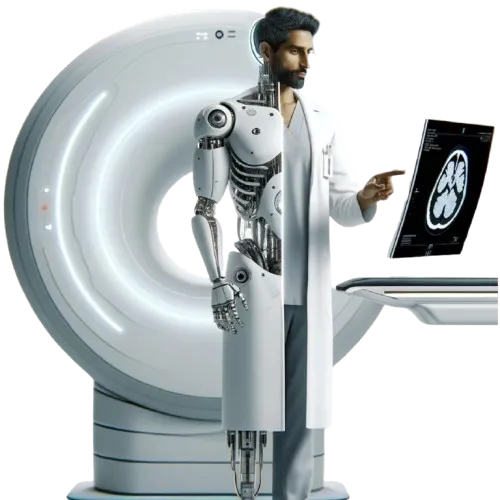
The future isn't man versus machine—it's man and machine working together.
What Happens When AI Meets Real Patient Cases
Diagnosing Before the Last Bus Leaves
In Bihar, chest X-ray reports delivered in 16 minutes meant patients got results before the evening bus left town. Fast diagnosis meant access to treatment and livelihood.
Spotting Hidden Appendicitis
In Assam, a 3D reconstruction revealed massive appendicitis that was initially missed. Quick diagnosis and immediate surgery saved a life—timing made all the difference.
The Seizure That Wasn't a Fall
In Eastern UP, a woman came in after a bike accident. AI helped identify neurocysticercosis—a parasitic infection, not trauma. One accurate diagnosis changed everything: a simple tablet instead of repeated scans.
The difference between a correct diagnosis and a missed one? Life or death.
What's the Vision for Diagnostic Care
Every CT or MRI shows over 1,000 shades of gray, but the final report is black and white—you either get it right or you don't.
The mission at 5C Network is clear: ensure every patient, everywhere, gets accurate, timely, expert diagnostics.
Between a patient and uncertainty lies one bridge—diagnosis. And that bridge, powered by human expertise and AI, is where healthcare's future begins.
The Bottom Line
What started with one friend's MRI wait has become a mission to transform diagnostic access for millions. From generator-powered scan centers in rural India to cloud-connected radiologists nationwide, technology is proving it can close the gap between patients and life-saving diagnosis.
The question isn't whether AI will replace radiologists—it's how we'll use it to empower them. When human expertise combines with intelligent technology, every scan becomes an opportunity to save time, improve accuracy, and ultimately, save lives.
That's the future of radiology. And it's happening now.