The New Radiologist AI Is Creating
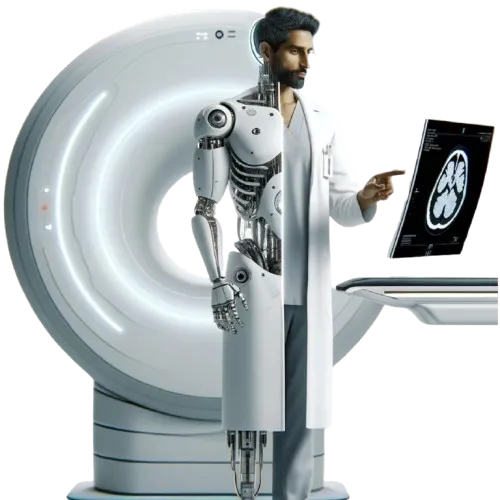
The first generation of radiology AI was described as if it would compete with radiologists. That was the wrong frame. The more important change is that AI is creating a new kind of radiologist: one who reads with deeper context, learns faster, works across a larger clinical surface area, and turns expertise into systems that improve every day.
For years, the public conversation around AI in radiology has been too narrow. It has focused on one dramatic question: will AI replace radiologists?
That question misses what is actually happening.
Radiology was never just image recognition. A good radiologist does not merely identify a bright spot, a dark spot, a fracture line, or a nodule. A good radiologist understands the patient's clinical question, the quality of the study, the limits of the modality, the probability of competing diagnoses, the urgency of the finding, and the consequence of each word in the report.
The future is not a world where AI does radiology and humans disappear. The future is a world where the best radiologists become much more powerful than before.
The old radiologist was measured by volume
The traditional radiology system rewarded speed, stamina, and pattern recognition. These are important skills, but they are not the whole of radiology.
A radiologist's day has historically been shaped by queues: CT, MRI, X-ray, ultrasound, emergency studies, routine studies, backlog, night work, clinician calls, corrections, comparisons, and reporting templates. The system often measured productivity by how many studies were reported, how quickly they were turned around, and how few errors were made.
That created a certain type of radiologist: efficient, careful, and deeply trained, but often forced to spend too much time on repetitive work and too little time on higher-order clinical thinking.
AI changes this balance.
When AI can pre-read images, detect abnormalities, retrieve priors, summarize history, flag missing clinical information, suggest structured measurements, and check report consistency, the radiologist's role moves up the stack.
The job becomes less about manually carrying every cognitive load and more about directing attention to the places where judgment matters most.
AI commoditizes basic pattern detection, but it increases the value of clinical judgment.
The new radiologist is not just a reader
The new radiologist will still read scans. That remains central. But reading will no longer be the entire definition of the profession.
The new radiologist will be a clinical interpreter, AI supervisor, quality architect, subspecialty learner, workflow designer, and communication layer between imaging and care.
This sounds like a bigger role because it is.
AI will take over some of the mechanical work around radiology. It will reduce friction in measurements, comparisons, triage, drafting, follow-up recommendations, and quality checks. But that does not reduce the need for radiologists. It changes where radiologists add the most value.
A radiologist who simply converts images into text may feel pressure. A radiologist who can combine imaging, clinical context, AI outputs, uncertainty, and treatment relevance will become more valuable.
AI will create faster subspecialization
One of the most important effects of AI will be on learning.
Today, becoming a strong subspecialty radiologist takes years of exposure: cases, mentors, feedback, mistakes, tumor boards, surgical correlations, pathology correlations, and follow-up imaging. That will remain true, but AI can compress part of the learning loop.
A radiologist reading MSK, neuro, body, cardiac, breast, fetal, or oncology imaging can soon have a layer that explains differential diagnoses, compares similar cases, highlights subtle misses, shows evidence trails, and asks: what would change management here?
That does not replace training. It makes training more continuous.
The old model was: learn for many years, then report.
The new model will be: report, learn, compare, audit, and improve continuously inside the workflow.
This matters deeply for India and other markets where demand for high-quality imaging is growing faster than the number of expert radiologists. We cannot solve the radiology gap only by asking every radiologist to work harder. We need systems that help good radiologists become excellent faster, and help excellent radiologists scale their expertise to more patients.
The new radiologist will own quality, not just output
In an AI-enabled radiology system, the best radiologists will not only ask, "What is the finding?" They will ask better questions.
Clinical relevance. Was the right study done for the clinical problem, and does the report answer the referring doctor's real question?
Technical quality. Is the image quality adequate, are the priors available, and are the measurements consistent?
AI supervision. Did the AI miss something subtle, overcall something irrelevant, or generate a fluent but weak impression?
Patient consequence. What follow-up is necessary, and what would create unnecessary anxiety or unnecessary care?
System improvement. Where is the workflow repeatedly failing, and how do we improve it for the next thousand patients?
This is where radiologists become architects of quality.
Every report becomes data. Every correction becomes feedback. Every discrepancy becomes a learning event. Every peer review becomes a signal. Every difficult case becomes training material for both humans and machines.
At scale, this creates a new possibility: radiology that improves as a network, not just as individual doctors working in isolation.
That is why AI in radiology should not be seen only as a tool at the workstation. It is operating infrastructure. It connects reporting, quality, education, workflow, triage, and clinical feedback into one loop.
The best radiologists will not merely produce reports. They will shape the systems that make reporting more accurate, more consistent, and more clinically useful.
The human part becomes more important
The more AI enters radiology, the more important the human part becomes.
AI can generate a draft. It can mark a lesion. It can suggest a diagnosis. It can compare priors. But it does not carry responsibility in the same way a radiologist does. It does not understand the emotional weight of a cancer diagnosis, the consequences of overcalling, the danger of undercalling, or the trust a clinician places in a final report.
The new radiologist must be comfortable with technology, but not submissive to it.
They must know when to accept AI assistance, when to challenge it, when to ignore it, and when to use it as a prompt for deeper thinking. They must understand that an AI-generated answer can be fluent and still wrong. They must be able to explain uncertainty, not hide it behind confident language.
In that sense, AI does not eliminate radiologist responsibility. It raises the standard for it.
What this means for radiologists
The radiologists who thrive in the next decade will not be those who simply "use AI." Everyone will use AI. That will not be special.
The radiologists who thrive will be those who develop three capabilities.
Clinical depth. They will connect imaging findings to patient management, not just report appearances.
System thinking. They will understand how protocols, reporting formats, AI models, peer review, and feedback loops shape quality.
Learning velocity. They will use AI to expose gaps, build subspecialty expertise, and get better case by case.
This is a more demanding version of radiology, not an easier one. But it is also a more exciting version.
For too long, many radiologists have been trapped inside reporting queues. AI gives the profession a chance to move beyond that: from volume to value, from isolated expertise to networked intelligence, from reporting studies to shaping outcomes.
The question is no longer whether AI will change radiology. It already is.
The real question is whether we will use AI to make radiology cheaper and more mechanical, or whether we will use it to create a new generation of radiologists who are more specialized, more clinical, more connected, and more impactful than ever before.
At 5C, we believe the future belongs to that second path.
Radiology will not become less human because of AI. Done right, it will become more intelligent, more scalable, and more worthy of the trust patients place in it.