Most RIS and PACS Companies Are Selling You Software From 2010 (And They Don't Even Know It)
Most RIS and PACS Companies Are Selling You Software From 2010 (And They Don't Even Know It)
The dirty secret of medical imaging: your "modern" radiology system was architected before the iPhone had Face ID.
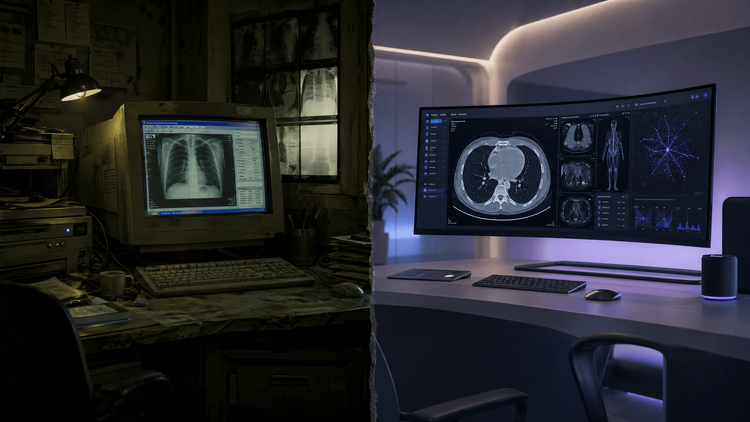
Walk into any diagnostic centre in India today and you'll find radiologists wrestling with software that looks like it was designed for Windows XP. The interface is cluttered. The workflow is broken. The AI features — if they exist at all — are bolted-on afterthoughts that require three clicks and a prayer to access.
And the worst part? The companies selling this software genuinely believe they're selling "state-of-the-art" technology.
The Reality Check
Most RIS/PACS vendors are running on architectures built 10–15 years ago. They've slapped fresh paint on the UI, maybe added a "cloud" sticker, and called it innovation.
The Legacy Trap
Most RIS and PACS vendors in the market today are running on architectures built 10–15 years ago. They've slapped fresh paint on the UI, maybe added a "cloud" sticker, and called it innovation. But underneath?
- Monolithic codebases that can't integrate with modern AI tools without fragile, custom middleware
- On-premise-first designs retrofitted for cloud with all the elegance of a sedan converted into a pickup truck
- Workflow engines built for volume, not velocity — they can store millions of studies but can't prioritise the urgent ones intelligently
- APIs that are either non-existent or so poorly documented that integrating them costs more than the software itself
These weren't built for the age of AI. They were built for the age of CD-ROMs and LAN cables.
⚠️ Warning Sign
If your vendor's "cloud solution" still requires a VPN and a server in your basement, you're not using cloud. You're using remote access to legacy software.
Why They Don't See It
Here's the uncomfortable truth: most RIS/PACS companies aren't technology companies. They're sales organisations with a software appendage.
Their engineering teams maintain old code. Their product teams iterate on feature checklists from 2012. Their leadership comes from sales backgrounds, not software architecture. They measure success in licenses sold, not radiologist satisfaction.
They don't know what they're selling because they've never spent a day reading studies at 2 AM. They've never felt the frustration of a PACS viewer freezing during a critical emergency case. They've never had to explain to a referring physician why the report is delayed because "the system is syncing."
When you don't live the problem, you can't solve the problem.
What "Modern" Actually Means in 2026
A radiology platform built for today's reality looks fundamentally different:
✓ AI-Native Architecture
Not AI as a plugin. Not AI as a separate tab. AI woven into the entire workflow — from auto-prioritisation of critical findings to intelligent report templates that adapt to the study type.
✓ API-First Design
Every function is accessible via well-documented APIs. Integration isn't a professional services project — it's a few lines of code.
✓ Cloud-Native, Not Cloud-Washed
True multi-tenant cloud architecture. Automatic scaling. Zero-downtime deployments. Data residency controls.
✓ Built for Speed
Sub-second image loading. Real-time collaboration. Instant report distribution. In teleradiology, speed isn't a feature — it's the product.
✓ Designed for Radiologists, Not Administrators
The buyer isn't the user. PACS systems are often purchased by hospital administrators who care about price and compliance. But the user — the radiologist — cares about workflow, ergonomics, and not wanting to throw their monitor out the window.
The Cost of Settling
When diagnostic centres settle for legacy RIS/PACS, they don't just get bad software. They get:
- Slower turnaround times — old systems can't prioritise, batch, or route efficiently
- Higher error rates — clunky UX leads to fatigue, and fatigue leads to mistakes
- Vendor lock-in — proprietary formats and closed systems make switching expensive
- Missed AI opportunities — your competitors are using AI to read faster and more accurately while you're waiting for your "integration roadmap"
🚨 The Hard Truth
Most RIS and PACS companies aren't going to fix this. They can't. Their technology debt is too deep, their incentives are misaligned, and their understanding of modern radiology is theoretical at best.
The Hard Truth
Most RIS and PACS companies aren't going to fix this. They can't. Their technology debt is too deep, their incentives are misaligned, and their understanding of modern radiology is theoretical at best.
They'll keep selling you software from 2010 because that's what they have. They'll keep calling it "enterprise-grade" because that sounds impressive. They'll keep pointing to their client list because volume is easier to measure than value.
But radiology in 2026 doesn't need more features on a legacy foundation. It needs a foundation built for how radiology actually works today — AI-powered, cloud-native, API-first, and relentlessly focused on the radiologist's experience.
The question isn't whether your current RIS/PACS is "good enough." The question is whether it was built for the radiology of 2026 or the radiology of 2010.
Because your patients — and your radiologists — can tell the difference.
5C Network is an AI-native teleradiology platform built for how radiology actually works today. If you're tired of software that fights you instead of helping you, let's talk.