CT Brain Report: Findings, Indications, and Turnaround in India
Hybrid AI + neuroradiologist intelligence. Reports in 20 minutes. Critical findings escalated immediately.
- What is a CT Brain?
- A CT brain is a non-contrast computed tomography study of the head that uses thin-slice X-ray imaging to visualise the brain parenchyma, skull, ventricles, and intracranial blood. It is the first-line scan for acute neurological emergencies because it is fast, widely available across India, and highly sensitive to fresh intracranial bleeds and skull fractures.
- How long does a CT Brain report take with 5C?
- In India, 5C Network's hybrid intelligence workflow delivers structured CT Brain reports in an average of 20 minutes, signed off by a neuroradiology specialist. Emergency cases are prioritised for 15-minute turnaround.
When is a CT Brain ordered?
Ordered urgently for suspected stroke (within the thrombolysis window), head trauma, severe headache, suspected intracranial bleed, altered sensorium, and pre-operative neurosurgical planning. It is also used for follow-up of known intracranial lesions, post-operative neurosurgery review, and triage in emergency departments where MRI is not immediately accessible. In India, a non-contrast CT brain is the default first scan in any acute neuro presentation.
How 5C reads a CT Brain
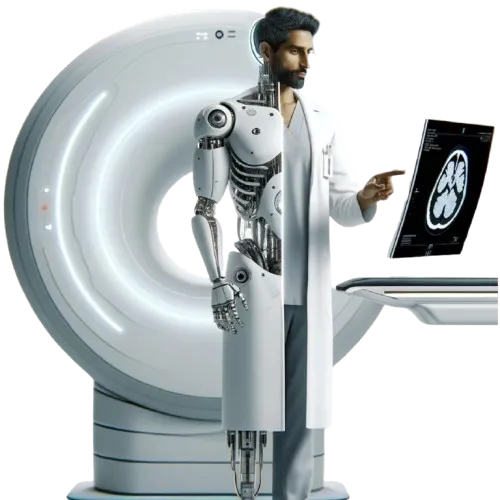
Every CT Brain on the 5C network is read by AI and a board-certified radiologist — never one without the other. Here's the 4-step workflow.
Bionic AI pre-read
Bionic — 5C's radiology AI trained on 4B+ clinical images — pre-reads the ct and flags findings for the radiologist's attention.
- intracranial haemorrhage (intraparenchymal, subdural, extradural, subarachnoid)
- midline shift
- mass effect / sulcal effacement
- acute infarct (hyperdense MCA sign)
- hydrocephalus
- skull fractures
- space-occupying lesion / tumour
- cerebral oedema
- hyperdense vessel sign
Radiologist read
An NMC-registered neuroradiology specialist from 5C's 400+ radiologist network reviews every image, validates or corrects AI findings, and adds clinical context.
- NMC-registered, medico-legally valid in India
- Subspecialty-trained for brain / head
- Available 24/7 across India time zones
QA & peer review
Critical and complex CT Brain reads get a second-radiologist review. Random sampling across all reads supports continuous QA.
- Double-reading on critical findings
- Audit trail for medico-legal use
- NABH-aligned escalation protocol
Structured report
Signed PDF report delivered to your PACS / RIS / email in an average of 20 minutes from the time of acquisition.
- Structured findings + impression
- 15-minute SLA for emergencies
- Critical-finding phone escalation
What's in a 5C CT Brain report
A standard 5C CT Brain report is structured to be readable by the referring clinician, the hospital admin reviewing TAT, and any auditor checking NABH compliance.
Clinical history
Captures the referring clinician's indication — trauma, suspected stroke, headache, altered sensorium — along with time of symptom onset, which drives stroke-window decisions.
Technique
Documents slice thickness, contrast status (non-contrast in the default protocol), and whether thin-section reconstructions of the skull base or posterior fossa were generated.
Findings
Structured comments on brain parenchyma, grey-white differentiation, ventricles and sulci, midline structures, basal cisterns, calvaria, skull base, paranasal sinuses, and mastoids.
Stroke window assessment
For suspected stroke, the report indicates whether the patient is within the thrombolysis window (typically <4.5 hours from onset) and flags any contraindications visible on CT, such as established infarct or haemorrhage.
Impression
A concise, prioritised summary of the most clinically actionable findings — bleed type and volume, midline shift in millimetres, infarct territory, or absence of acute intracranial pathology.
Critical-finding escalation
Acute intracranial haemorrhage, mass effect, large infarct, or skull fracture trigger an immediate phone call from the 5C team to the referring clinician, on top of the written report.
Recommendations
Where indicated, the neuroradiologist suggests next steps — CT angiography, MRI brain, neurosurgical consult, or short-interval follow-up CT.
CT Brain reads, across India
5C Network reports CT Brain studies for 2,000+ hospitals and diagnostic centres across India — Bangalore, Mumbai, Delhi NCR, Chennai, Hyderabad, Kolkata, Pune, Ahmedabad, Kochi, Coimbatore, Jaipur, Lucknow, and 13 more tier-2 / tier-3 cities. NMC-registered, NABH-aligned, medico-legally valid.
See all coverage locationsFrequently asked questions
How long does a CT brain report take?
What does a CT brain show?
Is a CT brain enough for stroke diagnosis or do I need an MRI?
Is 5C's CT brain report medico-legally valid?
Can my hospital integrate 5C for CT brain reads?
Does Bionic AI replace the radiologist for CT brain?
Worried about a finding on your CT Brain report?
If your report mentions something unclear, or it doesn't match how you feel, you can have the same images re-read independently by a 5C super-specialist radiologist. You upload the scan you already have — no repeat scan, no extra radiation — and receive a fresh, signed report to discuss with your doctor.
Integrate 5C CT Brain reads at your hospital
20-minute average turnaround. AI + radiologist + QA on every read. NMC-registered, NABH-aligned, medico-legally valid in India. Pay-per-scan — no salary or locum commitments.