How AI Detects Missed Fractures in Musculoskeletal Radiology
What Challenges Do Radiologists Face with Subtle MSK Findings
Musculoskeletal radiology presents unique diagnostic challenges that even experienced radiologists struggle with. Occult fractures, tiny bone lesions, and joint abnormalities often hide in complex anatomy, overlapping structures, or suboptimal positioning.
High-volume radiology departments face additional pressure where fatigue and cognitive overload increase miss rates. Internal audits at 5C revealed that subtle MSK findings are among the most frequently missed diagnoses, particularly during busy shifts when radiologists review 50+ cases daily.
Can AI Identify Hidden Elbow and Other Occult Fractures
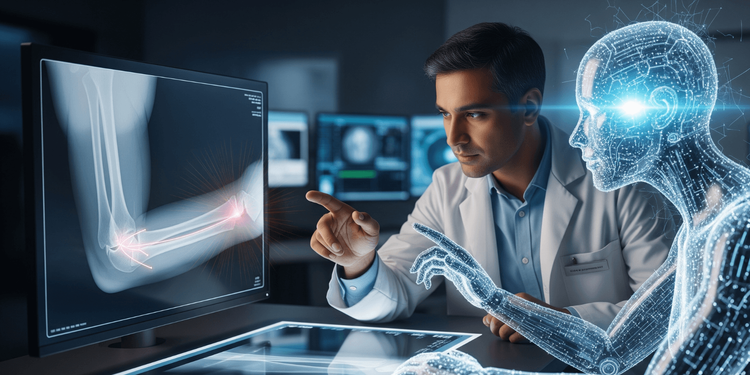
A middle-aged patient presented with elbow pain following a minor fall. The X-ray appeared unremarkable on initial review, with the radiologist dictating "No fracture or dislocation" after standard examination.
AI Intervention
Before report finalization, BionicLM's QA engine performed independent analysis and flagged a faint cortical irregularity on the radial head. The system auto-annotated the suspicious area and alerted the radiologist with specific anatomical reference and clinical rationale.
The Outcome
The radiologist reviewed the flagged region and confirmed a non-displaced radial head fracture matching the patient's clinical symptoms. Report was corrected before submission, orthopedic referral was made, and appropriate treatment initiated all within standard turnaround time.
Clinical Significance
Without AI detection, this subtle fracture would have been missed, potentially leading to delayed treatment, chronic pain, joint instability, and possible legal consequences.The patient received proper immobilization immediately, ensuring optimal healing outcomes.
How BionicLM's QA System Works
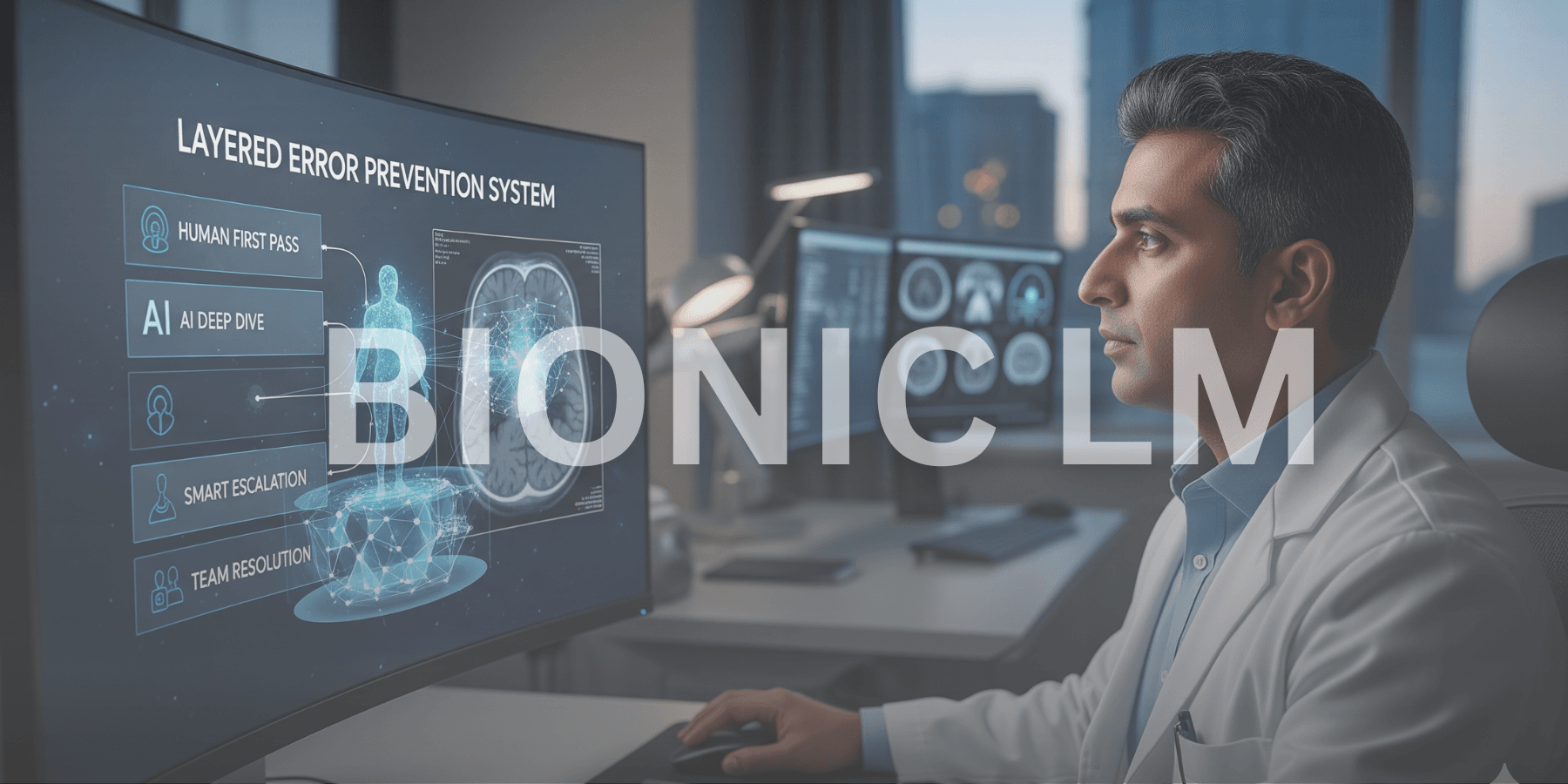
Four-Step Quality Process
Step 1: Human Initial Reading Radiologist performs standard examination and dictates findings using their usual workflow without any AI interference during primary interpretation.
Step 2: Independent AI Analysis BionicLM runs parallel deep learning analysis trained on thousands of MSK cases, specifically designed to detect cortical breaks, periosteal reactions, bone lesions, and joint abnormalities.
Step 3: Smart Flagging System When AI identifies findings absent from the radiologist's report, it generates real-time alerts with highlighted image regions, anatomical specificity, and clinical reasoning for the flag.
Step 4: Collaborative Resolution Radiologist reviews flagged findings, confirms true positives requiring report amendment, or dismisses false positives like artifacts. Every case logs for continuous quality improvement and audit tracking.
What AI Technology Powers Detection of Subtle Bone Lesions and Fractures
Deep Learning Architecture
BionicLM uses convolutional neural networks trained specifically on musculoskeletal imaging datasets containing verified fractures, bone lesions, and normal variants. The models learn to recognize subtle cortical disruptions, periosteal changes, and density variations invisible to quick visual scanning.
Detection Capabilities
The system identifies undisplaced fractures, stress fractures, occult fractures, bone lesions, joint effusions, soft tissue abnormalities, and foreign bodies. Pattern recognition algorithms analyze bone cortex continuity, trabecular patterns, and joint space characteristics with pixel-level precision.
Can AI detect MSK Findings
Occult Fractures
Detection Method: AI analyzes cortical bone continuity across the entire visible skeleton, identifying subtle breaks that appear as faint lines or minimal discontinuity on X-rays.
Clinical Value: Early fracture detection prevents complications like malunion, chronic pain, and joint dysfunction. Particularly valuable in scaphoid, radial head, and stress fractures.
Bone Lesions
Detection Method: System evaluates bone density patterns, identifying lytic or sclerotic lesions that may indicate infection, tumor, or metabolic disease.
Clinical Value: Early lesion detection enables timely oncology workup for malignancies or appropriate treatment for benign conditions before progression.
Joint Abnormalities
Detection Method: AI measures joint space width, analyzes alignment, and detects effusions or soft tissue swelling that may be subtle on standard radiographs.
Clinical Value: Identifies early arthritis, infection, or traumatic injury requiring intervention before chronic damage develops.
Why Radiologists Trust AI Assistance
Enhanced Efficiency
AI pre-screens images and flags problematic areas, allowing radiologists to focus attention on complex interpretations rather than exhaustive pixel-by-pixel searching. Average report time remains unchanged while accuracy improves measurably.
Reduced Cognitive Load
High-volume shifts create mental fatigue that increases error rates. AI provides consistent second-review regardless of radiologist workload, time of day, or case complexity, functioning as a tireless quality check.
Continuous Learning
Every AI flag serves as an educational opportunity, helping radiologists recognize subtle patterns they might have overlooked. Over time, this feedback loop improves both AI and human diagnostic skills.
Professional Support
Radiologists describe BionicLM as a "digital colleague" rather than replacement technology. The system augments human expertise without overriding clinical judgment, maintaining radiologist authority over all final diagnostic decisions.
Does AI work for all MSK imaging types
BionicLM currently supports X-ray analysis with highest accuracy, with CT and MRI capabilities in development.
X-ray remains the primary modality for acute fracture detection where AI provides maximum clinical value. The system handles all anatomical regions including extremities, spine, pelvis, and chest for rib fractures.
How Does BionicLM Improve Clinical Accuracy and Workflow Efficiency
Accuracy Improvements
Post-implementation audits show significant reduction in missed subtle MSK findings, particularly non-displaced fractures and small bone lesions. Detection sensitivity improved across all radiologist experience levels.
Workflow Integration
AI analysis completes within seconds of image acquisition without delaying report turnaround time. Seamless PACS integration means radiologists experience no workflow disruption or additional steps.
Error Rate Reduction
Quality metrics demonstrate measurable decrease in amended reports due to missed findings. Legal risk exposure is reduced through improved diagnostic accuracy and documented quality assurance processes.
Clinician Confidence
Referring physicians report increased trust in radiology reports, leading to more appropriate treatment decisions and reduced unnecessary follow-up imaging for verification.
Research Evidence Supporting AI in MSK Imaging
Published studies demonstrate AI-powered quality assurance improves fracture detection sensitivity and specificity in musculoskeletal radiology. Some systems show detection rate improvements up to 13% compared to unassisted human reading.
Meta-analyses of AI diagnostic performance in MSK imaging reveal consistent accuracy gains across fracture types, with particular strength in detecting subtle non-displaced fractures that human readers frequently miss under time pressure.
How does AI handle false positives
Radiologists review every AI flag and can dismiss false positives with a single click while true positives get incorporated into reports.
The system learns from dismissals to improve future accuracy. Most false positives result from artifacts, anatomical variants, or prior healed fractures that radiologists quickly recognize and ignore without workflow impact.
The Augmentation Advantage
AI in MSK radiology represents augmentation, not automation. BionicLM enhances radiologist capabilities rather than replacing clinical expertise, providing a safety net that catches errors while preserving professional judgment.
This collaborative approach reduces burnout by decreasing mental strain from repetitive pattern recognition tasks. Radiologists focus on complex interpretations and patient care while AI handles systematic image screening.
What Are the Key Technology Specifications of BionicLM
BionicLM's MSK module uses proprietary deep learning models trained on diverse patient populations representing various fracture patterns, bone densities, and anatomical variants. Continuous model updates incorporate new cases and radiologist feedback for ongoing accuracy improvements.
The system operates on cloud infrastructure with real-time analysis capabilities, processing standard X-rays in under 10 seconds. HIPAA-compliant architecture ensures patient data security with encrypted transmission and storage.
How accurate is BionicLM AI in detecting fractures that radiologists miss
BionicLM significantly reduces missed MSK findings in real-world deployments. Studies show AI-powered systems improve fracture detection rates by up to 13% compared to unassisted human reading. The system identifies non-displaced fractures, stress fractures, and occult fractures across all anatomical regions including extremities, spine, and ribs, with detection completing in under 10 seconds per X-ray. SEE HOW AI catches a hidden fracture
Does AI work for all MSK imaging types
BionicLM currently supports X-ray analysis with highest accuracy, with CT and MRI capabilities in development. X-ray remains the primary modality for acute fracture detection where AI provides maximum clinical value. The system handles all anatomical regions including extremities, spine, pelvis, and chest for rib fractures with seamless PACS integration.
How does AI handle false positives in fracture detection
Radiologists review every AI flag and can dismiss false positives with a single click while incorporating true positives into reports. The system learns from dismissals to improve future accuracy. Most false positives result from artifacts, anatomical variants, or prior healed fractures that radiologists quickly recognize and ignore without workflow impact or time delays.
The Future of MSK Radiology is Collaborative
The evidence is clear: AI augmentation improves fracture detection, reduces radiologist burnout, and enhances patient outcomes. BionicLM doesn't replace radiologist expertise—it amplifies it, providing a tireless second pair of eyes that catches the subtle findings that matter most.
As radiology departments face increasing volume pressures and quality expectations, AI-powered quality assurance has evolved from innovation to necessity. The question is no longer whether to implement AI, but how quickly you can deploy it to protect your patients and your practice.
Ready to Transform Your MSK Reporting?
At 5C, AI isn't a future dream—it's today's reality, slashing errors and elevating care. Whether you're a radiologist or running a practice, imagine what BionicLM could do for you: scalable, validated, and ready to catch those "oops" moments before they happen.
Want to see it in action? Visit now.