Nuclear Medicine Centre of Excellence
India has the scanners.
Now it has the readers.
Sub-specialty PET-CT and gamma camera reporting, read and signed by credentialed nuclear medicine physicians and led by Dr. Ajit Shinto. Delivered to any centre in India, wherever the scanner is.
TL;DR
5C Network's Nuclear Medicine Centre of Excellence is a remote, distributed reporting service, headquartered in Bengaluru, that connects PET-CT and gamma camera scanners anywhere in India to a national panel of credentialed nuclear medicine physicians, led by Dr. Ajit Shinto, with structured reporting criteria and AI decision support built into the read. Every report is read and signed by a nuclear medicine physician. Reports follow PERCIST, Lugano, PSMA-RADS and SSTR-RADS, and they come at three depths, up to a tumour-board-ready report. It exists because India's 500+ PET-CT scanners depend on about 800 nuclear medicine physicians.
The gap we were built for
Reading PET-CT is licence-bound specialist work, so general radiologists cannot close this gap. The result is a scanner in a Tier-2 city running below capacity while oncologists send patients hours away.
India figures as stated in 5C Network's launch announcement, 23 September 2026.
What the Centre of Excellence reads
PET-CT and gamma camera, under one panel of nuclear medicine physicians
PET-CT
PET-CT reporting →- FDG PET-CTWhole-body oncology: staging, restaging, surveillance and response assessment
- PSMA PET-CTProstate cancer, reported with PSMA-RADS
- DOTA / SSTR PET-CTNeuroendocrine tumours, reported with SSTR-RADS
- Cardiac and brain PET-CTRegional FDG studies for the heart and brain
Gamma camera and SPECT
Gamma camera reporting →- Bone scanWhole-body skeletal scintigraphy
- Thyroid scanThyroid uptake and imaging
- Renal DTPA and DMSARenal function and cortical scarring
- HIDA scanHepatobiliary function
- Myocardial perfusionCardiac rest and stress studies
A report that is part of the care decision
A nuclear medicine report should tell the treating team how much disease there is, whether the therapy is working and what should change. Every PET-CT report comes at one of three depths, matched to who reads it.
For diagnostic centres
Standard report
- Whole-body PET-CT read by a credentialed nuclear medicine physician
- Staging, restaging and surveillance studies
- Clear impression written for the referring clinician
For hospitals
Comparison and response report
- Everything in the standard report
- Side-by-side comparison with the previous study and report
- Response assessment against the relevant criteria (PERCIST, Lugano and others)
- Staging written to the criteria that apply to the cancer (TNM, Lugano, FIGO)
For oncology hospitals and cancer centres
Tumour-board-ready report
- Everything in the comparison report
- Response criteria laid out in a table, study against study
- Comparison images with headers a tumour board can read at a glance
- Confidence language for borderline lesions and an overall study-quality note
- The questions the tumour board will ask, answered in advance: which site to biopsy, what a finding changes, what to do next
| Criteria | Used for |
|---|---|
| PERCIST | Metabolic response of solid tumours on FDG PET-CT |
| Lugano / Deauville | Staging and response in lymphoma |
| PSMA-RADS | Prostate cancer on PSMA PET-CT |
| SSTR-RADS | Neuroendocrine tumours on somatostatin-receptor (DOTA) PET-CT |
| TNM / FIGO | Anatomical staging written into the report, by cancer type |
Who leads it
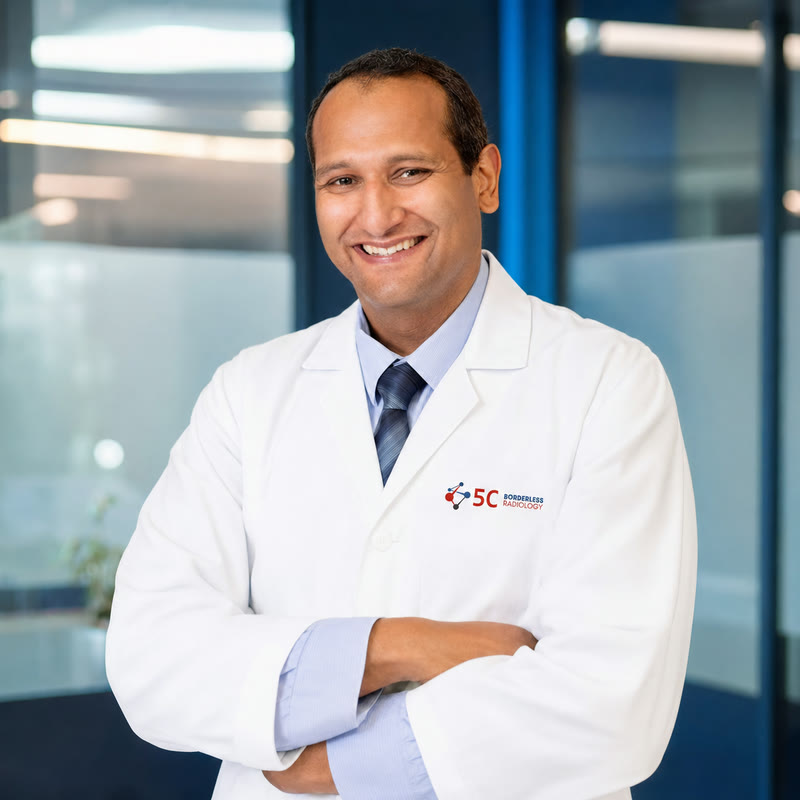
Dr. Ajit S. Shinto
Nuclear medicine physician with more than 20 years in the specialty. He commissioned India’s first digital PET-CT scanner and has personally reported more than 30,000 PET-CT studies. He has built nuclear medicine departments three times over: at Amala, at Kovai Medical Center, and at Apollo Proton Cancer Centre.
Full profile →- Commissioned India's first digital PET-CT scanner, at Kovai Medical Center and Hospital, Coimbatore
- Personally reported more than 30,000 oncologic, cardiac and neurological PET-CT studies
- Established the nuclear medicine department at Amala Institute of Medical Sciences, Thrissur
- Built Kovai Medical Center’s department into a regional centre of excellence over nine years
- Commissioned the nuclear medicine division at Apollo Proton Cancer Centre, South Asia’s first proton therapy centre
- Established high-dose theranostics and Lu-177 PSMA / DOTATATE protocols at Bharath Hospital, Kottayam
- Chairs the Rhenium Task Force of the World Association of Radiopharmaceutical and Molecular Therapy (WARMTH)
“Nuclear medicine in India is limited less by equipment than by reading capacity. A remote reading model built on credentialed physicians takes that scarce expertise to centres that cannot hire it. What a Centre of Excellence adds is depth: sub-specialty readers, structured reporting, peer review, AI in the read. Better science, closer to the treatment decision.”
“India has the scanners but not enough physicians to read them, and it cannot add them fast enough, at roughly 40 new specialists a year against volumes compounding at 13%. A Centre of Excellence is how you make scarce expertise travel: pooled sub-specialty readers, interpreting to a high standard, with AI supporting them for speed and accuracy.”
How a study moves through the Centre
- 01
Your scanner sends
Studies arrive over standard DICOM from your PET-CT or gamma camera, with prior studies and clinical history.
- 02
Routed to the right reader
A credentialed nuclear medicine physician picks up the study. Sub-specialty pods for onco, cardiac and neuro PET are the direction of build.
- 03
Read with AI alongside
Decision support for lesion tracking, SUV quantification and response assessment is being built into the read. It assists the physician; it does not sign.
- 04
Signed, structured, peer-reviewed
The physician signs a report structured to the right criteria, with peer review as part of the Centre's standard.
More than a reading room
The Centre is also meant to raise the standard of nuclear medicine in India, and to make it a specialty students want to choose.
Research and publications
Multi-institutional studies and publication, led by a Principal Investigator on active nuclear medicine trials.
Theranostics
Helping centres build theranostic capability, and reading the scans that decide who is eligible for Lu-177 PSMA and DOTATATE therapy.
New diagnostic molecules
Bringing newer tracers into routine Indian practice as they arrive.
Therapy decisions
A nuclear medicine view on whether a treatment is working and what should change, written for the treating team.
Built for three kinds of centre
Diagnostic and imaging centres
You own a PET-CT or gamma camera but cannot keep a nuclear medicine physician on staff. Standard staging and restaging reports, signed by a specialist, so the scanner can run at the capacity it was bought for.
Hospitals
Your physicians want comparisons with the last scan and a clear answer on response. Comparison and response reports, with cover for nights, leave and overflow.
Oncology hospitals and cancer centres
Your tumour board needs staging, response tables and a view on theranostic eligibility. Tumour-board-ready reports that anticipate the board's questions.
In the news
All coverage →- Express Healthcare 5C Network launches remote Centre of Excellence for Nuclear Medicine
- News Patrolling 5C Network Launches AI-Integrated Centre of Excellence for Nuclear Medicine to Bridge India's Cancer Diagnostics Deficit
- Business News This Week 5C Network Launches AI-Integrated Centre of Excellence for Nuclear Medicine to Bridge India's Cancer Diagnostics Deficit
- Day Life News 5C Network Launches AI-Integrated Centre for Nuclear Medicine
Frequently asked questions
What is the 5C Nuclear Medicine Centre of Excellence?
Who reads and signs nuclear medicine reports at 5C Network?
Is it a physical centre?
Why does India need remote nuclear medicine reporting?
Which studies does the Centre of Excellence report?
Which reporting criteria are used?
How is AI used in 5C's nuclear medicine reports?
What does nuclear medicine reporting from 5C cost?
Send us your nuclear medicine studies
Tell us your scanner, your study mix and your monthly volumes. We will send the report levels and pricing for your centre, and a sample report on the level you choose.
Talk to the Nuclear Medicine Centre of Excellence
Tell us where to reach you — a 5C radiology consultant responds within one business day.