How Does Bionic AI Eliminate Report Contradictions in Radiology
What Is the Critical Problem in Radiology Reporting
Every radiologist faces this challenge: submitting a report that later reveals internal contradictions. A finding states "no pleural effusion" while another section mentions "moderate effusion." These aren't typos, they're clinical coherence breakdowns that erode physician trust and create legal risk.
Contradiction errors result from high-volume workflows combining templates, voice dictation, and copy-paste methods under time pressure. Manual quality review can't catch everything when radiologists handle 50+ cases daily, making automated AI quality assurance essential.
What Are the Three Types of Critical Report Errors
Contradiction Errors
The Issue: Reports contain conflicting statements across sections—findings say "no mass" while impression describes "a 3cm lesion," or liver is described as both "enlarged" and "normal."
The Impact: Referring physicians receive confusing information that delays treatment decisions, triggers quality review callbacks, and creates indefensible documentation for legal proceedings.
Missing Organ References
The Issue: Template-based reporting generates incomplete phrases like "is enlarged with coarse texture" without specifying which organ, especially common with voice dictation shortcuts.
The Impact: Multi-organ studies become ambiguous when findings lack anatomical specificity, forcing clinicians to guess which structure is referenced and risking wrong-organ interpretation.
Ambiguous Pronoun Usage
The Issue: Reports use vague references like "it appears normal" or "this shows thickening" without clearly identifying the anatomical structure being described.
The Impact: Unclear pronouns force referring physicians to interpret which organ is referenced, creating potential misdiagnosis risk and requiring clarification calls that waste clinical time.
How Does Bionic's AI Quality Engine Work
The Technology Foundation
Bionic uses specialized language models fine-tuned specifically on radiology reports to analyze clinical meaning, not just keywords. The system runs in real-time during report creation, catching errors before submission rather than requiring post-review corrections.
Three integrated AI components work simultaneously to ensure report quality: contradiction detection, reference completion, and clarity enhancement. Each operates independently while sharing context to maintain clinical coherence.
LEARN MORE ABOUT AI-POWERED RADIOLOGY QA
The Clash Agent
Functionality The Clash Agent analyzes every statement across all report sections to identify conflicting findings. It understands clinical meaning contextually, detecting contradictions even when phrased differently—like "no pneumothorax" followed by "small left-sided pneumothorax."
Clinical Value Prevents contradictory reports from reaching referring physicians, eliminating embarrassing quality callbacks and protecting radiologists from legal exposure. Catches subtle conflicts that human reviewers miss under time pressure.
Organ Reference System
Functionality Identifies incomplete sentences missing anatomical specificity, analyzes surrounding context to determine intended organ, and suggests proper anatomical references like changing "is enlarged" to "the liver is enlarged."
Clinical Value Ensures every finding includes clear anatomical location, preventing misinterpretation in complex multi-organ imaging studies. Maintains report precision that supports accurate clinical decision-making.
Language Clarity Module
Functionality Parses each sentence for vague pronouns, unclear references, inconsistent tense usage, and ambiguous medical terminology. Suggests specific rewrites that eliminate interpretive risk while maintaining clinical accuracy.
Clinical Value Creates defensible reports with zero ambiguity, reducing follow-up clarification requests from clinicians. Ensures findings are communicated clearly without room for misreading or misinterpretation. SEE HOW BIONICS APPROACH DIFFERS - BIONIC AI
What Are Real-World Error Prevention Examples
Pleural Effusion Contradiction
Original Report: "No pleural effusion is seen" in the findings section, followed by "moderate left-sided pleural effusion" in impression.
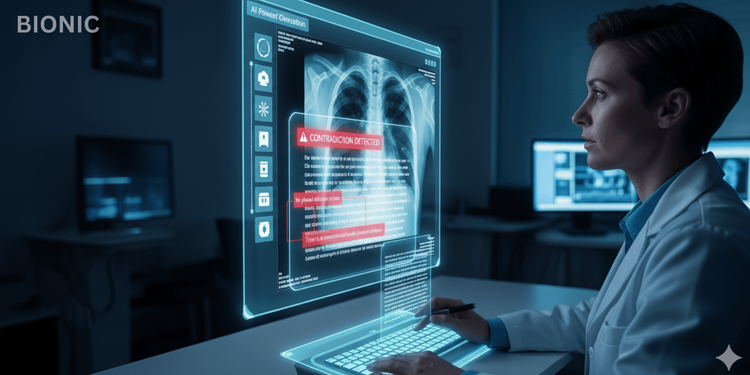
AI Detection: Clash Agent flagged "Contradiction: Effusion is both absent and present" before the radiologist submitted the report.
Resolution: Radiologist corrected inconsistency immediately, preventing confused clinical response and avoiding quality review callback from referring physician.
Ambiguous Liver Finding
Original Report: Abdominal ultrasound stated "Is enlarged with coarse echotexture" without organ specification in multi-organ study.
AI Detection: System identified missing anatomical reference and suggested "The liver is enlarged with coarse echotexture" based on report context.
Resolution: Specific organ reference added, eliminating ambiguity that could have caused wrong-organ interpretation in clinical decision-making.
Unclear Pancreas Reference
Original Report: Abdominal CT stated "It appears unremarkable" using vague pronouns without identifying which structure.
AI Detection: Language module flagged unclear reference requiring anatomical specificity for clinical clarity.
Resolution: Changed to "The pancreas appears unremarkable," removing ambiguity and ensuring clear communication of normal findings.
What Are the Measurable Quality Improvements
For Individual Radiologists
Bionic users produce consistently cleaner reports with standardized terminology, zero contradictions, and complete anatomical references across all sections. Error rates drop significantly even during high-volume shifts when fatigue increases mistake risk.
Fewer clarification callbacks from referring physicians mean less workflow interruption. Improved internal QA scores strengthen professional reputation while reducing legal liability exposure from ambiguous documentation.
For Healthcare Organizations
Hospitals using Bionic report measurably fewer quality incidents requiring report amendments or clarification phone calls. Standardized report quality across all radiologists improves referring physician satisfaction and institutional credibility.
Teleradiology groups particularly benefit from automated QA that maintains quality standards across distributed radiologist networks. Brand protection comes from consistent, defensible reporting regardless of individual reporting styles.
FAQ’s:
1. Do radiologists maintain control?
Yes. Bionic flags potential issues and suggests corrections but requires radiologist approval for all changes.
The AI provides a safety net for fatigue-related errors while preserving professional autonomy. Radiologists can accept, modify, or reject any suggestion, maintaining final authority over clinical content.
2. Does automation slow down reporting speed?
No. Quality checks run simultaneously with dictation without interrupting workflow or adding extra steps.
Error detection happens in real-time as radiologists type or dictate, with immediate flags appearing for quick correction. Most quality fixes take seconds to approve, actually reducing total reporting time by eliminating post-submission corrections.
3. Can it handle different reporting styles?
Yes. Bionic works with voice dictation, typed reports, template-based workflows, and copy-paste methods.
The AI adapts to individual radiologist preferences while applying consistent quality standards. Works seamlessly with existing PACS/RIS systems without requiring workflow changes or retraining.
Why Automated QA Is Essential Now
The Volume Challenge
Radiology imaging volumes grow 5-10% annually while radiologist workforce remains flat, creating unsustainable time pressure per case. Manual quality review becomes impossible at scale, allowing systematic errors to accumulate across high-volume practices.
Automated AI quality assurance is the only scalable solution that maintains report standards without sacrificing turnaround time. Organizations can't rely on human review capacity that doesn't scale with volume growth.
The Quality Imperative
Modern healthcare demands both speed and accuracy simultaneously—neither alone is sufficient for patient safety or institutional reputation. Contradictory reports damage referrer trust immediately while delayed reports compromise timely treatment.
AI enables the speed-quality combination that human processes can't achieve alone. Bionic users don't choose between fast reporting and clean documentation—they achieve both consistently.
What types of errors does Bionic AI catch in radiology reports
Bionic catches three main error types: contradictions (e.g., "no pleural effusion" then "moderate effusion"), missing organ references (e.g., "is enlarged" without specifying what), and ambiguous pronouns (e.g., "it appears normal" without identifying the structure). The system flags these errors in real-time before report submission, preventing misinterpretation by referring physicians.
Does Bionic AI replace radiologist judgment in report writing
No. Bionic flags potential errors and suggests corrections, but radiologists maintain final control over all report content. The AI acts as a quality check, identifying contradictions and ambiguities that might be missed during high-volume shifts. Radiologists can accept, modify, or reject any suggestion—the system supports rather than overrides clinical expertise.
How does Bionic improve radiology report quality without slowing down workflow
Bionic performs quality checks in real-time during dictation without adding extra steps. The system analyzes reports as radiologists write them, instantly flagging contradictions, missing references, and unclear phrasing. This catches errors before submission rather than requiring post-review corrections, actually reducing total reporting time while improving consistency and accuracy.
Add Automated QA to Your Workflow
Every radiologist deserves a safety net. Every hospital needs consistent, readable, defensible reports.
Bionic plugs into existing workflows and starts checking for errors immediately — no change in how you work, just fewer mistakes and more peace of mind. Check out AI in HEALTHCARE