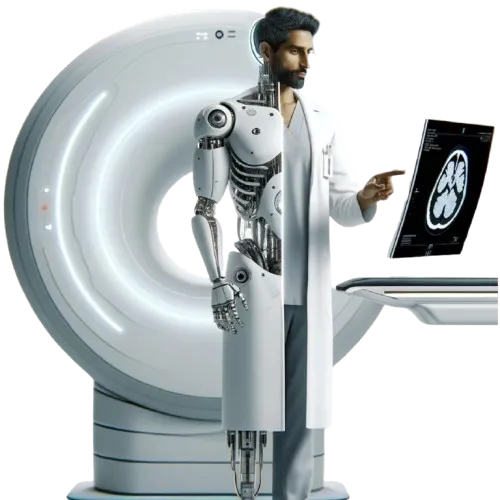
60,000 Studies. One Day. AI Filtered the Normals.
When a screening programme generates tens of thousands of imaging studies, the bottleneck is not image capture. It is interpretation. AI triage separates the normals from the abnormals — so radiologists focus only on what matters.
See How AI Triage WorksIn brief: 5C Network's Bionic AI triages imaging studies into normal and abnormal categories at volumes exceeding 60,000 per day. Normals are filtered out with high-confidence AI classification. Abnormals are routed to radiologists for full interpretation. No study receives a final report without radiologist sign-off. This reduces radiologist workload by 40-60% while maintaining clinical safety.
The Scenario
A large screening programme — spanning multiple facilities — needed to process tens of thousands of imaging studies. The bottleneck was not image capture. It was interpretation. With fewer than 20 radiologists available, the programme faced a reporting timeline measured in weeks.
How AI Triage Works
Four steps from study ingestion to radiologist-signed report
Study Ingestion
Studies arrive via DICOM push, batch upload, or Drive. All standard imaging formats accepted.
AI Classification
Bionic AI classifies each study as normal or abnormal with a confidence score. Processing takes seconds per study.
Normal Filtering
High-confidence normals are separated. Borderline cases are routed to the radiologist queue for full review.
Radiologist Review
Abnormal and borderline studies receive full radiologist interpretation and report. No AI-only final reports.
Triage Flow
The Numbers
Studies triaged in one day
Classified as normal (filtered)
Radiologist workload reduction
AI-only final reports
Source: 5C Network platform data, March 2026.
Clinical Safety
False Negative Monitoring
Real-time dashboards track AI classification accuracy. False negative rates are monitored continuously and reported per deployment.
Human-in-the-Loop
No study receives a final report without radiologist sign-off. AI classifies; the radiologist decides.
Tunable Confidence Thresholds
Confidence thresholds are adjustable per deployment. Higher sensitivity means more studies go to radiologists; higher specificity means more normals are filtered.
Audit Trail
Every AI decision is logged with timestamp, confidence score, and classification result. Full traceability for compliance and quality review.
"AI triage does not replace the radiologist. It replaces the inefficiency of asking a subspecialist to confirm that a normal chest X-ray is, in fact, normal. The radiologist's time is redirected to where it creates clinical value."
Where AI Triage Applies
Diagnostic Chain Volume Spikes
When study volumes spike beyond your reporting capacity, AI triage prevents backlogs from forming.
Trust Hospital Health Check Drives
Annual health check programmes generate thousands of chest X-rays. AI triage processes them in days, not weeks.
Government Screening (TB, NCD)
National TB elimination and NCD screening programmes require population-scale triage. AI handles the volume.
Private Hospital ER Overflow
Emergency departments generate imaging surges. AI triage prioritises critical findings for immediate radiologist attention.
Insurance and Corporate Wellness
Pre-policy medical exams and corporate wellness programmes require fast turnaround on high volumes of routine imaging.
Frequently Asked Questions
AI triage uses machine learning to classify imaging studies as normal or abnormal before radiologist review. High-confidence normals are filtered, reducing the volume that requires full interpretation. At 5C Network, this is powered by Bionic AI, which has been trained on millions of studies.
No. AI triage is a pre-screening layer. Every abnormal study and every borderline case receives full radiologist interpretation. No final report is issued by AI alone. The radiologist remains the clinical decision-maker.
Bionic AI achieves an F1 score of 0.93 across hundreds of pathologies on chest X-ray. Sensitivity and specificity vary by pathology and are shared with institutions before deployment. Confidence thresholds are tunable.
AI triage is most mature for chest X-ray, which represents the highest-volume screening modality. CT and MRI triage capabilities are available for specific use cases. Contact us for modality-specific details.
Bionic AI sits in the routing layer of the 5C platform. Studies are triaged as they arrive — before reaching the radiologist queue. No changes to your imaging equipment or PACS are required. Integration is handled via DICOM connectivity.
Scale Your Screening Programme
AI triage is available for deployment across all imaging volumes. Talk to our team about your screening programme requirements.
Contact Us