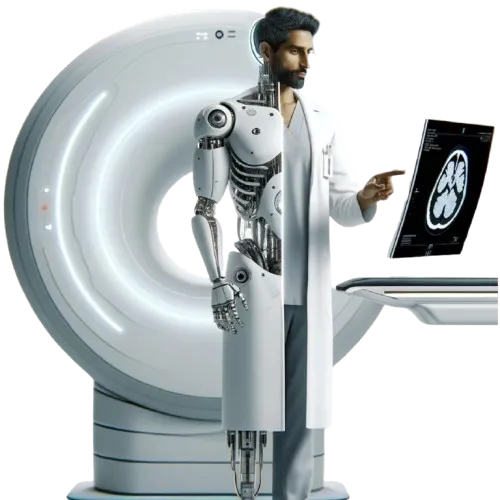
What a radiology second opinion is
When you have a scan, a radiologist interprets the images and writes a report. A second opinion means a different, equally qualified radiologist reads the very same images again — independently, without being anchored to the first report — and writes down what they see.
Nothing physical happens to you. There is no repeat scan, no injection, no radiation, and no appointment at a machine. The entire exercise operates on the image files you already own. That makes it one of the very few checks in medicine with meaningful upside and essentially no bodily risk.
A second opinion has two useful outcomes. If the second read agrees with the first, you proceed with real confidence. If it differs, you and your treating doctor now know precisely what to clarify — before surgery, before treatment, before worry hardens into a decision.
Why two radiologists can read the same scan differently
Radiology is interpretive work. Images contain shadows, overlaps, and borderline findings, and turning them into words requires judgment. Peer-reviewed discrepancy studies have consistently documented that experienced radiologists can reach different conclusions on the same images — most often on subtle or complex cases, and most often in ways that matter only at the margins. It is not a scandal; it is the nature of interpretation, and it is why double-reading and peer review are built into quality radiology practice everywhere.
Subspecialization is the other reason. A radiologist who reads brain MRIs all day accumulates pattern exposure that a generalist covering every modality cannot. Much of India's scan volume is reported by generalists — capable doctors covering a wide field — so a subspecialist re-read of a complex study is often the first time a dedicated expert in that body area has seen your images.
None of this means your report is wrong. Most re-reads confirm the original. The point of a second opinion is not suspicion — it is certainty proportionate to the stakes.
When a second opinion is worth it
A serious or unexpected diagnosis
A suspected cancer, a mass, or any finding that changes your life deserves independent confirmation before you act on it. Confirming the read is not doubting your doctor — it is due diligence on a high-stakes decision.
The report doesn't match your symptoms
A 'normal' report when you are clearly unwell — or a significant finding when you feel fine — is a reasonable trigger for a fresh set of expert eyes.
Before surgery or major treatment
If an operation, chemotherapy, or a long course of treatment rests on what the scan shows, the cost of a re-read is trivial next to the cost of acting on an incomplete interpretation.
Hedged or unclear language
Phrases like 'cannot be ruled out', 'possibly', or 'clinical correlation advised' are honest radiology language for uncertainty. A subspecialist re-read can often narrow that uncertainty.
No subspecialist read the first time
Many scans in India are reported by generalists. A neuroradiologist re-reading a brain MRI, or a musculoskeletal specialist re-reading a shoulder X-ray, brings pattern exposure a generalist may not have.
How to get a radiology second opinion in India
Collect your images
Get the DICOM files from the imaging center — CD, pen drive, or portal link. The printed film or PDF report alone is not enough; the radiologist needs the full image data.
Upload them online
With 5C SecondRead you upload directly at secondread.5cnetwork.com — no referral, no appointment, no travel. You can add your original report, but the re-read is done independently of it.
A super-specialist re-reads
A radiologist who focuses on the relevant body area reviews every image, AI-assisted for completeness, and signs a fresh written report.
Discuss it with your doctor
Take the second report to your treating clinician. If the two reads agree, you proceed with confidence. If they differ, you and your doctor now know exactly what to clarify before acting.
What it costs
The fee scales with the complexity of the study: an X-ray re-read costs less than a multi-sequence MRI review. With 5C SecondRead the exact price for your scan type is shown before you pay — no subscription, no follow-on commitment.
The more useful way to think about cost: a second opinion is a small fraction of the price of repeating the scan, and a rounding error next to the surgery, treatment course, or months of uncertainty that often follow an unconfirmed finding.
What a second opinion is not
A radiology second opinion is a report on your images, signed by a qualified radiologist. It is not a diagnosis of you as a whole patient, not a treatment plan, and not a substitute for your treating doctor — who knows your history, your examination findings, and your context. The second report is written to be taken back to that doctor as an input to their decision.
It also carries no guarantee of a different answer. Often the most valuable outcome is agreement: two independent experts seeing the same thing, so you can stop second-guessing and start deciding.
Frequently asked questions
Can an X-ray, CT, or MRI report be wrong?
Is it worth getting a second opinion on an MRI or CT scan?
How do I get my scan images from the hospital or imaging center?
Will asking for a second opinion offend my doctor?
Do I need a referral for a radiology second opinion in India?
How much does a radiology second opinion cost in India?
Ready for an independent read?
Upload your CT, MRI, X-ray, or mammogram and have a super-specialist from 5C Network's 400+ radiologist panel review it. No new scan, no radiation.
Get a second opinionSecond opinion by scan type
What to send and what a re-read can settle, for the study you actually have.
This guide is written for patients in India. In the UK, the NHS route and your right to a copy of your images work differently — see radiology second opinions for UK patients.