The most common scan, the shortest report
X-rays are the highest-volume study in radiology by a wide margin, and they are reported accordingly: quickly, and often in a single line. That is standard practice rather than a shortcut — most plain films genuinely are normal, and a brief report is the honest description of a normal film.
But two things follow. The first is that less gets written down, so a report may not address the specific question you had when you walked in. The second is that the findings most easily passed over in a long reporting list are exactly the subtle ones: a small nodule, an early consolidation, a small pneumothorax, a hairline fracture.
A second opinion addresses both. One radiologist, one study, no queue behind it — and a written answer to the question you actually asked.
What an X-ray can and cannot settle
An honest second opinion sometimes concludes that the images cannot answer the question. A plain film is a two-dimensional projection of three-dimensional anatomy: structures overlap, and some findings are simply not visible on it. Some fractures — scaphoid fractures being the classic example — can be genuinely invisible on initial films and only become apparent later or on a different study.
That is a useful result, not a failed one. Knowing that your question needs a CT, an MRI or a repeat film in two weeks is better than an inconclusive answer repeated more confidently. Where a second read reaches that conclusion, it says so.
How an X-ray second opinion works
Ask for the image files
Request your X-ray images from the centre that took them — CD, pen drive or download link. Ask for every view, and for any previous X-ray of the same area. In India you are entitled to a copy of your own medical records.
Upload them
Upload the DICOM files at secondread.5cnetwork.com. Add your existing report if you have it — the radiologist reads the images independently first, then addresses where the two readings agree or differ.
A specialist re-reads them
A chest radiologist for a chest film, a musculoskeletal radiologist for a joint or fracture question. Every view is reviewed, assisted by Bionic for completeness.
Take the written opinion to your doctor
You receive a signed written report. If it confirms the original, the question is settled. If it differs — or if it concludes that an X-ray cannot answer your question — you know what to do next.
Ask for the DICOM image files rather than the printed film sheet — the radiologist reads the full image data. Our patient guide covers how to make the request.
When an X-ray is worth a second read
Chest X-ray — a persistent cough or breathlessness
Early consolidation, a small nodule or a subtle interstitial change can be difficult to see on a single film, particularly against a busy reporting list. A second read either confirms the film is clear or identifies what to pursue.
Suspected fracture with ongoing pain
Scaphoid, rib, stress and undisplaced fractures are known to be difficult on initial films. If your X-ray was reported as normal and the pain has not settled, a re-read of the same images is the cheapest next step before another study.
A one-line report
Brief reporting is standard for high-volume plain films. Where the single line does not address the specific question you had, a second read that answers it directly is worth more than the cost.
Pre-employment and screening films
Chest X-rays taken for employment, visa or insurance screening are read quickly and at volume. Where an unexpected finding appears on one, an independent read before you act on it is proportionate.
Comparison with an older film
Some findings only become meaningful next to a previous X-ray. If you have prior films, a re-read that formally compares them can settle whether something is new, stable or resolving.
Paediatric X-rays
Growth plates and developing bone make children's films their own interpretive problem. A radiologist used to paediatric anatomy reads them differently from a generalist.
Who re-reads your X-ray
Your images go to a specialist from 5C Network's panel of 400+ radiologists, matched to the question: a chest radiologist for a chest film, a musculoskeletal radiologist for a joint or fracture. 5C Network reports 15,000+ scans a day for 2,000+ hospitals and diagnostic centres.
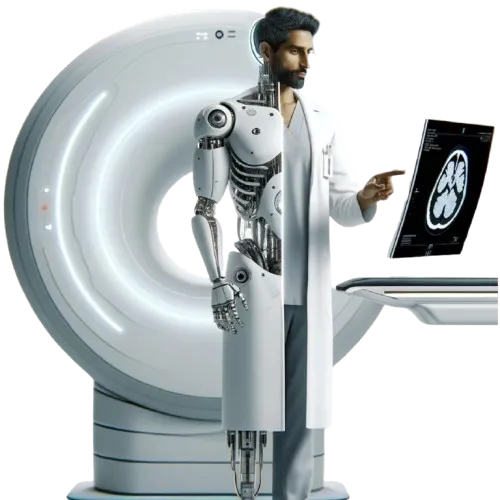
The radiologist reads and signs your report. Bionic, 5C Network's clinical AI, assists by flagging findings for attention so nothing on the film is skipped. Bionic is licensed as a medical device in India and is an assistive tool, not the reader.
On the chest X-ray AI
5C Network's chest X-ray AI was evaluated in a multi-site study across 17 healthcare systems, after training on 5M+ chest X-rays. Across the 76 pathologies evaluated it reached 98% precision and 95% recall, with a mean AUC of 0.97.
Those figures describe the AI's performance on the evaluated set in that study — not the second-opinion service, which is a radiologist's read that Bionic assists. The full methodology, per-pathology results and subgroup analysis are on the clinical evidence page.
Frequently asked questions
Can I get an X-ray reviewed online?
Yes. You upload a copy of your existing X-ray images and a specialist radiologist reviews them and returns a signed written report, without you travelling or being X-rayed again. You need the DICOM image files from the centre that took the X-ray — the printed film or the PDF report alone is not enough, because the radiologist reads the full image data.
Why would an X-ray need a second opinion?
Because X-rays are the highest-volume study in radiology and are often reported very briefly. A one-line report is normal practice, not negligence — but it also means less is written down, and subtle findings such as a small nodule, an early consolidation, a small pneumothorax or a hairline fracture are the ones most easily passed over in a high-volume list. An unhurried second read is cheap relative to what it can catch.
Can a fracture be missed on an X-ray?
Yes, and it is a recognised limitation of the modality rather than a rare failure. Some fractures are genuinely not visible on the initial films — scaphoid wrist fractures are the classic example — and others are visible only on a view that was not taken or on careful inspection. If you have ongoing pain after a 'normal' X-ray, that mismatch between the report and your symptoms is a reasonable trigger for a second read.
My chest X-ray was reported as normal but I still feel unwell. What should I do?
Tell your treating doctor first — the clinical picture matters more than the image. Alongside that, an independent re-read of the same films is inexpensive and quick, and can either confirm the original reading or identify something subtle worth pursuing. A chest X-ray is also a limited test: some findings simply are not visible on it, and a second opinion may conclude that a CT is what your question actually needs.
What do I need to send for an X-ray second opinion?
The DICOM image files, and ideally the original report and any previous X-rays of the same area. Ask the centre that took the X-ray for the images on a CD, pen drive or download link, and ask for every view that was taken rather than a single picture. Comparison against an older film is frequently how a subtle change is confirmed.
How much does an X-ray second opinion cost?
An X-ray re-read is the least expensive second opinion 5C SecondRead offers, because a single study takes less to review than a multi-sequence MRI. The exact price is shown before you commit, with no subscription and no referral needed.
Does a second opinion mean the first X-ray report was wrong?
No, and most re-reads confirm the original report. Radiology is interpretive work and reporting lists are long. Confirmation is a useful result in itself — it turns a lingering doubt into a settled question. Where the two readings differ, you and your treating doctor know exactly what to clarify.
Is AI reading my X-ray?
No — a radiologist reads your X-ray and signs the report. 5C Network's Bionic AI assists that radiologist by flagging findings for attention so nothing is skipped, and it is licensed as a medical device in India. The clinical judgement, and the signature on your report, belong to the radiologist.
Get your X-ray reviewed
Upload the X-ray you already have. A specialist radiologist reviews every view and returns a signed written report for your treating doctor. The lowest-cost second opinion 5C SecondRead offers, priced before you commit.
Start at secondread.5cnetwork.comHave a CT or MRI instead? See CT scan second opinion or MRI second opinion.
Scope. A second opinion is an independent interpretation of existing images. It does not include a physical examination, does not prescribe treatment, and does not replace the judgement of the doctor treating you. 5C Network's radiologists are registered with India's National Medical Commission. Bionic is licensed as a medical device in India. Where a finding needs urgent attention, contact your treating doctor or emergency services rather than waiting for a second read.