Reporting-support infrastructure for UK radiology — your GMC-registered radiologists stay in charge
The NHS spent £241m on outsourced reporting in 2025, per the RCR. 5C takes a different position in the stack: human-in-the-loop support for every radiologist — AI-assisted workflow, expert-reviewed draft output and QC infrastructure that make each GMC-registered radiologist faster, not a substitute reporting service.
- What does 5C Network offer in United Kingdom?
- 5C provides UK imaging providers with human-in-the-loop reporting support: AI-assisted workflow orchestration, structured draft output that an NMC-registered specialist radiologist reviews before it reaches your team, and an automated QC layer — your radiologists never receive raw AI output. 5C does not report UK imaging: every report is authored and signed by a radiologist with GMC registration and a licence to practise, using 5C’s expert-reviewed drafts as decision support.
- Who signs the final report?
- The reporting clinician is a GMC-registered radiologist holding a licence to practise, reporting within their employer’s or insourcing provider’s clinical governance framework. Clinical and medico-legal responsibility for every report sits with that radiologist — 5C’s expert-reviewed drafts and QC signals are inputs they are free to accept, amend or reject.
How the backend model works
RCR standards are explicit that anyone reporting UK imaging must be GMC-registered with a licence to practise, and 5C’s UK model is built around that line rather than against it. What 5C supplies sits below the reporting act: triage and worklist orchestration, structured draft output — prepared through 5C’s workflow and reviewed by an NMC-registered specialist, never raw AI output — for the reporting radiologist to review, amend and sign, and a QC pipeline over the reporting workflow. Outsourced reporting itself is normal at NHS scale — £241m spent in 2025, per the RCR — but 5C’s role is to expand the productivity of GMC-registered reporters, not to add another outsourced reporting pool.
- 1
Scope and residency are agreed first: 5C can deploy UK/EEA-resident hosting with expert review against locally resident data; where a transfer to India applies, the IDTA (or UK Addendum) plus a Transfer Risk Assessment are executed — typically with pseudonymized imaging — before integration begins.
- 2
Your PACS/RIS connects to 5C over a secure DICOM integration, typically live within 72 hours.
- 3
AI-assisted triage and worklist orchestration organize the queue; for each case, an NMC-registered specialist radiologist reviews the structured draft and QC signals before release — your radiologists receive an expert-reviewed draft, never raw AI output.
- 4
Your GMC-registered radiologists report from this prepared worklist — reviewing, amending and signing every report themselves, with 5C’s QC pipeline and audit trail running underneath.
- 5
Throughput, turnaround and QC metrics are reported back to your clinical governance leads, so the productivity gain is measured rather than asserted.
Two experts behind every study — and honest regulatory status
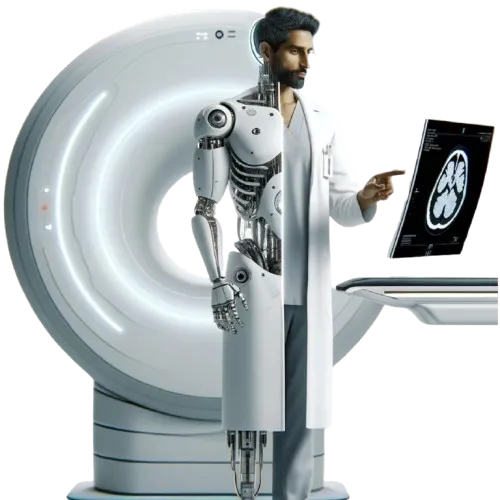
Bionic, 5C's clinical AI engine, is approved for clinical use in India. Outside India it operates as workflow and quality infrastructure, not as a cleared medical device. What travels with every study instead is human expertise: an NMC-registered Indian specialist reads each case as structured decision support, so the clinician who signs in United Kingdom starts from an expert-reviewed draft — human-in-the-loop support for every radiologist, on every study.
Radiology capacity in United Kingdom
The RCR 2024 census reports a 29% shortfall of clinical radiologists, projected to reach 39% by 2029, and roughly 940,900 scan results in England took over a month to report in 2025. The constraint is reporting capacity per radiologist — which is exactly the variable workflow infrastructure can move.
The India time-zone advantage
India is 4.5–5.5 hours ahead of the UK, so India’s morning runs before the UK working day begins. Overnight accumulation is triaged, prepared and QC-processed so reporting radiologists start their 9 am session against an organized, draft-supported worklist rather than a raw queue.
Data protection & compliance
5C supports UK/EEA-resident deployment, with expert review performed against locally resident data — aligned with NHS off-shoring guidance, which favours UK/EEA hosting. Where a restricted transfer to India does apply, it is underpinned by the ICO’s International Data Transfer Agreement (or the UK Addendum to the EU Standard Contractual Clauses) together with a documented Transfer Risk Assessment — executed per engagement, not assumed — typically with pseudonymized imaging data and UK-resident identifiers. 5C’s security and privacy management is certified to ISO 27001 and ISO 27701.
ISO 27001, 27701, 13485 and 9001 certified — relevant to both information governance and clinical quality management diligence.
Infrastructure proven at volume: 20M+ studies processed, 15,000+ studies per day across 2,000+ hospitals and diagnostic centres in India.
Around 400 NMC-registered radiologists on the network — the specialists who review every draft before it reaches your team.
Automated QC pipeline on every study, giving audit-ready consistency checks across the reporting workflow.
Full audit trail per study — who touched what, when — supporting clinical governance and information governance reviews.
DICOM/PACS integration in about 72 hours, so evaluation can run on live workflow rather than slideware.
Frequently asked questions
Can radiologists in India report our UK imaging?
Is sending imaging data to India lawful under UK GDPR?
Who is clinically responsible for the report?
Is 5C’s AI approved for clinical use in the UK?
How is this different from outsourced reporting companies?
Also serving
🇬🇷 Europe
Greece
Greek imaging runs on a thin radiologist layer stretched across islands and a large private diagnostic sector. 5C adds human-in-the-loop support for every radiologist — triage support, expert-reviewed drafts and QC infrastructure — while every clinical interpretation is made and signed by a Greek-registered radiologist.
🇺🇸 Americas
United States
The nighthawk model is more than twenty years old and was pioneered from Bangalore. 5C runs it at modern scale: preliminary overnight reads, AI-driven workflow and QC — with final interpretation, signature and billing always by your US radiologist.
🇦🇪 Middle East
United Arab Emirates
The DHA telehealth standards expressly allow a UAE-licensed physician to consult an expert physician licensed in another jurisdiction. 5C builds on exactly that footing: AI-driven workflow and expert-reviewed preliminary reads that support your DHA, DoH or MOHAP-licensed radiologist — who issues every final report.
Sources
Every regulatory and workforce claim on this page traces to a primary or peer-reviewed source.
- Royal College of Radiologists — Clinical Radiology Workforce Census reports
- Royal College of Radiologists — NHS spent record £1.4bn on short-term fixes to radiologist shortage in past 5 years
- ICO — International transfers guidance (UK GDPR)
- ICO — Standard data protection clauses: the UK IDTA and the Addendum
- NHS England — NHS and social care data: off-shoring and the use of public cloud services
- General Medical Council — Registration and licensing
Bring 5C's AI and clinical backend to your imaging operation in United Kingdom
Your clinicians keep clinical authority. 5C brings the AI, the preliminary reads, and the quality infrastructure behind them.