Overnight preliminary reads for Canadian radiology — your provincially licensed radiologist signs
Per the Canadian Association of Radiologists, MRI volumes more than doubled and CT volumes nearly doubled between 2006 and 2023, while wait times worsened. 5C adds capacity beneath your radiologists: preliminary overnight reads, AI-driven workflow and QC, with the final report always signed in-province.
- What does 5C Network offer in Canada?
- 5C provides Canadian hospitals, imaging clinics and radiology groups with human-in-the-loop support: every study receives a structured preliminary read by an NMC-registered radiologist in India, with AI-assisted triage, worklist orchestration and an automated QC pipeline underneath — your team never receives raw AI output. Every study returns to your radiologist, licensed by the college in your province, who performs the final interpretation and signs the report. 5C never issues the final report for Canadian patients.
- Who signs the final report?
- The signing radiologist holds a license from the medical regulatory college of the province where the patient is imaged — the CPSO in Ontario, for example — together with your hospital’s credentialing. Medico-legal responsibility for the final report rests with that radiologist; 5C’s preliminary reads and QC flags are inputs to their judgment, never a substitute for it.
How the backend model works
Medical licensure in Canada is provincial, and the colleges are clear about who practices on their patients. The College of Physicians and Surgeons of Ontario’s Virtual Care policy, for example, requires physicians providing virtual care to patients in Ontario to hold a CPSO certificate of registration, with narrow patient-interest exceptions that it says may not be used to circumvent Ontario licensing. 5C’s model does not ask for an exception: its preliminary read is a work product for your licensed radiologist, who reports, signs and holds responsibility. Each engagement is structured with your counsel against your province’s rules.
- 1
Scope is agreed first: your privacy office confirms which instruments apply — PIPEDA, PHIPA or another provincial health privacy law, and any public-body rules such as BC’s FIPPA or Nova Scotia’s PIIDPA — and the matching contract and hosting configuration are documented before any data moves.
- 2
Your PACS connects to 5C over a secure DICOM integration, typically live within 72 hours.
- 3
Overnight and overflow studies route to 5C, where AI-driven triage and worklist orchestration prioritize urgent cases and flag studies for QC attention.
- 4
An NMC-registered radiologist reads every study and produces a structured preliminary interpretation during India’s working day, and each read passes through 5C’s automated QC pipeline before release — your team never receives raw AI output.
- 5
Your provincially licensed radiologist performs the final interpretation and signs the report, with the full study context and a complete audit trail in front of them.
Two experts behind every study — and honest regulatory status
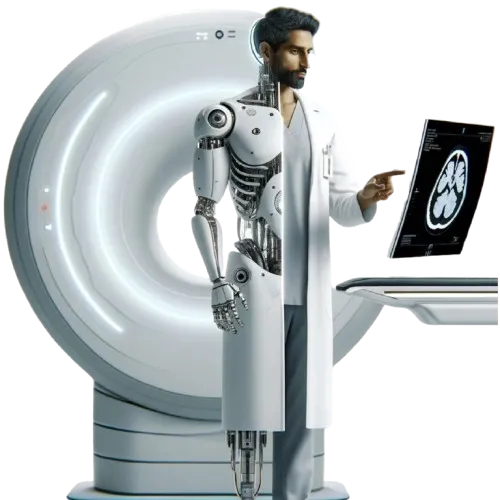
Bionic, 5C's clinical AI engine, is approved for clinical use in India. Outside India it operates as workflow and quality infrastructure, not as a cleared medical device. What travels with every study instead is human expertise: an NMC-registered Indian specialist reads each case as structured decision support, so the clinician who signs in Canada starts from an expert-reviewed draft — human-in-the-loop support for every radiologist, on every study.
Radiology capacity in Canada
The Canadian Association of Radiologists’ March 2026 policy statement reports that MRI scans rose 117% (1.02 million to 2.21 million a year) and CT scans 90% (3.38 million to 6.42 million) between 2006 and 2023, that wait times worsened anyway, and that in many provinces one patient in ten waits well over 100 days for an MRI. It names human resource shortages as a primary driver.
The India time-zone advantage
The Canadian night is India’s working day: India is 10.5 hours ahead of Eastern Standard Time and 13.5 hours ahead of Pacific Standard Time (9.5 and 12.5 in daylight time). At 10 pm in Toronto in winter it is 8:30 am in Bengaluru, so overnight studies are read during India’s day and waiting on your radiologist’s worklist by morning.
Demand has outgrown imaging capacity
The Canadian Association of Radiologists’ policy statement Reducing Diagnostic Imaging Wait Times in Canada (board-approved March 2026) describes a system “running red”: MRI scans rose from 1.02 million to 2.21 million a year and CT scans from 3.38 million to 6.42 million between 2006 and 2023, and hospitals performed 16% more scans over 2019–2024 than before the pandemic, yet wait times got longer.
Citing CIHI data, the same statement says that in many provinces one patient in ten waits significantly longer than 100 days for an MRI, and it names human resource shortages as a primary driver of wait times, alongside aging equipment and a scanner fleet that ranks 27th of 31 universal health systems for MRI units per capita.
5C Network cannot add scanners, and it does not replace Canadian radiologists. What it can add is reading capacity beneath them: preliminary reads prepared overnight, and QC on every study, so your radiologists spend their hours finalizing rather than starting from a raw queue.
Licensure is provincial — and so is the signer
There is no national medical license in Canada; each province’s college regulates who may practice on its patients. The CPSO’s Virtual Care policy is a clear example: physicians providing virtual care to patients located in Ontario must hold a valid CPSO certificate of registration, and its patient-interest exceptions — care not readily available in Ontario, bridging an existing relationship, urgent or emergency care — are not a route to practicing primarily in the province without a license.
5C Network therefore never acts as the practitioner of record. The preliminary read from India is an input to your radiologist, who is licensed in your province, issues the final interpretation and is named on the report. Where a group reads across provinces, the licensing map is documented per site before go-live rather than assumed.
Privacy: a federal baseline with provincial rules on top
For private-sector organizations, the Office of the Privacy Commissioner’s guidelines for processing personal data across borders state that PIPEDA does not prohibit transfers to another jurisdiction for processing; the organization remains responsible for the information, must use contractual or other means to provide a comparable level of protection, and must make it plain to individuals that their information may be processed in a foreign country.
Health privacy is also provincial. Ontario’s Information and Privacy Commissioner says in its PHIPA FAQ (September 2015) that PHIPA does not require personal health information to be retained and stored in Ontario or Canada, but that the custodian remains accountable for its agents and must ensure safeguards, for example through contracts. Public bodies face stricter rules in some provinces: British Columbia’s FIPPA section 33.1 lets a public body disclose personal information outside Canada only in accordance with the minister’s regulations, and Nova Scotia’s PIIDPA requires public bodies, including health authorities, and their service providers to keep personal information in Canada unless the head of the public body allows otherwise as necessary for operations and reports that decision to the Minister of Justice.
The practical consequence: a private imaging clinic in Ontario and a public health authority in Nova Scotia are not in the same position. 5C Network scopes each engagement against the client’s own status and province, and where public-sector residency rules apply, the hosting configuration is agreed and documented before integration.
Data protection & compliance
PIPEDA does not prohibit transferring personal information to another jurisdiction for processing, but the transferring organization stays accountable, must secure comparable protection by contract, and must tell individuals their information may be processed abroad, per the Office of the Privacy Commissioner’s cross-border guidelines. Provincial law then layers on top: Ontario’s IPC says PHIPA does not require health information to be stored in Ontario or Canada, while British Columbia’s FIPPA and Nova Scotia’s PIIDPA set their own rules for public bodies. 5C names the instrument per engagement and holds ISO 27001 and ISO 27701 certification.
ISO 27001, 27701, 13485 and 9001 certified — security, privacy and quality management audited to international standards.
20M+ studies reported and 20,000+ studies handled per day across 2,000+ hospitals and diagnostic centers in India.
400+ NMC-registered radiologists on the network, giving genuine subspecialty depth for overnight preliminary coverage.
Automated QC pipeline runs on every study — not a sampled fraction — before any preliminary read is released.
Full audit trail on every study, supporting your credentialing, peer-review and privacy-office requirements.
DICOM/PACS integration in about 72 hours, so a pilot can start on real workflow quickly.
Frequently asked questions
Can radiologists in India read studies for a Canadian hospital?
Does Canadian privacy law allow imaging to be processed in India?
Who is responsible for the final report?
How does the time-zone difference help a Canadian department?
Is 5C’s AI licensed by Health Canada?
Also serving
🇺🇸 Americas
United States
The nighthawk model is more than twenty years old and was pioneered from Bengaluru. 5C runs it at modern scale: preliminary overnight reads, AI-driven workflow and QC — with final interpretation, signature and billing always by your US radiologist.
🇬🇧 Europe
United Kingdom
The NHS spent £241m on outsourced reporting in 2025, per the RCR. 5C takes a different position in the stack: human-in-the-loop support for every radiologist — AI-assisted workflow, expert-reviewed draft output and QC infrastructure that make each GMC-registered radiologist faster, not a substitute reporting service.
🇦🇺 Asia-Pacific
Australia
The federal health department’s workforce model projects a radiologist shortage through 2048. 5C does not add an offshore reporting pool: it adds AI-assisted workflow, expert-reviewed preliminary reads and QC beneath the Ahpra-registered radiologist who reports and signs every study.
🇧🇩 South Asia
Bangladesh
Bangladesh has roughly 700 radiologists for 170 million people, concentrated in Dhaka. 5C brings AI-driven workflow and expert-reviewed preliminary reads from next door — same working day, 30 minutes apart — behind the BMDC-registered clinician who issues every final report.
Sources
Every regulatory and workforce claim on this page traces to a primary or peer-reviewed source.
- Canadian Association of Radiologists — Policy statement: Reducing Diagnostic Imaging Wait Times in Canada (March 2026)
- College of Physicians and Surgeons of Ontario — Virtual Care policy
- Office of the Privacy Commissioner of Canada — Guidelines for processing personal data across borders
- Information and Privacy Commissioner of Ontario — Frequently Asked Questions: PHIPA (September 2015)
- BC Laws — Freedom of Information and Protection of Privacy Act, section 33.1
- Nova Scotia Department of Justice — FAQ: Personal Information International Disclosure Protection Act
Bring 5C's AI and clinical backend to your imaging operation in Canada
Your clinicians keep clinical authority. 5C brings the AI, the preliminary reads, and the quality infrastructure behind them.