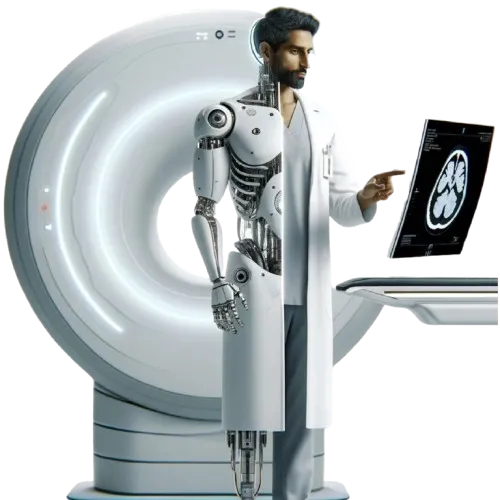
DICOM viewer comparison
RadDream vs OHIF Viewer
Two browser-based DICOM viewers. One is an open-source framework you host and build on, one is a finished reading room with AI and reporting in it.
Last updated: October 2026
TL;DR
The OHIF Viewer (Open Health Imaging Foundation, a program of Massachusetts General Hospital) is a free, MIT-licensed, zero-footprint web viewer and framework. You host it, connect it to a DICOMweb archive and extend it with your own modes; per its FAQ it is not FDA cleared or CE marked. RadDream (5C Network, India) is the browser-based viewer inside 5C's platform, with Bionic AI findings on the image, the report editor one click away, and MPR, curved MPR, 3D and PET-CT fusion.
Choose OHIF if you have engineers and want open source to build on. Choose RadDream if you want the viewer, the AI and the reporting as one working system: it is the viewer for every study 5C's 400+ specialist radiologists read.
By 5C Network
RadDream
The AI-native viewer inside 5C's platform. Engineered in-house, used every day by 400+ specialist radiologists.
- ✓Bionic AI findings on the image
- ✓Report editor one click from the image
- ✓MPR, curved MPR, 3D, MIP, PET-CT fusion
- ✓Nothing to host: 5C runs it in the cloud
- ✓Engineered for speed at 20,000+ scans a day
By the Open Health Imaging Foundation
OHIF Viewer
An open-source, zero-footprint web viewer and framework for building imaging applications (per OHIF).
- ✓Free and open source, MIT license
- ✓Extensions and modes for custom workflows
- ✓MPR, MIP, volume rendering, segmentation
- ✓Works with any DICOMweb archive
- ✓NIH/NCI-funded, with a large community
The key difference
OHIF is a framework. It gives your engineers an excellent open-source viewer to host, connect to an archive and shape into their own application. RadDream is a reading room. It is already hosted, already connected, the AI has already looked at the study and the radiologist signs the report in the same screen.
How do OHIF and RadDream compare, feature by feature?
| Feature | RadDream | OHIF Viewer |
|---|---|---|
| Made by | 5C Network (Bengaluru, India) | Open Health Imaging Foundation, a program of Massachusetts General Hospital, developed with Radical Imaging |
| What it is | A finished reading room: viewer, AI and reporting in one system | An open-source framework and viewer you host, configure and build on |
| License and cost | Comes with 5C's platform: reporting and 5C SuperPACS | Free and open source under the MIT license |
| Runs in | Any web browser, nothing to install | Any web browser (zero-footprint progressive web app) |
| What you need to run it | Nothing extra: 5C runs it in the cloud | Your own web hosting plus an image archive that supports DICOMweb |
| AI | Bionic AI built in: findings on the image, draft impression beside it | AI is something you integrate; OHIF's core engineers offer expert support to integrate AI |
| Reporting | Report editor one click from the image; 400+ radiologists on demand | Renders DICOM structured reports and PDFs; reporting comes from the system you connect |
| Advanced visualization | MPR, curved MPR, 3D volume rendering, MIP, PET-CT fusion | MPR, MIP, volume rendering, 4D, PET/CT, segmentation and RT STRUCT |
| Core tools | Window/level, measurements, annotations, hanging protocols, layouts, linked series, priors, cine, shortcuts | Annotations and measurement tracking, plus whole-slide microscopy and video |
| Customization | Configured by 5C | Extensions and modes: build your own task-based workflows in React |
| Regulatory | Bionic AI is CDSCO-licensed (Class B); every 5C report is signed by a radiologist | Per its FAQ, NOT FDA cleared or CE marked; compliance is the user's responsibility |
| Support | 5C's team | Community channels, plus expert support from OHIF's core engineers |
OHIF details are from ohif.org, its GitHub repository and its documentation FAQ as of 26 October 2026; check current capabilities with OHIF directly. OHIF is a trademark of its owner, used here only to compare products.
Why would you pick a framework over a finished viewer?
OHIF is built to be built on. It offers GPU-accelerated viewing in the browser, a plugin framework for task-based modes, and a React component library, all under the MIT license. OHIF's GitHub says it has served as the basis for many production and FDA-cleared viewers. If you have a team that wants that freedom, it is hard to beat.
That freedom comes with work. You host it, connect it to a DICOMweb archive, secure it and keep it updated. OHIF's own FAQ says the viewer is not FDA cleared or CE marked and is not HIPAA compliant by itself; compliance is the user's responsibility. AI and reporting are things you add.
RadDream is built to be read in. 5C's engineers wrote it for one job: helping a radiologist get through a study, then the next. Bionic AI has pre-read the study before it opens, its findings sit on the image, the draft impression is beside it and the report editor is one click away. For the archive side, see 5C SuperPACS and our guide to the best PACS software in India. Weighing a commercial viewer instead? Read RadDream vs MedDream.
Which one fits you?
Choose RadDream if you:
- ✓You want a working reading room, not a software project
- ✓You want AI findings on the image without sourcing and integrating an AI vendor
- ✓You want the viewer, the report and the radiologists in one system
- ✓You have no engineering team to host, secure and maintain a viewer and a DICOMweb archive
- ✓You are a hospital or diagnostic center in India reporting with 5C, or choosing a PACS
OHIF may fit better if you:
- ✓You have engineers and want to host, customize and extend the viewer yourself
- ✓You want free, open-source software under the MIT license
- ✓You are building your own imaging product or research tool on top of a viewer
- ✓You run research or clinical-trial imaging and need custom workflow modes
- ✓You need whole-slide microscopy or other specialist views OHIF supports
Viewers are best judged on your own studies. Tell us your modalities and volumes, and we'll open them in RadDream with Bionic AI.
See RadDream on your own studies
Tell us where to reach you — a 5C radiology consultant responds within one business day.
Frequently asked questions
What is the difference between OHIF and RadDream?
OHIF is a free, open-source, zero-footprint web viewer and framework from the Open Health Imaging Foundation, a program of Massachusetts General Hospital. You host it yourself, point it at a DICOMweb archive and extend it with your own modes. RadDream is 5C Network's browser-based viewer and the finished reading room inside 5C's platform: Bionic AI findings sit on the image, the report editor is one click away, and 400+ specialist radiologists read in it every day. OHIF is a foundation you build on; RadDream is ready to read in.
Is RadDream a good OHIF viewer alternative?
For hospitals and diagnostic centers that want a working reading room without an engineering team, yes. RadDream comes with 5C's platform, so the hosting, the archive, the AI and the reporting are already joined up. If you have developers, want free open-source code you can change, or are building a research tool or your own product, OHIF is the better starting point.
Is OHIF free?
Yes. The OHIF Viewer is open source under the MIT license, per its GitHub repository. The software is free, but you still need to host it and connect it to an image archive that supports DICOMweb, which takes engineering time and infrastructure.
Is the OHIF Viewer FDA cleared?
No. OHIF's own FAQ says the OHIF Viewer is not FDA cleared or CE marked, and that it is the users' responsibility to ensure compliance with applicable rules and regulations. The same FAQ notes its license does not stop a company from seeking FDA clearance for a product built on the platform, and OHIF's GitHub says it has served as the basis for FDA-cleared viewers.
Does OHIF have AI or reporting built in?
OHIF is a viewer framework: AI and reporting are things you integrate. It renders segmentations, DICOM structured reports and PDFs, and ohif.org offers expert support from OHIF's core engineers to integrate AI. RadDream includes Bionic AI, 5C's clinical AI engine, which covers 74 chest X-ray pathologies with a 0.93 F1 score in peer-reviewed research, plus a report editor one click from the image.
Do OHIF and RadDream support MPR, 3D and PET-CT fusion?
Both do advanced visualization in the browser. OHIF's GitHub and website list MPR, MIP, volume rendering, 4D and PET/CT. RadDream includes MPR, curved MPR, 3D volume rendering, MIP and PET-CT fusion.
Can I self-host or modify RadDream like OHIF?
No. RadDream comes with 5C's platform, for hospitals and diagnostic centers reporting with 5C or running 5C SuperPACS. It is not open source, not white-label and not sold as a standalone download. If you need to self-host and change the code, OHIF is built for that.