A Scanner Does Not Make a Radiology Department
The day after an expensive new CT or MRI is installed, a centre has a scanner. It does not yet have a radiology department.
I have seen this moment many times. The gantry is clean, the launch photographs are done, referrals are being discussed, and everyone is proud. A scanner is a serious capital decision. But the machine is the visible part of the service, not the whole service.
The difficult work starts after installation: making the examination happen properly on a busy afternoon, during a power interruption, when the senior technician is on leave, or when an urgent case arrives in a queue of routine studies.
Patients and clinicians experience whether the scan is done well, whether the report is useful, and whether somebody owns problems when things go wrong.
The machine is the easy part to see
Every centre can describe its scanner: the number of slices, the magnet strength, the new software release. These details shape the examinations a centre can offer.
But a scanner cannot decide whether a CT pulmonary angiogram had the right contrast timing. It cannot notice that a restless child has made a brain MRI non-diagnostic, assign a difficult oncology follow-up, or call a surgeon about an unexpected finding.
These are operating decisions. They happen hundreds of times a day, usually without drama. When they are made consistently, a department feels dependable. When they are not, even a very good machine becomes a source of re-scans, avoidable calls, delayed reports and quiet loss of clinician confidence.
The mistake is to treat radiology as an equipment business with a reporting layer attached. It is an operating system that happens to use expensive equipment.
Protocols are how standards survive a busy day
A protocol is not a PDF prepared for accreditation and forgotten in a folder. It is the shared answer to practical questions: Which sequence is essential for this MRI? What should happen when the creatinine value changes the contrast plan? Who confirms that a trauma CT covers what the emergency clinician is asking? When should a technician pause and escalate rather than proceed?
Good protocols make room for clinical judgment, but they remove needless variation. A patient should not receive a fundamentally different examination because the shift changed at 2 pm.
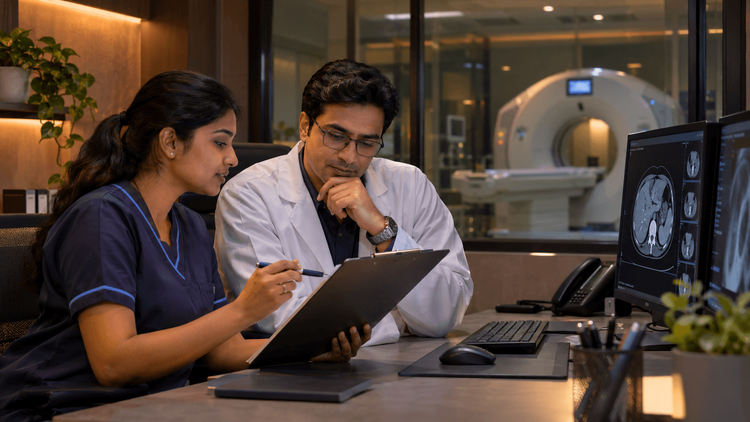
Technician consistency is central here. The technician is often the person who turns a clinical request into an actual study. Positioning, communication with an anxious patient, contrast preparation, image review before the patient leaves, and knowing when to ask for help are not minor execution details. They determine whether the radiologist gets a study worth reporting.
Well-run centres make this visible. They review rejected and repeated studies, discuss why a sequence was missed, and update protocols when a recurring issue appears. This is how the department learns before an inconsistency becomes normal practice.
Uptime is not the same as recovery
Every machine will have downtime. Hardware needs service. Software behaves unexpectedly. A tube reaches the end of its life. The meaningful question is what the centre does next.
Does the front desk know which patients to call first? Is there a clear view of who is waiting, who needs an urgent study, and who can be moved to another slot? Does the service team have the right escalation path? Can the clinical team give a referring doctor an honest update without promising a time nobody can keep?
This is service recovery. It matters as much as the maintenance contract because it determines whether disruption remains manageable or becomes chaos in the waiting area.
A good department does not pretend downtime will never happen. It makes the response predictable when it does.
The same principle applies to reporting coverage. A centre may have an excellent primary radiologist and still be exposed without planned coverage for leave, late-evening work, or a sudden increase in complex cases. Coverage is ensuring the right person can read the right study with necessary context.
Worklists need clinical intelligence
The worklist is where a radiology operation shows its maturity. Sending studies to whoever is free is simple. It is not always safe or useful.
An HRCT chest, a post-operative spine MRI, a fetal anomaly study and a knee MRI are not interchangeable pieces of work. They need different expertise, different context and sometimes different turnaround expectations. Routing should reflect that reality.
That does not mean every centre needs a large in-house panel of subspecialists. It means the centre needs a clear system for matching cases to capability, escalating uncertainty, and ensuring that urgent studies do not disappear behind a long queue of routine work.
Case routing. Define which studies need specific expertise and what happens when that expertise is unavailable.
Quality control. Review image quality and report quality as regular operational work, not only after a complaint.
Escalation. Make it unambiguous who owns a difficult study, an urgent finding, or a failed hand-off.
These are ordinary disciplines. Their value is that they are ordinary daily.
Clinician trust is earned in the exceptions
Most referrals are not decided by a brochure. A clinician remembers whether the abdomen CT answered the question, whether the report was available when a patient was in front of them, and whether a radiologist could be reached when the case was complicated.
Trust is built in the exceptions: the subtle fracture that is discussed before the patient is discharged, the non-diagnostic scan that is identified early, the critical finding that is communicated and documented, the report that clearly states the limitation instead of covering it with vague language.
This requires a working relationship between the diagnostic centre, radiologist and referring clinician. People need to be reachable, and systems need to preserve context. A phone call should not be the only place where an urgent message lives.
Before buying the next machine feature, ask a harder question: if a clinician calls about a difficult case at 7 pm, does your department know who owns the answer?
Buy the machine. Build the department.
None of this diminishes the importance of the scanner. Choosing the right modality, planning capacity and maintaining equipment are leadership responsibilities. But they are the beginning of the work, not the finish line.
A radiology department is protocols that are followed, technicians who are supported to do precise work, service recovery that respects patients' time, a worklist that understands clinical priority, reporting coverage that is designed rather than improvised, and quality control that catches problems early.
Buy the scanner with care. Then invest the same seriousness in the operating system around it. That is what makes a radiology department.